
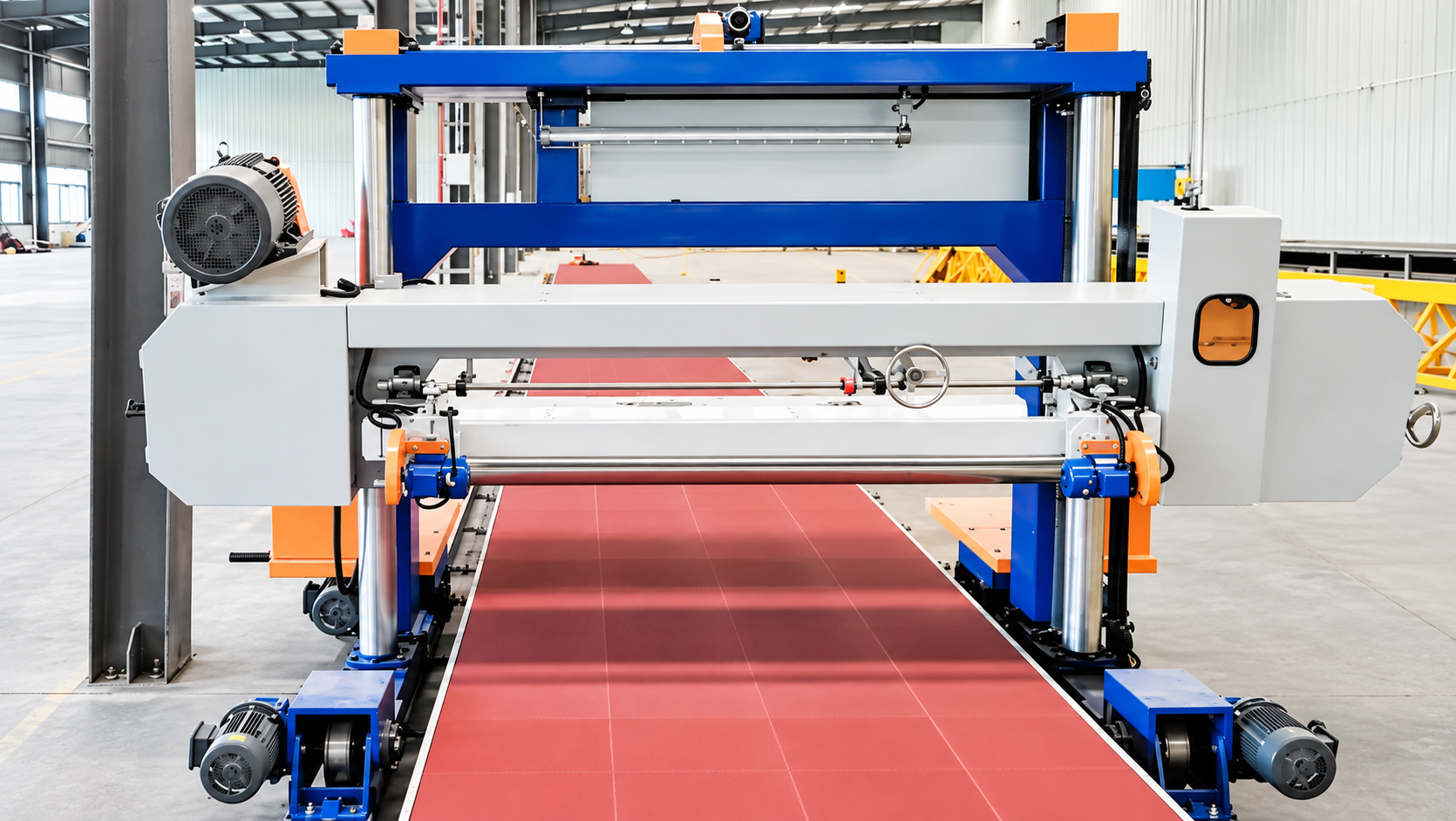
Foam Block Cutting and Sheet Conversion Solution
Convert conditioned foam buns into sheets, rolls and prepared blanks with a selected handling, horizontal slicing and vertical cutting arrangement.
Foam Block Cutting and Sheet Conversion Solution
Convert conditioned foam buns into sheets, rolls and prepared blanks with a selected handling, horizontal slicing and vertical cutting arrangement.
Application-led selection
Equipment listed below represents available process options. Confirm the selected route and equipment scope for each project.
Connection to foam production
Coordinate downstream processing with the selected Box Foaming or Continuous Slabstock Foaming process and the required conditioning space.
Choose a conversion route from the input foam and finished sheet/web requirements. Group block handling, horizontal slicing, skin removal, joining, length measurement/rewinding and vertical trimming as selected stages rather than one mandatory equipment bundle.
From Input Material to Finished Product
Select and validate the process sequence for the actual material and finished product.
Define the foam input
Confirm foam type, density, bun dimensions and conditioning state before selecting handling and cutting equipment.
Prepare and position blocks
Plan access, block transfer and workholding for the actual foam load. Confirm handling load limits and guarding.
Cut and convert
Choose horizontal slicing, vertical cutting or rotary peeling according to the required sheet or roll geometry. Joining and rewinding are optional downstream steps.
Selection and Acceptance Requirements
Use these inputs to define the configuration. Equipment-specific reference parameters appear on the corresponding product pages.
| Planning input | Engineering confirmation |
|---|---|
| Material and input geometry | Foam type, density, condition and maximum dimensions. |
| Finished product | Drawings, dimensions, tolerance and inspection method. |
| Production requirement | Batch mix, working hours, feeding and discharge arrangement; throughput to be confirmed. |
| Factory interfaces | Layout, electrical supply, guarding and process-specific utilities. |
| Acceptance | Representative material trials and agreed measurable criteria. |
Equipment Options for This Process
Clamps/transfer, cutters/slicers, skin splitting, sheet joining and metering/rewinding perform different duties. Select the actual sequence and alternative cutter.
Foam Handling Clamp | Slabstock Foam Handling
Handles long foam buns. The clamp length can be configured around the handling layout.
Foam Sheet Joining Machine | Continuous Foam Webs
Joins foam rolls into a continuous web. Joining time is adjusted for foam density and thickness, and the machine can be paired with a length meter and rewinder.
Precision Vacuum Horizontal Foam Cutter | Thin Foam Sheets
Slices foam blocks using digital settings, automatic reciprocating travel on rails and a vacuum worktable. Pressure rollers help retain the foam during cutting.
High Density Rail Foam Slicer | High Density Foam Sheets
Slices high-density foam with controlled reciprocating travel and a retaining worktable. Material and sheet requirements guide configuration.
Foam Length Meter and Rewinder | Foam Web Finishing
Measures foam-web length and rewinds the measured material into rolls. It can be paired with foam sheet joining equipment.
Foam Skin Splitting Machine | Foam and EVA Splitting
Splits top and bottom foam skins and can be reviewed for EVA splitting applications. Material suitability and the finished sheet requirement are checked before selecting the setup.
Rail Mounted Horizontal Foam Slicer | Long Foam Buns
Slices long foam buns into sheets using digital thickness settings and automatic reciprocating rail travel. It can form part of the downstream cutting arrangement of a slabstock plant.
Horizontal Foam Block Slicer | Flexible Foam Sheets
Slices foam blocks into sheets using digital thickness settings and a reciprocating worktable. Pressure rollers help retain the foam; a vacuum arrangement is optional.
Automatic Vertical Foam Cutter | Foam Block Conversion
Cuts foam vertically with touchscreen and PLC settings for multiple thicknesses. A fixed aluminum worktable holds foam between retaining plates while the blade carriage travels on linear guides.
Mesh Belt Vacuum Foam Slicer | Horizontal Foam Cutting
Horizontally slices foam blocks using digital settings and a roller-supported mesh-belt vacuum table. Pressure rollers help retain foam during reciprocating cutting.
Foam Rotary Peeling Machine | Continuous Foam Rolls
Peels cylindrical foam into a continuous sheet and rewinds it into rolls. Cutting and rewinding settings are adjusted to the required thickness and foam density.
Carousel Horizontal Foam Slicer | Multiple Foam Blocks
Slices several foam blocks arranged on a rotating table. Digital thickness settings and reversible table rotation support repeated sheet cutting.
Manual Vertical Foam Cutter | Foam Sheet Conversion
Cuts foam vertically by positioning the foam on the worktable and moving the table along its rails. Cutting thickness and position are set before travel.
Horizontal Foam Core Drilling Machine | Cylindrical Foam Buns
Drills a core through cylindrical foam supported on a V-shaped worktable. The worktable is advanced for drilling before downstream rotary peeling.
Foam Cell Opening Compression Machine | Flexible Foam Conditioning
Compresses flexible foam through rollers for cell-opening conditioning. The required compression setting and material response are reviewed for the foam formulation.
Horizontal Latex Foam Slicer | Latex Foam Sheets
Horizontally slices latex foam using touchscreen and PLC settings with automatic reciprocating rail travel. Settings are selected for the required sheet thickness and foam density.
Define the Configuration Before Procurement
Use the actual material and production plan to establish scope.
Input and support
Confirm conditioned block geometry and the support required during feeding.
Selected conversion
Choose slicing, skin removal and sheet/web finishing for the intended output.
Sheet acceptance
Measure thickness and surface on representative material under agreed conditions.
Production Planning FAQ
Selection, supply scope and validation for this production route.
What block dimensions must be supplied?
Does machine positioning equal finished-sheet thickness accuracy?
Why does foam conditioning matter?
How are feeding and packing interfaces selected?
What inputs are needed for this configuration?
How should a thin-sheet conversion package be selected?
Discuss Your Foam Processing Project
Share the following for this application: Foam type/density and condition, block envelope, target sheet thickness/width, roll length, tolerance, batch mix and handling. Our team will reply within one business day. Once requirements are clear, we provide a preliminary proposal within two business days.


