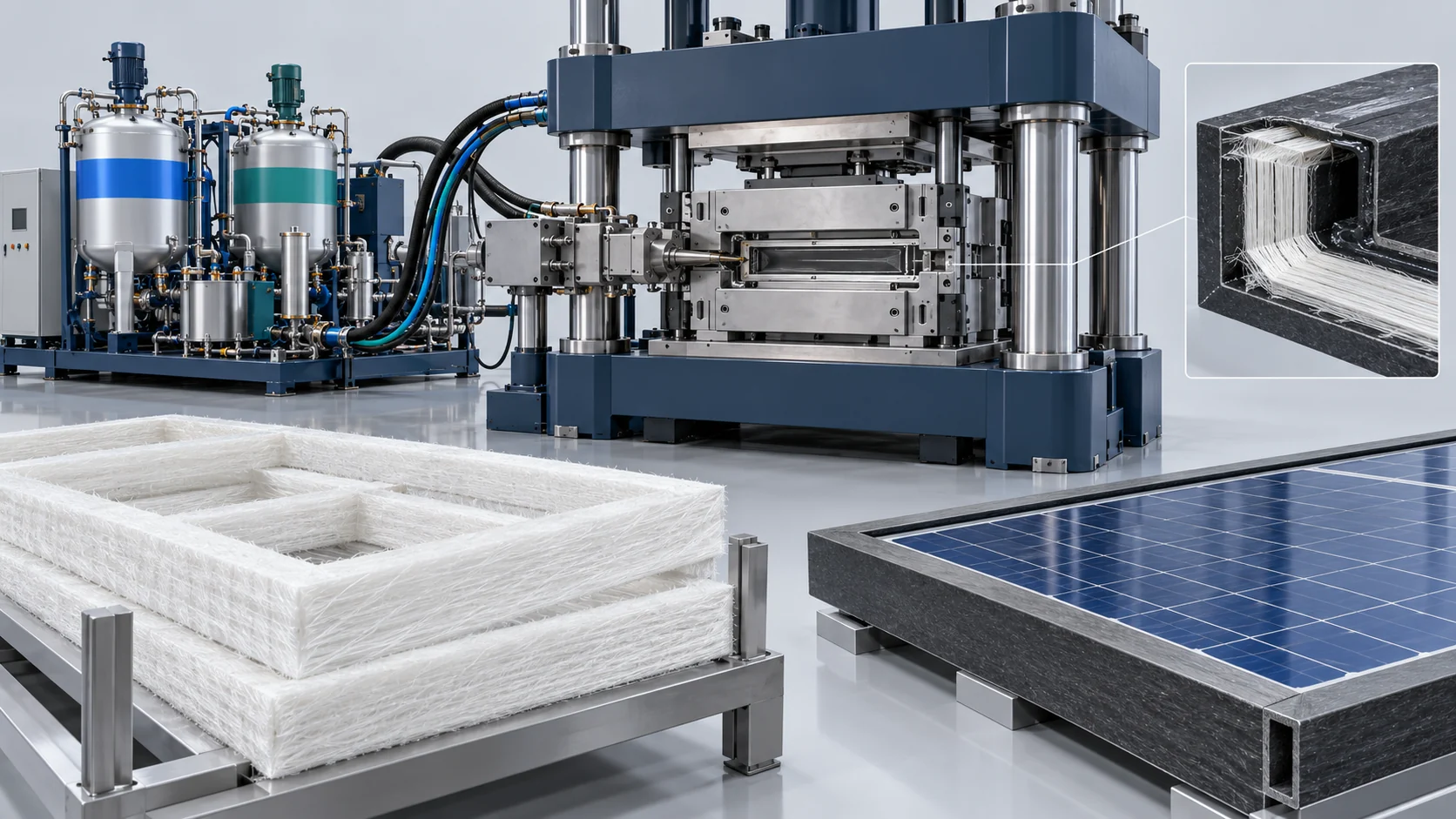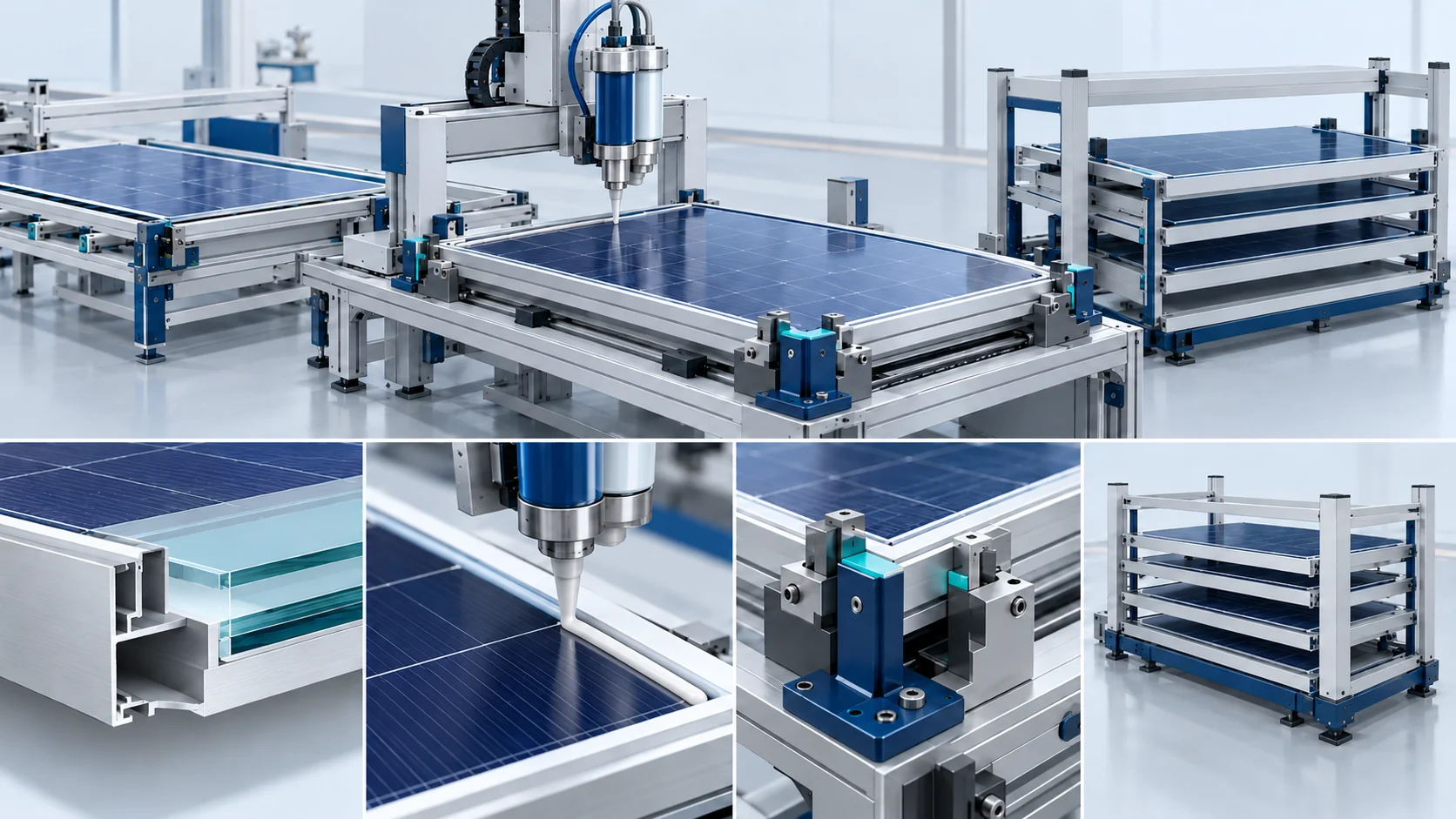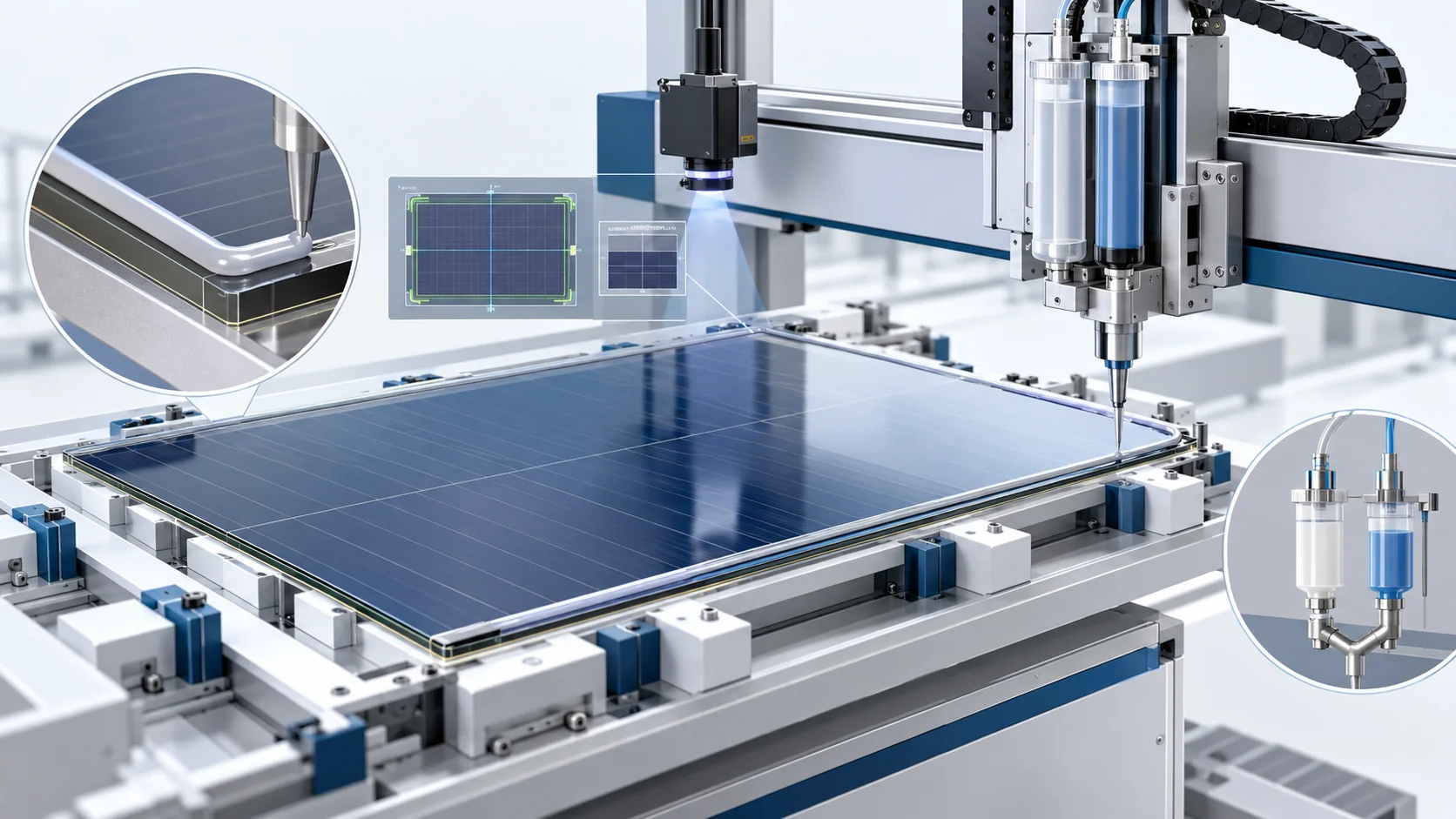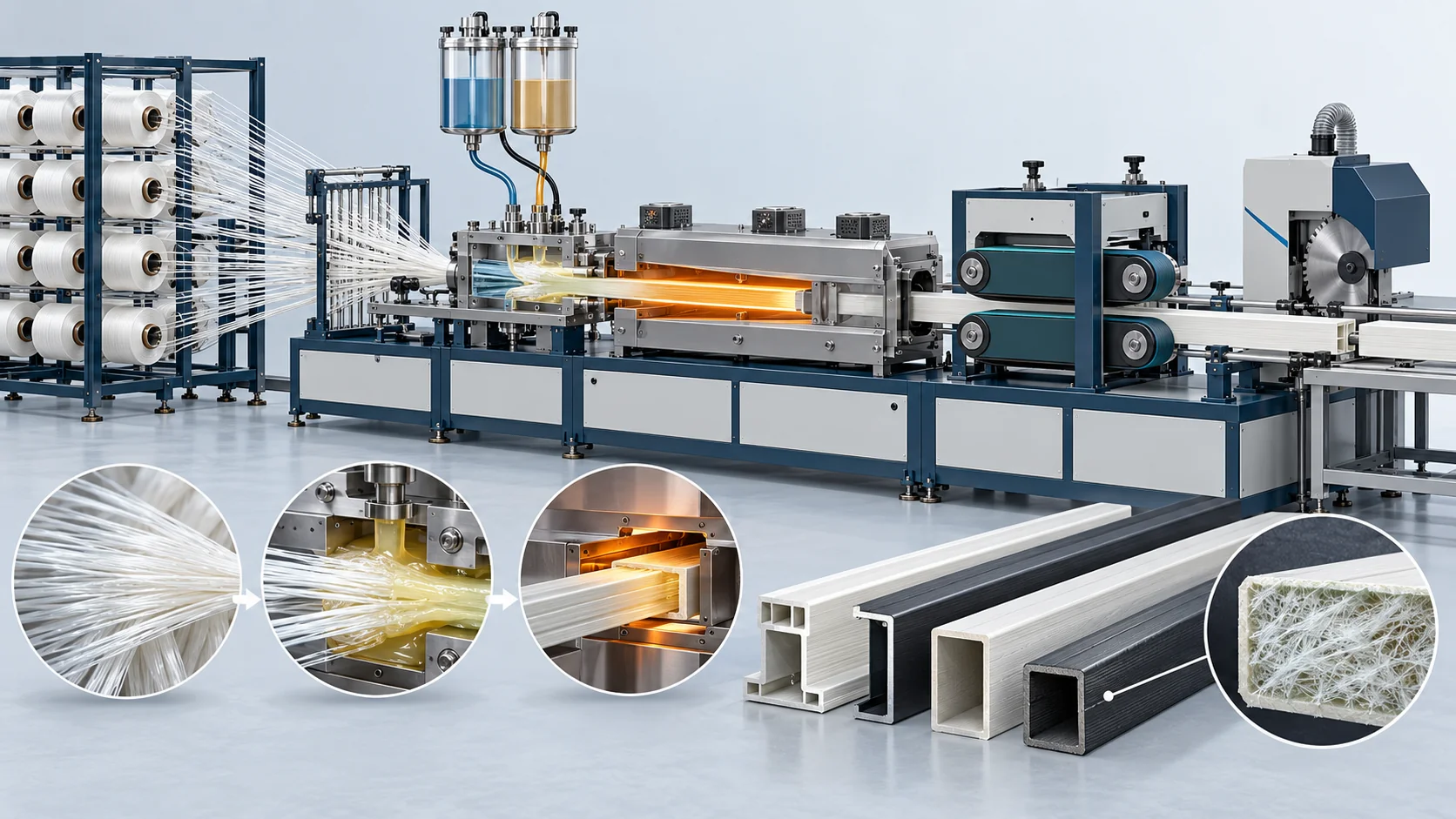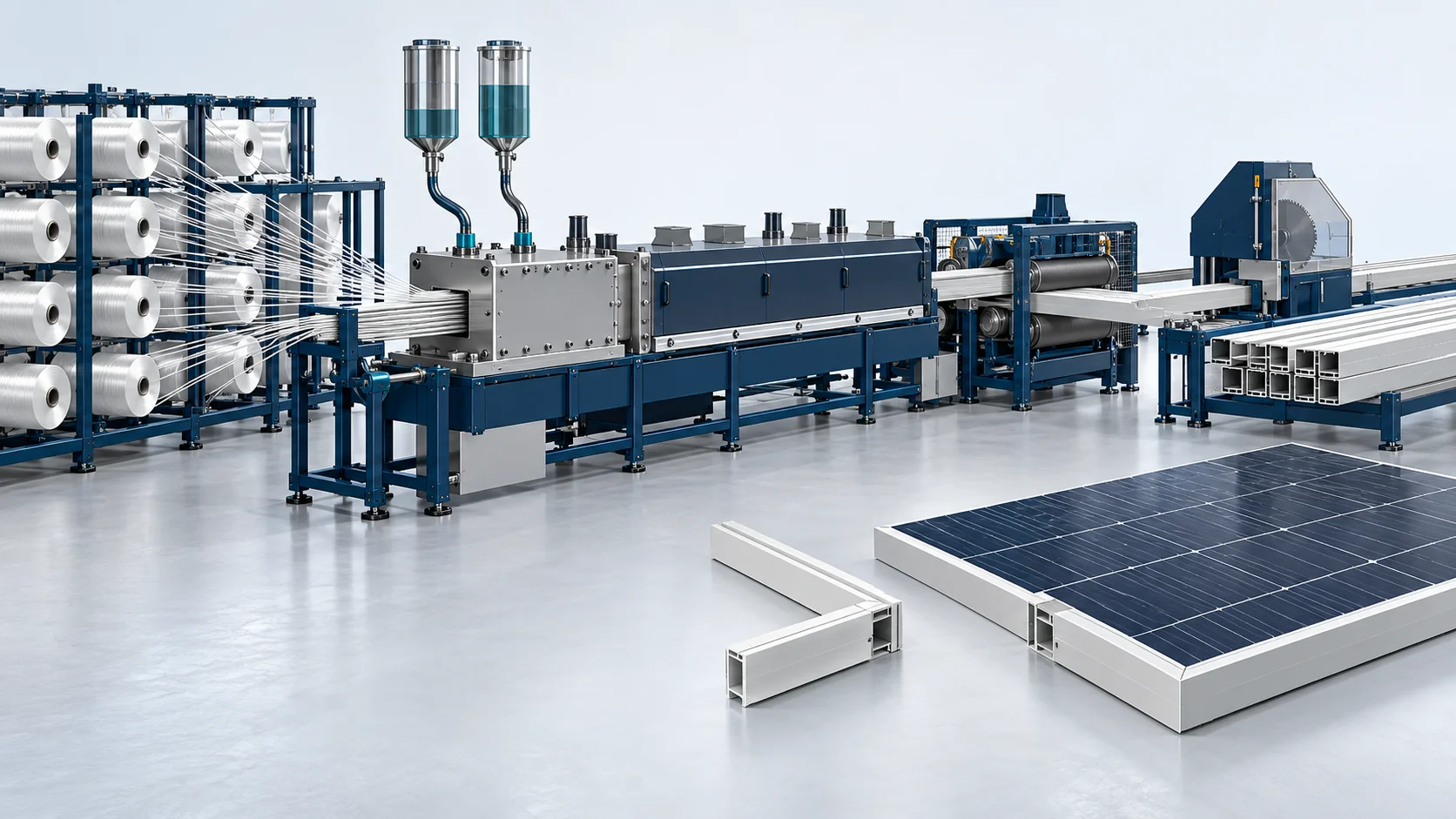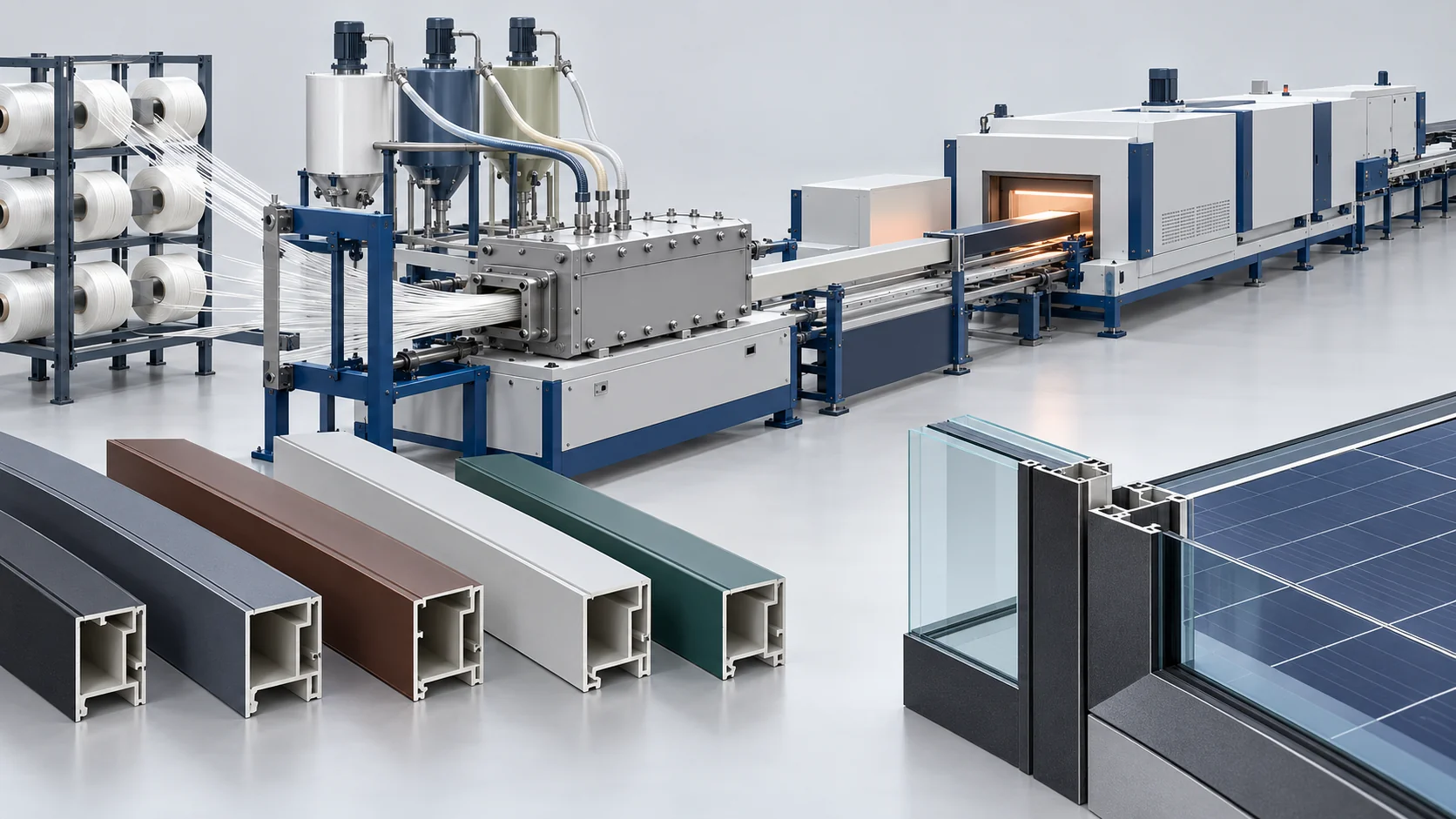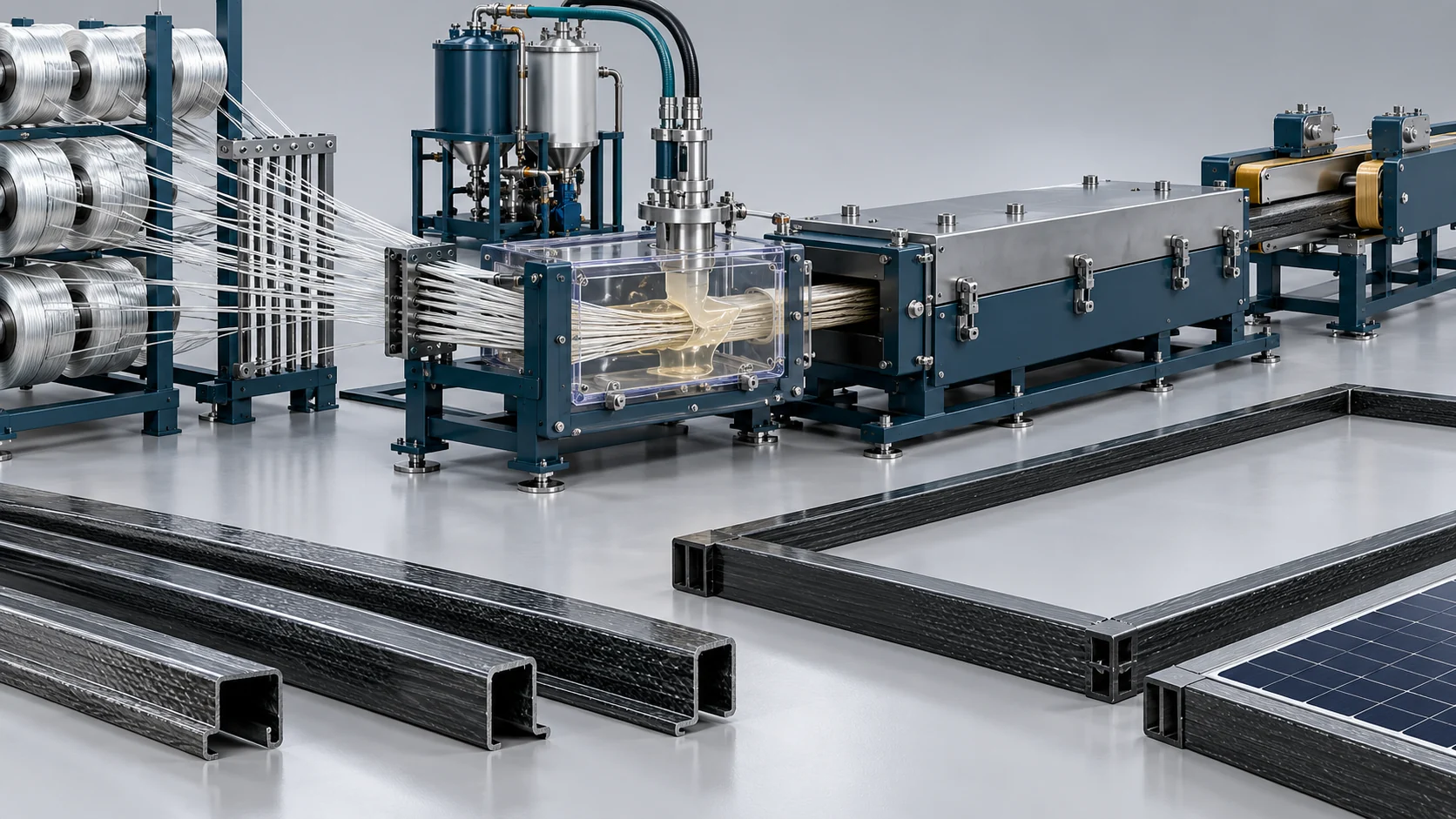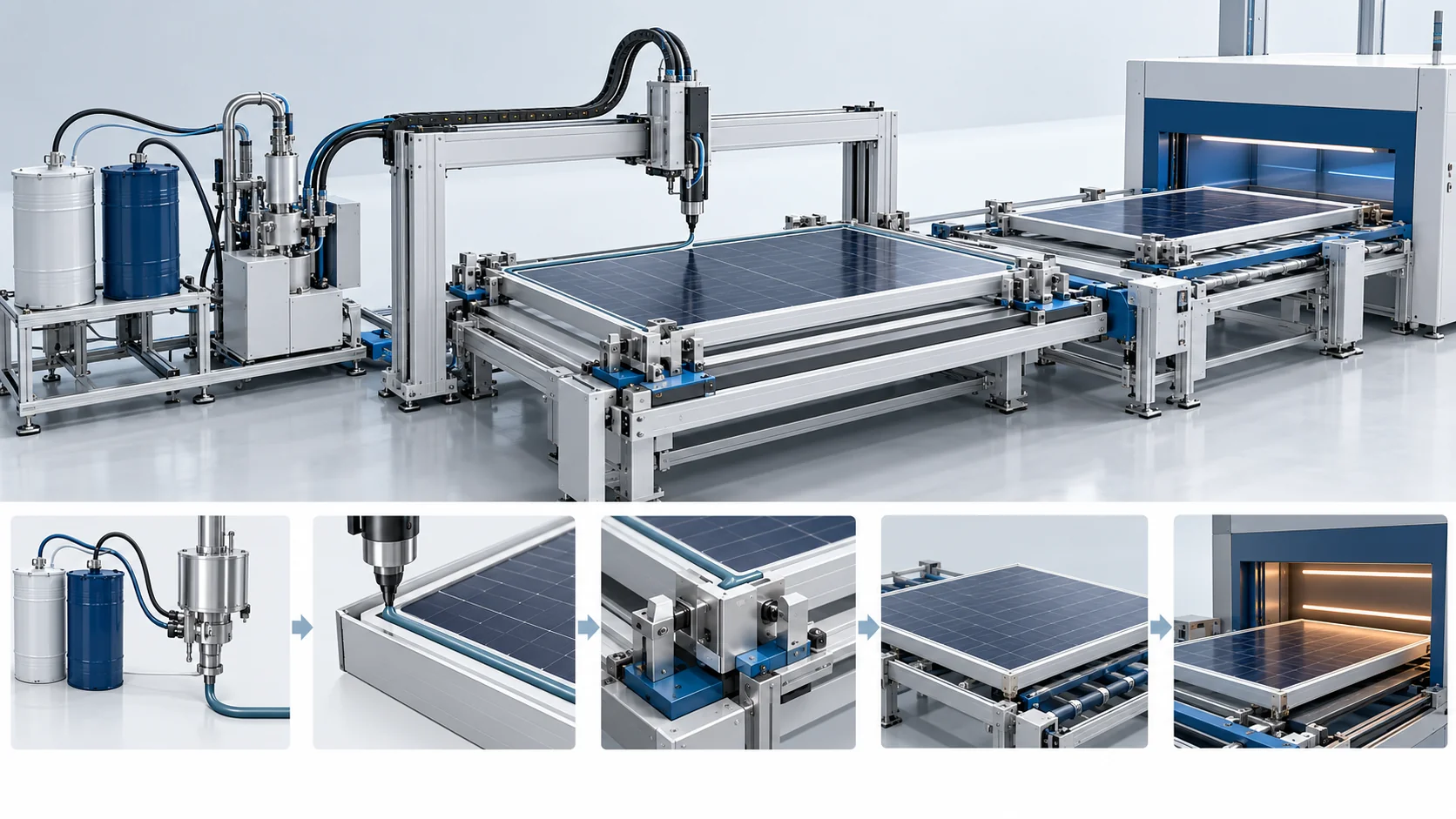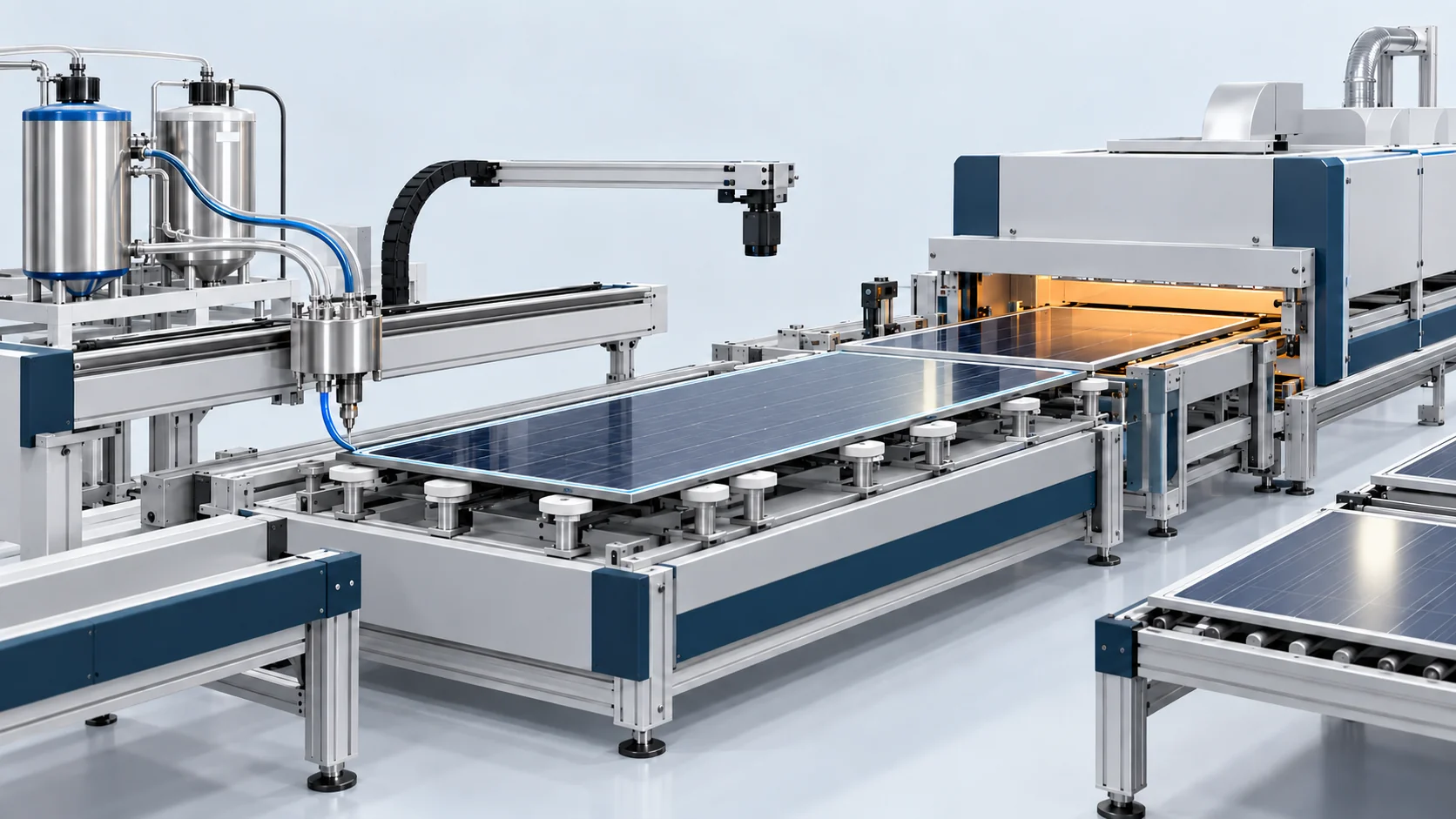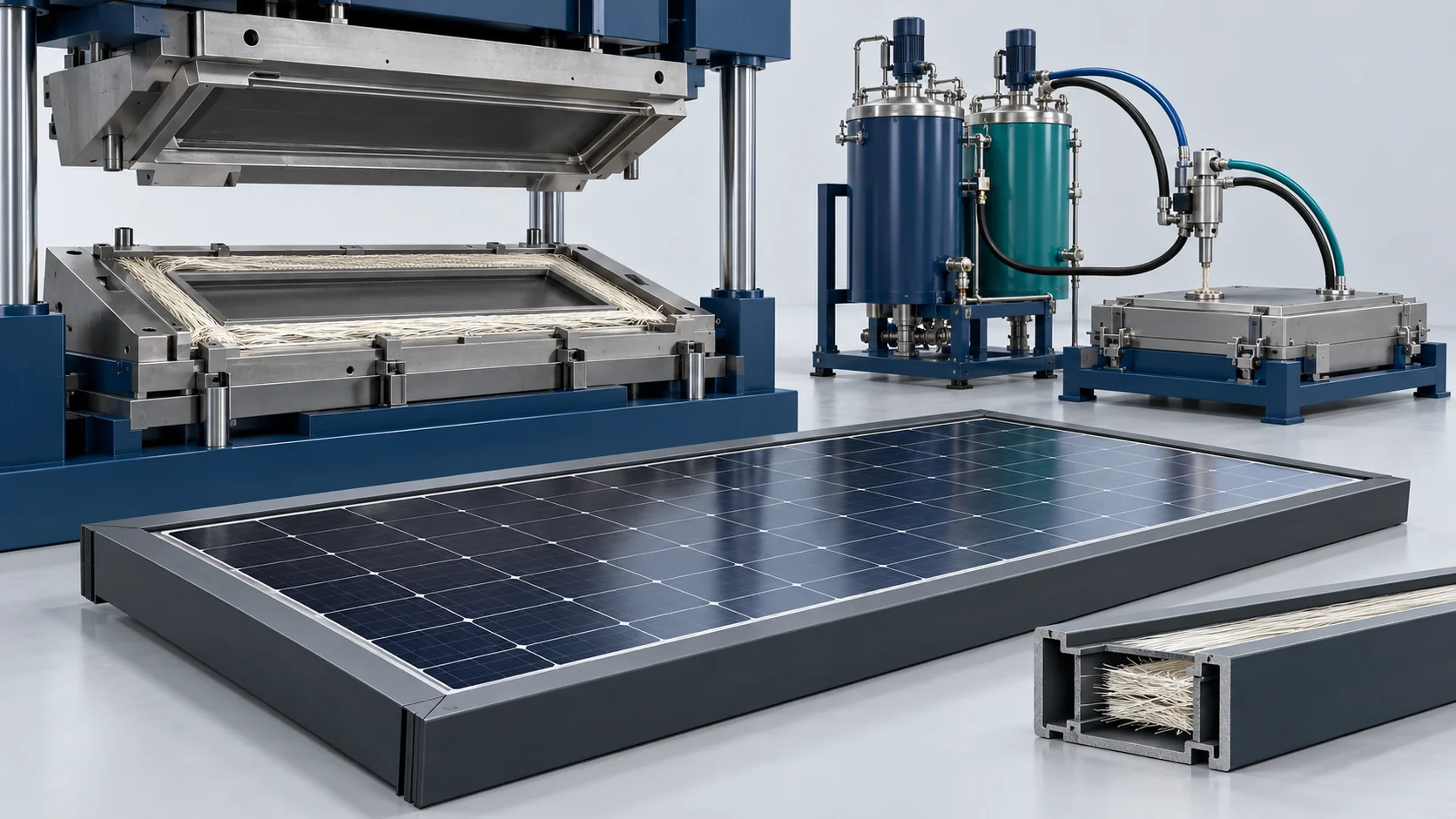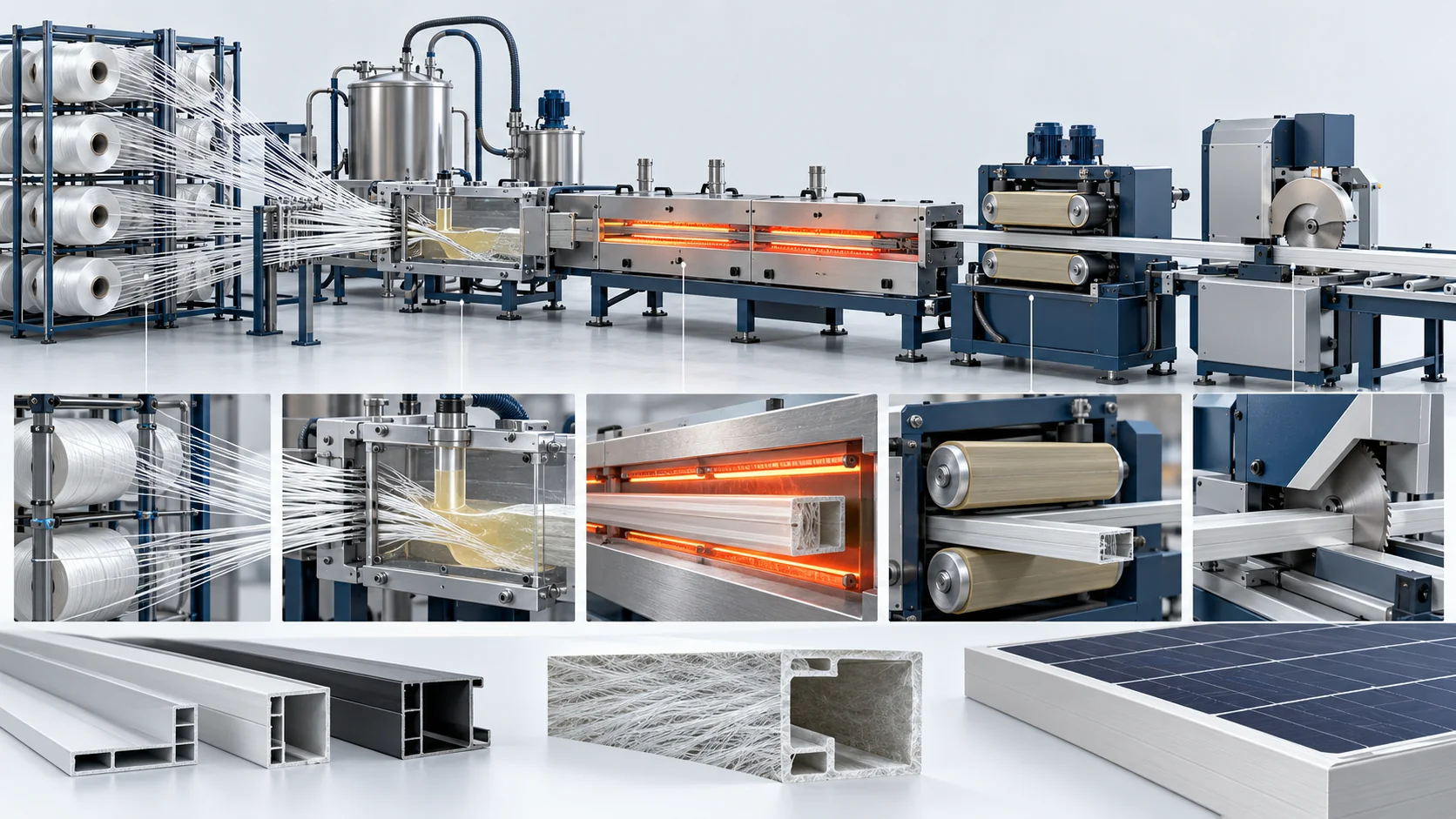
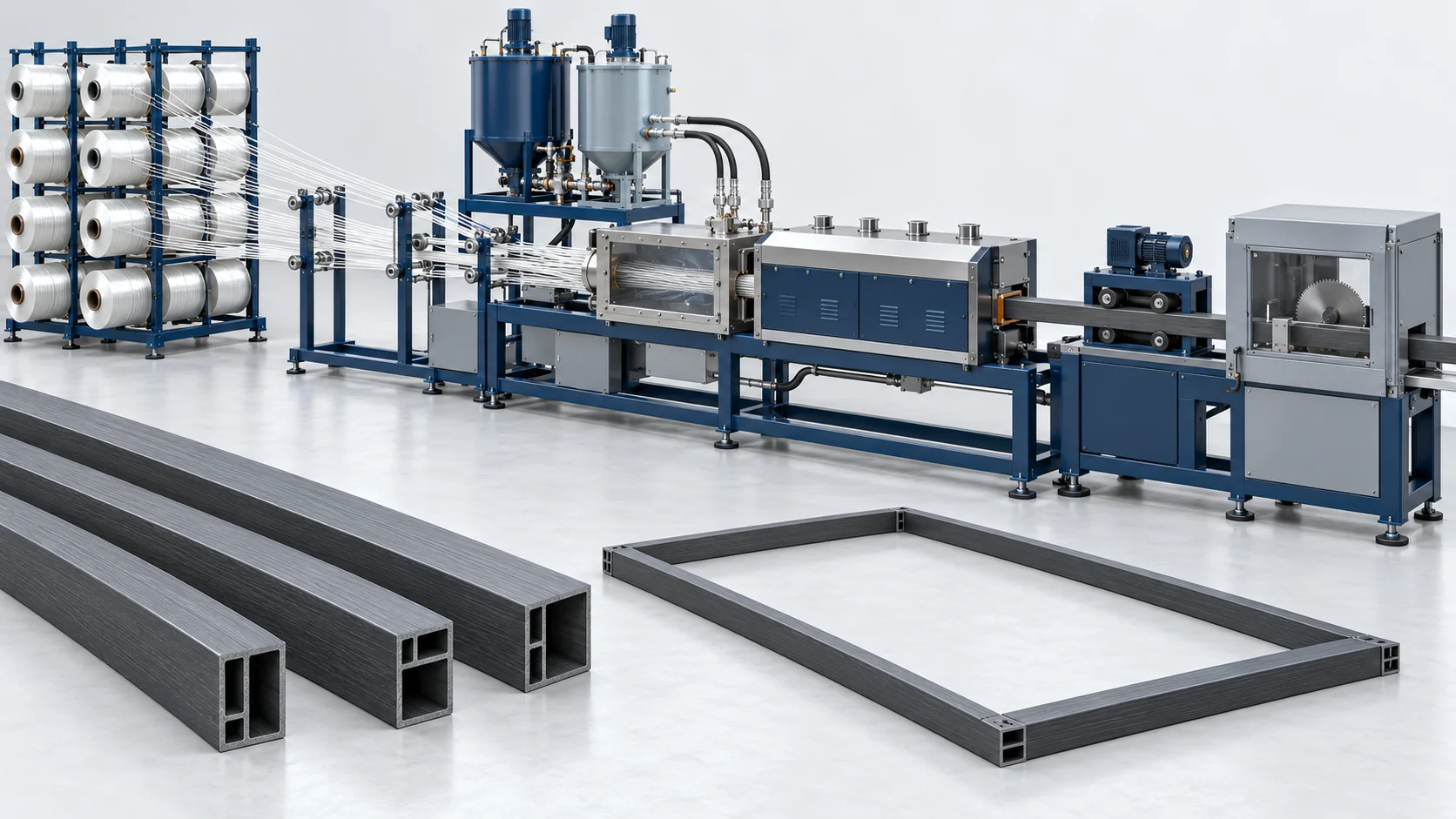
Concept illustration for Composite Solar Panel Frames Manufacturing Solutions.
Manufacturing Solutions

Composite Solar Panel Frames Manufacturing Solutions

Explore composite PV frame production and assembly routes, from injection pultrusion and closed-mold forming to adhesive dispensing. Configure each route for the profile, material and module design.

6 Published Solution Pages
1 Selected Equipment Pages
6 Related Application Records

Find Your Production Route

Manufacturing solutions

Explore PV Frame Production and Assembly Routes

Compare continuous profiles, molded components and module assembly by reinforcement, resin or adhesive, frame geometry and qualification requirements.

Continuous composite profiles

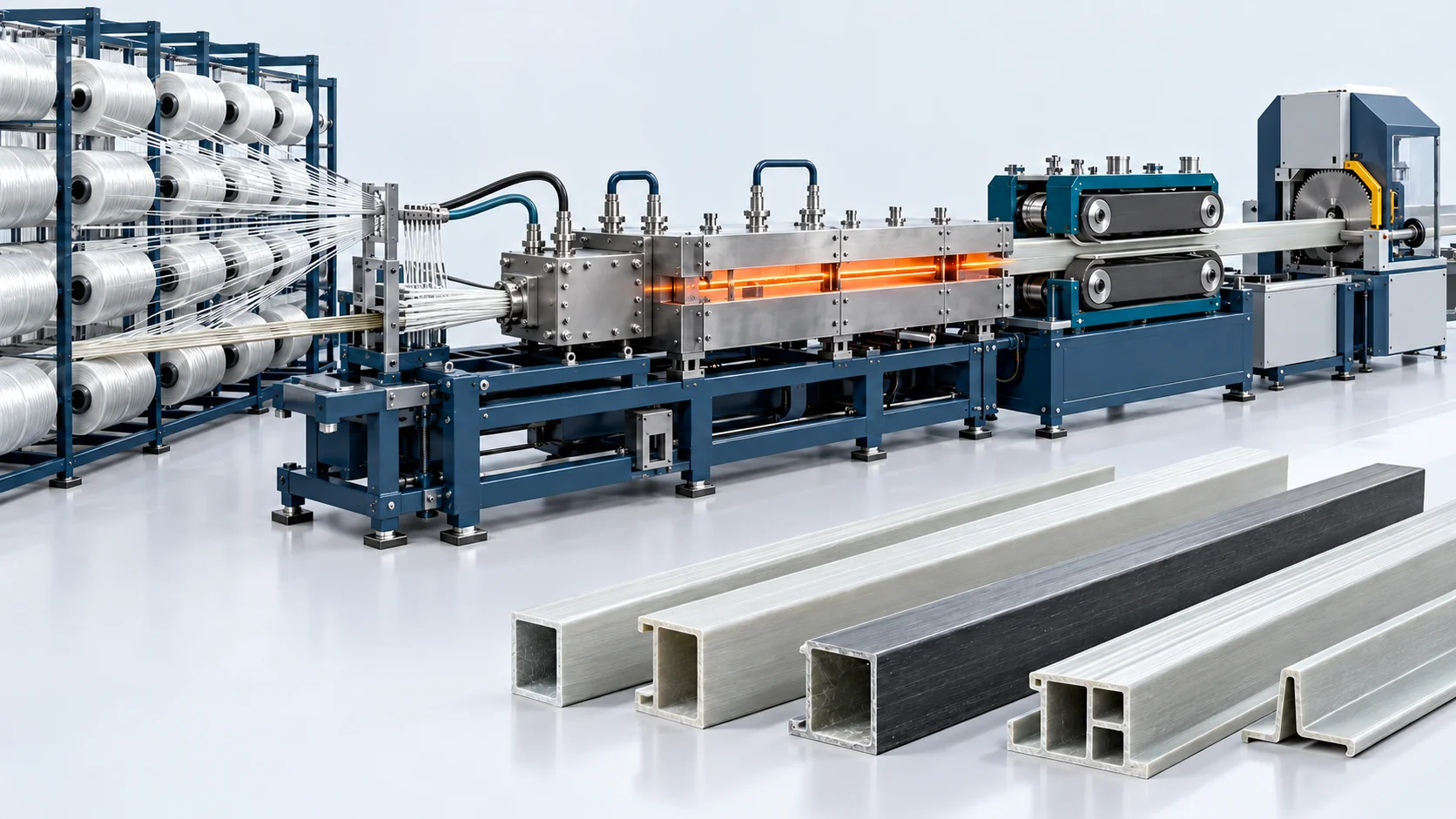
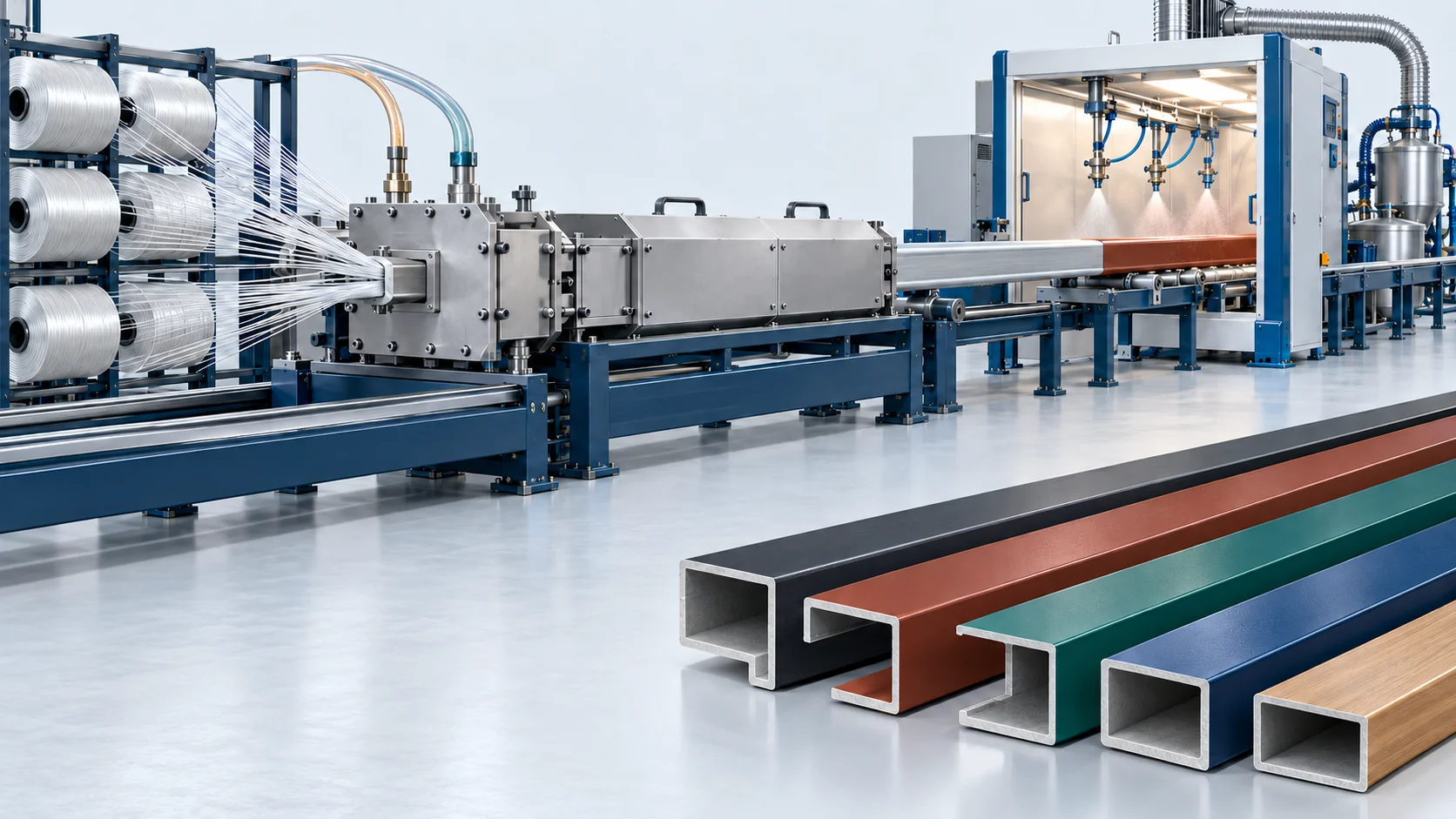
Resin injection into an impregnation box supports pultrusion; pulling, die heating and cutting are separate coordinated interfaces.

Closed-Die Injection Pultrusion

Composite PV Frame Direct Injection Solution

A direct-injection pultrusion solution with closed-die resin feed and line-synchronized metering for composite PV frames. Emissions depend on the formulation, ventilation and site controls; impregnation and final profile properties require validation.

Direct injection here feeds a continuous pultrusion impregnation box; it is not discrete batch frame molding.
Discrete closed-mold frame parts

Module framing and perimeter dispensing

These routes assemble or dispense around a module; they do not manufacture the cell or establish complete-module qualification.

Precision Perimeter Dispensing

Perovskite Module Edge Dispensing Solution

Configure low-stress perimeter dispensing for thin-glass or flexible perovskite modules with vision alignment, micro-metering and controlled material curing.

Existing detail scope: low-stress module-perimeter micro-dispensing, vision and curing. This is not cell manufacture or a complete module-qualification package.

Process routes & production planning

Planning the Composite Solar Panel Frames Production Process

The published solar-frame solutions include pultrusion, closed-mold injection and structural grouting references. Choose the manufacturing route before specifying reinforcement handling, resin delivery, tooling and module interfaces.

01

Define the Frame

Confirm module dimensions, frame profile, joint design and the intended conventional, BIPV, offshore or other stated application.

02

Select Material and Route

Match reinforcement and resin to pultrusion, closed-mold injection or the separate structural grouting operation.

03

Arrange Reinforcement

Configure fiber feeding and guidance for pultrusion or prepare the required reinforcement and assembly for the alternative route.

04

Deliver Resin

Coordinate the selected metering, mixing, impregnation, injection or grouting arrangement with the tooling.

05

Form and Finish

Use the route-specific forming and cure sequence, then cut profiles or complete the molded part and joining operations.

06

Validate the Assembly

Inspect dimensions and joints and agree mechanical and environmental tests. Frame evidence does not replace finished-module qualification.

Machinery & process equipment

Equipment for Composite Solar Panel Frames

The linked PU injection pultrusion machine is relevant to the pultruded composite-frame route. Closed-mold frame injection and structural grouting have distinct tooling and delivery requirements and need a separately agreed configuration.

The sole listed machine supports the pultruded-profile route. Closed-mold framing and module-edge dispensing require separately agreed equipment.

PU Injection Pultrusion Machine for Composite Solar Frames. Review configuration, material requirements and process interfaces with Haifeng.

Related applications

Composite Solar Panel Frames Application & Project Records

Explore the published composite solar panel frames application and project records selected from this category's solution pages. Each record describes its own material, process and equipment scope; project figures and industry references are not universal machine ratings or independently verified results for a new installation.

Pultruded-profile application records

Project review brief for marine composite solar frame pultrusion. Equipment configuration, implementation scope and reported outcomes.

Exposure duration, offshore follow-up dates and fiber fraction already remain pending in the record. Confirm constituent-density corrections before converting burn-off results to volume fraction.

Process illustration; not a verified installation photograph.

BIPV Composite Solar Frame Line: equipment configuration and application-specific outcomes reported in the supplied project brief.

Color difference, production cost and pencil hardness use separate methods and baselines. Pencil-hardness grades are categorical, not multiples of scratch resistance.

Process illustration; not a verified installation photograph.

Composite PV Frame Pultrusion Upgrade: equipment configuration and application-specific outcomes reported in the supplied project brief.

Fiber fraction requires its mass/volume basis and measurement method. Quantitative void content is separate from ultrasonic coverage; pull speed is specific to the stated profile and die.

Process illustration; not a verified installation photograph.

Module assembly and edge-dispensing records

Project review brief for hjt module four-edge structural adhesive framing. Equipment configuration, implementation scope and reported outcomes.

Framing/dispensing cadence is separate from green cure and final cure. Floor-space comparison and module loading require the actual layout, residence and module test report.

Process illustration; not a verified installation photograph.

Project review brief for precision perovskite module edge dispensing. Equipment configuration, implementation scope and reported outcomes.

Reconcile the defect denominator and rounding. Frame mass as a fraction of aluminum baseline is not the same percentage as weight reduction; reaction exotherm needs actual shot and temperature records.

Process illustration; not a verified installation photograph.

Public patent reference

The patent example is not evidence of a Haifeng commercial delivery.

A public patent reference on reinforced polyurethane photovoltaic frames and injection-molding experiments; it does not establish a Haifeng delivery or commercial frame-production line.

Public patent example, not a Haifeng commercial delivery or production acceptance result. Coupon, frame and complete-module qualification remain separate.

Process illustration; not a verified installation photograph.

PV Frame Production and Assembly Routes Selection FAQ

Is frame manufacturing the same as module frame assembly?

No. Manufacturing creates the composite profile or molded part; module assembly uses a finished frame and may require adhesive or structural filling equipment.

How do pultrusion and closed-mold forming differ?

Pultrusion targets continuous profiles, while closed-mold forming is reviewed for the selected discrete part. Reinforcement, tooling and handling interfaces differ.

Can the equipment guarantee module qualification?

Equipment supports the agreed process. Qualification depends on the complete module construction, selected materials and applicable testing.

Plan Your Production Line

Tell us your material system, part dimensions and production target. Our team will reply within one business day. Once requirements are clear, we provide a preliminary proposal within two business days.

Haifeng Polyurethane Machinery on TikTok
Haifeng Polyurethane Machinery on Instagram
Haifeng Polyurethane Machinery on Facebook
Haifeng Polyurethane Machinery on X
Haifeng Polyurethane Machinery on LinkedIn
Contact Haifeng Polyurethane Machinery on WhatsApp
Haifeng Polyurethane Machinery on YouTube