Insulation failure in a cold store or metal-faced building panel rarely announces itself. It shows up as rising compressor hours, condensation along panel joints, slow drift in core density, or boards that no longer sit flat after one season. Engineers specify closed-cell polyurethane foam because it attacks those failure modes at the same time: low thermal conductivity, high closed-cell content, low water vapor permeability, and predictable dimensional behavior.
When tested by the heat flow meter method in ASTM C518, closed-cell polyurethane and polyisocyanurate foams typically sit in the 0.020–0.028 W/(m·K) range after thermal aging, and many boardstock and spray formulations hold closed-cell content above 90% when measured by ASTM D6226 [1], [2]. That combination is why closed-cell polyurethane foam remains one of the strongest thermal choices for freezers, reefer bodies, pipe insulation, and metal-faced panels.
The Performance Case Is Measured, Not Marketed
A K-value on a technical data sheet is a starting point, not the whole story. The cell gas inside closed-cell foam has a lower thermal conductivity than still air. As air diffuses in and the blowing agent slowly diffuses out over years, the K-value ages. That is why insulation buyers should compare long-term thermal resistance or aged values, not only fresh-foam numbers [3].
Representative aged thermal conductivity ranges for common insulation materials are shown below [3].
| Insulation material | Typical aged thermal conductivity range (W/(m·K) |
|---|---|
| Closed-cell polyurethane / PIR | 0.020–0.028 |
| Extruded polystyrene (XPS) | 0.028–0.035 |
| Expanded polystyrene (EPS) | 0.030–0.039 |
| Mineral wool | 0.032–0.044 |
| Cellular glass | 0.038–0.050 |
Against this table, closed-cell PU and PIR foams earn their place in confined details: narrow cavities, curved tank surfaces, pipe penetrations, and continuously laminated panels. The material only performs at the upper end of the range when the cell structure is complete and uniform. A badly mixed foam with collapsed cells or trapped voids will not deliver the table value.
What Closed Cells Do That Open Cells Cannot
Closed cells form thousands of gas-filled compartments with solid polymer walls. That structure does three practical jobs in insulation. First, it slows gas movement and keeps low-conductivity cell gas in place. Second, it limits liquid water uptake because there is no open pathway through the foam. Laboratory water absorption tests for rigid cellular plastics typically show closed-cell PU at below 4% by volume after the 96-hour immersion procedure in ASTM D2842 [4]. Third, the same cell walls add compressive strength and reduce the chance of progressive crushing under floor load or panel lamination.
Water vapor control is a related but separate property. Under ASTM E96, closed-cell spray polyurethane foam at typical building thickness is normally low enough in permeance to act as a vapor retarder within the assembly, while open-cell foam generally is not [5]. In cold-room and freezer walls, that difference matters because moisture that reaches the dew point inside the envelope condenses, corrodes metal skins, and progressively raises the effective K-value.
The foam also needs to remain still. Dimensional movement in rigid foam usually comes from a mismatch between gel strength and internal gas pressure during curing. A panel that shrinks after demolding can pull away from facings or open a joint at the perimeter; that failure is visible long before it appears in an energy audit.
Dimensional stability in rigid foam is not only a formulation issue. <Causes Of Shrinkage In Polyurethane Foam How To Control It> covers the process and chemical causes that produce shrinkage in closed-cell rigid polyurethane systems.
Fire performance is governed by assembly-level testing such as EN 13501-1; process settings and foam density can change results, but no equipment adjustment replaces a tested construction [6]. When closed-cell PU is specified in a building envelope, the supporting test reports should match the final density, facings, and installation method.
Where Closed-Cell PU Foam Earns Its Payback
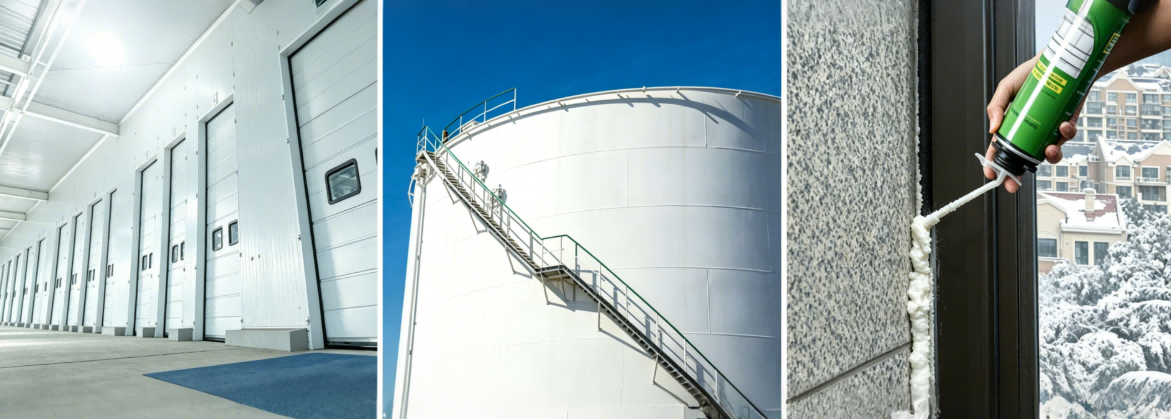
Closed-cell polyurethane foam becomes the rational choice where heat gain is costly and space is limited: frozen food warehouses, refrigerated trucks, cold-chain containers, pipe insulation, water heaters, refrigerators, and metal-faced wall or roof panels.
Spray-applied closed-cell foam stands out in retrofit cold storage and irregular steel structures because it forms a seamless, adherent layer that fills gaps around purlins and pipe hangers. Spray systems meter two components and deliver them to a gun under pressure; the foam rises and cures directly on the substrate, reducing joint thermal bridges.
Spray application changes how insulation gaps, adhesion, and overspray are managed on the job. <What Is Spray Polyurethane Foam Composition And Application> covers the two-component construction and practical application windows for spray polyurethane foam.
Pour-in-place and continuous lamination are the other two workhorse processes. Pour-in-place fills refrigerator cabinets, water heaters, and tank enclosures. Continuous lamination bonds foam directly between metal skins for wall and roof panels, a product class specified under standards such as EN 14509 [7]. In every process, the insulation result depends on the same fundamentals: accurate component ratio, complete mixing, controlled material temperature, and the right discharge rate for the cavity geometry.
What Determines the Final K-Value: Formulation, Process, and Equipment
The formulation sets the ceiling for performance. Blowing agent choice, polyol functionality, isocyanate index, catalyst balance, and surfactant package decide cell size, cell distribution, and closed-cell content. A formulation intended for low density may build compressive strength more slowly, so gel time must be matched to rise time. If the cell walls are still weak when the foam reaches full height, cells open or collapse. If the polymer gels too early, flow into narrow cavities is lost and voids form.
Machine settings then convert the formulation into a repeatable product. A deviation of one percentage point in the component ratio can shift final foam density and change the reaction profile; for a rigid insulation pour, metering accuracy under ±0.3% across the operating range is a practical baseline. Material temperature control is equally important because viscosity, reaction speed, and blowing agent solubility all move with temperature. High-pressure impingement mixing gives finer cell structure, but only if the mixing chamber is clean and the injection pressure is stable.
A rigid foam’s cell shape and final K-value are set in the first seconds after mixing. <The Role Of Rise Time In Polyurethane Foaming> covers how rise and gel time combine to lock in cell structure.
One practical example shows why equipment matters as much as formulation. In cold-storage spraying, the chemical system may be capable of strong thermal performance, but if the B-side cools too much in a long unheated hose, viscosity rises, impingement quality falls, and the installed K-value can land above the data-sheet value. Haifeng’s HF-SP-03 platform addresses this with a 6 kW heater and up to 93 m of insulated hose for insulation work, so the two components reach the gun inside a stable processing window. That matters most on low-ambient jobs where data-sheet performance is only real if the material temperature is real.
If your line is running but panel cores or spray passes show density drift, weak corners, or K-values that creep upward over the first year, send the current processing window, A:B ratio history, and a few core density readings to Info@chinahaifeng.com or WhatsApp 86 13566296633. A short review of metering, temperature, and rise behavior usually identifies the limiting step before you reformulate.
A Practical Specification Checklist
- Define aged K-value or long-term thermal resistance, not only initial thermal conductivity [3].
- Specify minimum closed-cell content and the test method, for example ≥90% per ASTM D6226 [2].
- Give a density range plus the compressive strength needed at the service condition.
- Confirm the water absorption limit under ASTM D2842 [4] and, where relevant, water vapor permeance under ASTM E96 [5].
- Obtain assembly-level fire test evidence for the exact density, facings, and installation method [6].
- Ask the equipment partner how ratio accuracy, material temperature stability, and discharge rate are verified for your part volume and cycle time.
- Validate after commissioning: cut cores, measure density across the cavity, and test K-value from representative samples rather than relying on hand-mix plaques.
These points appear basic, but most rejected panels trace back to a mismatch between the specified foam and what the process can actually reproduce.
Contact Haifeng Polyurethane Machinery
Haifeng Polyurethane Machinery supplies metering, mixing, pouring, and turnkey line engineering for PU insulation processes, including cold-room panels, spray-applied cold storage, and pour-in-place cabinet work. If you are evaluating a line, send the part geometry, required aged K-value, density range, and cycle time to Info@chinahaifeng.com or WhatsApp 86 13566296633 for a technical review.
Frequently Asked Questions
How long does closed-cell polyurethane foam keep its low K-value?
Thermal aging depends on the blowing agent, facing permeability, and foam thickness. Closed-cell PU and PIR foams are normally compared on aged or long-term thermal resistance values rather than fresh-foam data because the cell gas exchanges slowly with air over years [3]. The useful performance is the long-term value, not the initial laboratory K-value.
What is the minimum closed-cell content for effective insulation?
Most rigid insulation specifications look for closed-cell content of at least 90% when tested by ASTM D6226 [2]. Below that threshold, both thermal resistance and resistance to water uptake begin to decline, although the exact requirement should follow the application standard.
Does closed-cell polyurethane insulation need a separate vapor barrier?
In many cold-room and building assemblies, closed-cell spray foam acts as its own vapor retarder because its permeance under ASTM E96 is low [5]. Whether a separate barrier is required depends on the service temperature difference, local code, and the joints and facings; the foam’s published permeance is only one input.
Can one machine pour refrigerator cabinets and spray cold-room walls?
Not as a single setting. Pour-in-place cabinet work uses lower discharge rates and cavity-filling logic, while spray application uses higher pressure and a spray gun with a different mixing chamber. Machines can share the same metering and temperature-control philosophy, but the mixing head, flow range, and hose arrangement must match the process.
Is higher density always better for insulation?
No. Density mainly raises compressive strength and can reduce cell size, but above a certain point additional polymer replaces low-conductivity gas and may not improve K-value. The practical target is the lowest density that reliably holds closed cells and passes the compressive requirement.
References
[1] ASTM C518-21, “Standard Test Method for Steady-State Thermal Transmission Properties by Means of the Heat Flow Meter Apparatus,” ASTM International, West Conshohocken, PA, 2021.
[2] ASTM D6226-21, “Standard Test Method for Open Cell Content of Rigid Cellular Plastics,” ASTM International, West Conshohocken, PA, 2021.
[3] ASHRAE, “Thermal and Water Vapor Transmission Data,” Chapter 26, 2021 ASHRAE Handbook—Fundamentals, American Society of Heating, Refrigerating and Air-Conditioning Engineers, Atlanta, GA, 2021.
[4] ASTM D2842-19, “Standard Test Method for Water Absorption of Rigid Cellular Plastics,” ASTM International, West Conshohocken, PA, 2019.
[5] ASTM E96/E96M-22, “Standard Test Methods for Gravimetric Determination of Water Vapor Transmission Rate of Materials,” ASTM International, West Conshohocken, PA, 2022.
[6] EN 13501-1:2018, “Fire classification of construction products and building elements — Part 1: Classification using data from reaction to fire tests,” CEN, Brussels, 2018.
[7] EN 14509:2013, “Self-supporting double skin metal faced insulating panels — Factory made products — Specifications,” CEN, Brussels, 2013.
If you’re interested, check out these related articles:
RRIM Vs RIM Which Process Suits Your Structural Part
Measuring Polyurethane Foam Resilience A Practical Test Guide
How Polyurethane Rollers Are Made From Casting To Cure
Shore A Vs Shore D Hardness In Polyurethane
What Is Spray Polyurethane Foam Composition And Application