Most writeups on how polyurethane rollers are made describe the obvious sequence: mix, pour, cure, grind. The outcome is usually decided earlier. I look at core preparation and metering first because a small ratio drift or a poorly primed steel core cannot be corrected by better grinding. This article walks through the production path from a machine builder’s view: where adhesion is won or lost, how metering precision sets hardness and rebound, and which process checks catch scrap before a roller reaches the customer.
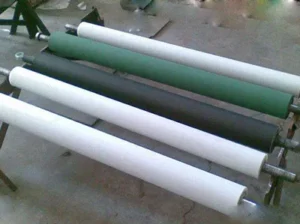
The Polyurethane Roller Manufacturing Sequence at a Glance
A polyurethane roller starts with a steel or aluminum core, a cast polyurethane cover, and a bond line between them. The order below is the same for printing, conveying, papermaking, and steel mill rollers, but dwell times and temperatures change with Shore hardness and cover thickness.
| Stage | Key process condition | Failure mode if missed |
|---|---|---|
| Core preparation | Clean, profiled surface ready for primer | Adhesive delamination from the core |
| Prepolymer degas | Vacuum at or below minus 0.095 MPa | Voids trapped below the surface |
| Metering | Plus or minus 0.3 percent across the full flow range | Hardness drift and ratio error |
| Mixing | High shear head at 7000 to 11000 rpm | Streaks, soft spots, poor pigment wet out |
| Pouring | Laminar flow and bottom up fill | Trapped air and knit lines |
| Cure and post-cure | Staged temperature ramp to full crosslink | Residual stress, grind out, dimensional creep |
The rest of this article expands the three places where I see the most scrap: core to polyurethane adhesion, component ratio control, and post-cure handling. If those three are wrong, the grinder only makes the defect rounder, not invisible.
Core Preparation and Adhesion Priming for Polyurethane Rollers
If the polyurethane cover does not bond to the core, the roller fails at the interface before the elastomer itself wears out. Most adhesion failures reported as material problems start with residual oil, finger marks, or a media blasted surface that was allowed to sit too long before priming.
Core Cleaning and Roughness
The core needs a clean, uniform profile that lets the primer grip. I prefer to bring the core above dew point and hold it in the same thermal window as the prepolymer before pouring. A cold core chills the liquid at the bond line, and that chilled layer can tear away as the cover shrinks during cure. If the core carries solvent residue or condensation, no primer chemistry will fix the problem.
Applying the Bonding Agent
Primer choice follows the core grade and the prepolymer chemistry. The control issue is coverage: a thin, continuous, haze free film, not a flood coat. Excess primer forms a weak boundary layer. I have seen shops apply primer generously because they wanted more safety, only to produce a glossy failure line between core and cover after a few thousand cycles. The correct amount looks unimpressive when wet, and that is usually fine.
Metering and Mixing Parameters That Decide Roller Hardness and Rebound
Roller hardness starts with the prepolymer to chain extender ratio. On a 2A2B roller casting machine, MOCA formulas commonly run near 100 to 9 through 100 to 12 by weight, while BDO formulas sit lower, near 100 to 3 through 100 to 6. That difference is not a minor chemistry detail. MOCA builds higher hardness and compression resistance; BDO shifts the cover toward resilience and lower hysteresis.
MOCA or BDO Cure
Temperature windows also differ. MOCA must stay molten, usually at 90 to 115 C, while BDO stays near 25 to 50 C. If a line switches between formulas, every residual crystal in the MOCA circuit or moisture pocket in the BDO line changes local ratio. The machine needs separated temperature control and a clean circulation path for each formula.
Metering Accuracy at Low Flow
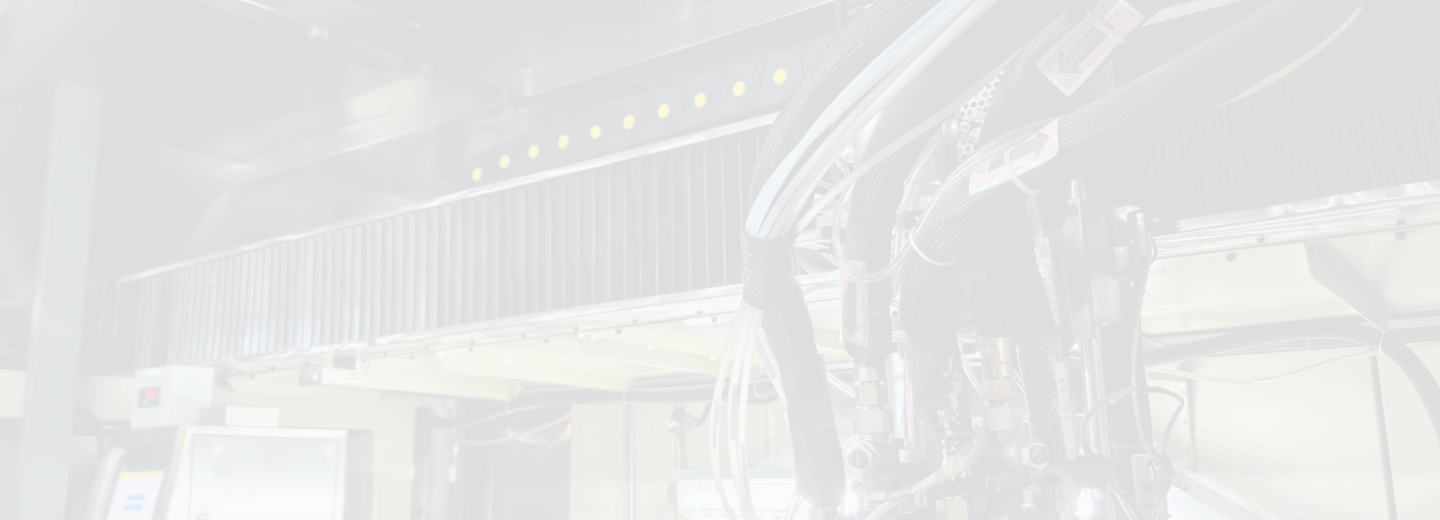
Because the B side flow is small relative to the prepolymer, a metering error of one percentage point does not stay one percentage point in the mixed product. It becomes a stoichiometry shift, and the practical effect is a roller that feels different even if it looks identical. I use a 2A2B machine rated from 50 to 1000 g/s with dynamic metering accuracy of plus or minus 0.3 percent full range, vacuum defoaming below minus 0.095 MPa, and mixing head speed from 7000 to 11000 rpm. That control band is what keeps Shore A and rebound inside the range the customer actually tests.
Two formulations or a large turndown range carries a hidden risk. The metering train may hold plus or minus 0.3 percent at 800 g/s but lose linearity below 100 g/s, exactly where prototype and laboratory rollers are poured. If your program includes small trial rollers before volume production, confirm the low flow calibration curve rather than relying on the full range specification. Send your core diameter, cover thickness, and target Shore A to info@chinahaifeng.com or WhatsApp 86 13566296633, and I can check what flow window your roller actually sits in.
Roller Casting, Post-Curing, and Quality Checks That Catch Scrap
Polyurethane covers fail in shear when voids concentrate stress around the core or below the grinding envelope. Voids start in three places: dissolved gas in the prepolymer, air introduced at the mix head seal, and turbulence during mold fill.
Casting Without Trapped Air
Vacuum degassing under minus 0.095 MPa removes much of the first source, but it does not fix a leaking shaft seal. The best mold fill is laminar. The stream should enter at the lowest point and let the liquid climb evenly. I prefer a slight mold rotation or a stationary inclined fill rather than dumping a thick stream down the center of a vertical roll, because that creates a crown shaped wet out pattern and traps air at the top.
Hardness, Runout, and Visual Checks
Three checks catch most process drift before a roller ships. First, section a witness ring from the same pour rather than testing only the finished surface. Hardness at 2 mm below the surface tells you whether the center reached cure. Second, check total indicated runout after grinding with the roller supported on its journal centers, not on the polyurethane surface. Third, inspect the bond line under a light press or bend test if the roller will see impact or high nip load.
If a roll comes out with a soft band at one end, the common assumption is that the mold was cold. Sometimes it is. More often one side of the laminar flow path starred the liquid and created an air rich region that cured soft. The same symptom comes from two different mechanisms, so the correction is not the same. That is why the pour pattern and mold temperatures need to be recorded together.
What to Confirm Before Finalizing a Roller Production Specification
Roller production goes wrong when a buyer locks in nominal machine output without defining the flow range the actual roller family occupies or the chemistry changeover the shop will need. A line that pours one large mining roller at 1200 g/s and one laboratory roller at 80 g/s has two very different metering demands, and both matter.
The specification conversation should not begin with pump size. It should begin with the smallest and largest shot, the Shore A range, the cover thickness, and whether the plant will change between MOCA and BDO formulas. Those four inputs determine tank temperature zones, mixing head speed, vacuum capacity, and whether a single casting unit can cover the range without recalibration between products. Send us your core diameter range, cover thickness, target hardness, and expected daily output, and we will specify the metering accuracy, vacuum, and temperature control your roller family actually needs. Contact info@chinahaifeng.com or WhatsApp 86 13566296633.
Common Questions About Polyurethane Roller Production
How long does it take to make a polyurethane roller?
Most solid polyurethane rollers take 8 to 48 hours from pour to ready-to-ship. Mixing and casting are fast, but post-cure alone commonly runs 12 to 24 hours, and grinding, balancing, and final inspection add more. Thin covers on small printing rollers may move through in one shift, while a thick steel mill backup roller can run several days because the cover must be ground in stages to control heat and residual stress. The schedule should be built around the cure window and grinding stock, not the pour time.
Does higher hardness always mean longer wear life?
A common misconception is that higher hardness automatically means better wear life. Hardness matters, but it works with rebound, tear strength, and the load cycle. A 90 Shore A cover with poor energy return may run hot and degrade faster than an 85 Shore A cover that returns energy efficiently. The harder formula also exposes weaknesses: it can be more brittle, harder to bond, and less tolerant of impact. Choose hardness for the grip, compression, and load pattern first, then adjust the formulation to keep the roller running cool.
Can a workshop switch between MOCA and BDO on the same machine?
It depends on how the machine is configured. MOCA must stay molten, usually at 90 to 115 C, while BDO stays near 25 to 50 C. The two formulas need separate temperature zones or a strict purge sequence, otherwise residue from one cross contaminates the other and moves the ratio. Many 2A2B roller casting machines support both, but the operator has to switch tanks, calibration files, and mix head temperature points. If a shop runs the same formula for weeks, switching is not worth the added risk.
Why do polyurethane rollers delaminate from the core?
In the delamination failures I investigate, the clean separation usually sits right at the metal surface, not inside the polyurethane. That points back to core preparation: residual oil, a blast profile that sat too long, or primer that was either too heavy or too light. Polyurethane can also pull away if the core enters the mold too cold and chills the first liquid layer. If your failure face is clean at the metal, send the core material, cleaning method, and a close photo to info@chinahaifeng.com, and we can narrow the cause before you change any formula.