A PU rain boot machine purchase usually comes down to one question before price: does the line need one color circuit or two? Single-color lines cover the standard black, navy, and dark green boots that still make up most volume orders. Two-color lines add a second metering and mixing circuit so the sole, the band, or a logo panel can run in a contrasting shade without a separate molding pass. That difference is not cosmetic. It changes shot weight, mold count, purge loss, floor space, and how often the line stops for a color change.
What a PU Rain Boot Line Has to Do Before Color Enters the Picture
A PU rain boot is a thick-walled, direct-injection molded part. Two reactive streams, a polyol blend and an isocyanate, are metered in a fixed ratio, mixed in the head, and injected into a closed mold built around a last. The material cures in the mold, the boot is demolded, and the flash line is trimmed.
Everything upstream of color serves that sequence. The metering pumps must hold ratio within a narrow band, because a ratio drift changes hardness, elongation, and tear strength at the same time. The mixing head must deliver a homogeneous shot without entraining air, because a bubble that migrates to the surface becomes a pinhole after trimming. Mold temperature must stay stable across the carousel, because a cold cavity at the end of the run produces a short shot while the first cavities fill cleanly.
PU is a thermoset. Once the boot cures, the material cannot be remelted or reground into new parts. Scrap from a PU rain boot line is waste, not feedstock, which is why shot weight accuracy and purge discipline carry more financial weight here than they do in a thermoplastic operation.
What a Single-Color PU Rain Boot Line Actually Includes
A single-color scope is one metering unit, one mixing head, one color circuit, and one mold set. The color can come from a pigmented polyol drum or from a color paste dosed into the polyol stream. Either way, the whole line runs one shade at a time.
The mechanical package is compact. A low-pressure foaming machine in the 1 to 15 kg/min output range covers most rain boot molds, with metering accuracy around ±0.3% of full range. The mold carousel carries the lasts, and rotary carriers in the 8 to 20 station range appear across footwear and industrial PU lines. Mold temperature controllers, a release agent station, and a trimming bench complete the cell.
Changeover on this scope is a drum swap or a pigment change followed by a purge. The operator verifies ratio with a weighed shot before the first good pair. That sequence is short enough that a single-color line can run several colors per week without much loss, provided the purge is collected and the first shots are checked rather than assumed.
The limit is design range. A single-color line produces one color per shot. If the order calls for a contrasting sole, a colored band, or a two-tone logo panel, the second color has to come from a separate operation: painting, a second molding pass, or an assembled component.
What the Second Color Circuit Adds to a Two-Color Line
A two-color scope adds a second independent metering and mixing circuit, or a dual head that sequences two shots into the same mold. The color supply grows from one circuit to two or three, each with its own pump, tank, and purge path.
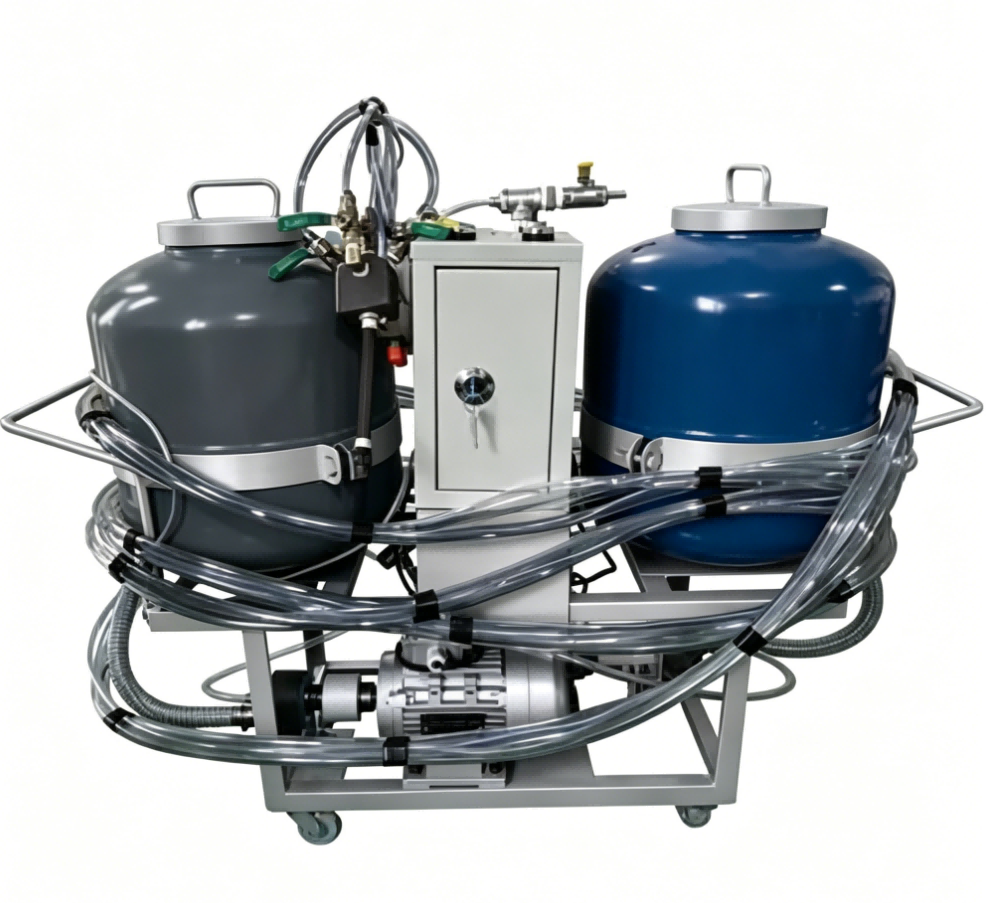
The hardware is where the scope difference becomes visible. Haifeng Polyurethane Machinery builds a three-channel additive mixer that meters three independent color pastes at ±0.5% or better, at 0.1 to 100 g/s per channel, with a two-minute color changeover and a PLC link to the host line. That is the kind of unit a two-color rain boot cell needs when the sole color and the upper color are dosed separately rather than pre-blended.
There are three common routes to a two-tone rain boot, and they are not interchangeable. Two-shot molding injects the sole color first, cures it partially, then injects the upper color against it. Dual-density molding uses one color but two hardness values, which is a different selling point. Two-material molding combines PU with rubber or TPU, which brings a bonding step and a different mold design.
Dual-density work depends on knowing which hardness scale the buyer is quoting. <Shore A Vs Shore D Hardness In Polyurethane> explains which scale applies to a flexible boot upper and which applies to a rigid component.
Each route changes the mold. A two-shot mold needs a shut-off at the color boundary that survives repeated clamping, and it needs a second injection path that does not wash the first shot out of position. Alignment errors show up as a wavy boundary line, and that line is a reject, not a cosmetic variation.
Single-Color and Two-Color Scope Compared
The table below compares the two scopes on the items that change the purchase decision. It is written as a decision aid, not a specification sheet, because the right answer depends on the order mix rather than on the machine alone.
| Decision item | Single-color scope | Two-color scope | Do not choose it when |
|---|---|---|---|
| Metering and mixing | One metering unit and one mixing head | Two independent circuits or a dual head with sequenced injection | The design needs three or more colors in the same shot |
| Color supply | One pigment or pigmented polyol circuit | Two or three color paste channels with separate purge | There is no floor space for extra tanks, pumps, and a purge station |
| Mold and tooling | One mold set on the carousel | Two mold sets or a two-position mold with PLC sequencing | The order mix is almost entirely one color |
| Changeover | Drum or pigment swap plus a purge shot | Channel clean, purge shot, and ratio re-verification | Changeovers happen several times a day |
| Scrap and rework | Single-color scrap with no cross-contamination | Mixed-color purge scrap that cannot be reused | Scrap tolerance is already tight |
| Best fit | High-volume standard boots | Two-tone designs sold as a visible feature | The two-tone look can be painted or assembled instead |
Sizing the Line by Shot Weight, Mold Count, and Cycle Time
Shot weight is the number that sizes the metering unit, and it is easy to calculate before any quotation arrives. Multiply the part volume of one pair by the PU density, add the runner and gate allowance, then multiply by the cavity count.
Shot weight per shot (g) = part volume per pair (cm³) × density (g/cm³) × cavities + runner allowance
As an arithmetic example, a pair that displaces 1,400 cm³ at a density of 1.1 g/cm³ needs about 1.54 kg of PU. A two-cavity mold turns that into a 3.08 kg shot. At a 5 kg/min output setting, the pour itself takes roughly 37 seconds. The rest of the cycle is cure, and cure is set by wall thickness and mold temperature, not by the pump.
That split matters for equipment selection. A larger pump shortens the pour but does nothing for a cycle dominated by cure. A second mold set usually adds more output than a bigger metering unit, provided the carousel has the stations and the clamping has the tonnage.
Shot weight errors show up as density variation long before they show up as a visible defect. <How To Calculate Shot Weight In Polyurethane> covers the volume and density inputs that keep a pour within tolerance.
Color Changeover, Purge Loss, and Scrap in Two-Color Production
Every color change on a two-color line costs a purge shot, and the purge shot is the visible part of a larger loss. The mixing head, the color channel, and the line between them all hold material that has to be pushed out before the next shade runs clean.
The cost scales with changeover frequency, not with line size. A plant that changes color twice a week absorbs the loss in a normal scrap allowance. A plant that changes twice a shift needs a purge recovery plan, dedicated color circuits, or a smaller machine that reaches steady state faster.
Because PU is thermoset, mixed-color purge scrap has no regrind value. It is disposal cost plus material cost, and both are booked against the color change rather than against the boot.
The two-color interface also concentrates shrinkage risk. The first shot cures and shrinks before the second shot fills against it, and if the first shot is under-cured, the boundary sinks. That sink line is difficult to trim out and usually becomes a reject.
Shrinkage at a two-shot boundary is a cure and packing problem before it is a mold problem. <Causes Of Shrinkage In Polyurethane Foam How To Control It> covers the cure, packing, and temperature conditions that drive it.
Utilities, Floor Space, and Staffing Differences
A two-color scope is not a single-color line with one extra pump bolted on. It carries a larger tank farm, a second temperature control loop, a purge station, and more mold storage, because two mold sets have to be handled and staged.
Power demand rises with the second metering unit and the added temperature control. Low-pressure PU machines in the footwear range typically draw 5.5 to 15 kW, and a two-color cell sits at the upper end of that band once the second unit, the purge system, and the ventilation are counted.
Staffing changes by one operator in most plants, but the more important shift is skill. A two-color operator has to read a boundary line, judge whether a first shot is cured enough to take the second, and decide when a purge is complete. That judgment is learned, and it is the reason a two-color line usually runs better in a plant that already has PU experience than in a plant moving up from PVC.
Floor space is the constraint that surprises buyers most often. The machine footprint is only part of the cell. Tank storage, drum handling, mold racks, and the purge station all need clear access, and a layout that ignores them turns a two-color line into a bottleneck at the aisle.
How to Choose Between Single-Color and Two-Color Scope
Start with the order mix, not the machine catalog. If almost every order is one color, a single-color line plus a paint or assembly step for the occasional two-tone design is usually the lower-cost route. The paint step can be outsourced, and the line keeps running while it happens.
Choose the two-color scope when the two-tone look is a feature customers pay for and when the volume justifies the purge loss. That condition is met more often in branded and export orders than in commodity volume, where the buyer is comparing on price per pair.
Count the changeovers before committing. A two-color line with two changes a week is a different investment from a two-color line with two changes a shift, and the difference shows up in material loss, not in the quotation.
Confirm the standard question early. Rain boots sold as occupational footwear may need to meet a specific standard the buyer names, and the test method affects the formulation and the mold, not just the label. Ask the buyer which standard applies before the mold is cut.
Send the order mix, the boot size range, the target cycle, the color count, and the available floor space when you request a scope. Those five inputs decide whether a single-color cell, a two-color cell, or a phased build is the honest answer.
Send Your Order Mix and We Will Scope the Line
Tell us the boot size range, the number of colors per style, the target pairs per hour, the mold cavity count you have in mind, and the floor space available. With those five inputs we can tell you whether a single-color cell covers the order or whether the two-color scope earns its purge loss. Email Info@chinahaifeng.com or message WhatsApp 86 13566296633 with your order mix and we will come back with a line scope and a mold count.
FAQ
Can a single-color PU line produce two-tone rain boots?
Not in one shot. A single-color line runs one color circuit, so a two-tone boot needs a second operation: painting the sole or band, molding a separate component and assembling it, or moving the order to a two-color line. Painting is the lowest-cost route at low volume, but it adds a process step and an adhesion failure mode that molding does not have.
How much floor space does a two-color line need compared with single-color?
More than the machine footprint suggests. The second metering unit, the extra tanks, the purge station, and the second mold set all need clear access, and mold storage is often the item left out of the layout. Measure the aisle and the drum handling path before comparing quotations, because a line that fits the drawing but blocks the forklift will not run at the quoted rate.
What shot weight should I specify for rain boots?
Specify it from the part, not from a catalog range. Multiply the pair volume by the PU density, add the runner allowance, and multiply by the cavity count. A pair that displaces about 1,400 cm³ at 1.1 g/cm³ needs roughly 1.54 kg, so a two-cavity mold needs a shot above 3 kg. Give the machine supplier that number and the cycle target, and the metering unit can be sized against both.
Is PU the right material for rain boots, or should I compare PVC and EVA?
PU gives abrasion resistance, low-temperature flexibility, and oil resistance that suit work and outdoor boots. PVC is usually cheaper and easier to process but has a narrower flex range and different environmental compliance issues. EVA is lighter and used more in casual and garden boots. The right choice depends on the use case and the standard the buyer names, not on a single material ranking.
How do I verify ratio accuracy on a new line before acceptance?
Weigh a purge shot and a molded part, compare the measured ratio against the formulation, and repeat at the start, middle, and end of a production run. Check mold temperature at the first and last cavity, because a cold cavity produces a short shot that looks like a ratio fault. Record the values and repeat the check after a color change, since the purge is where ratio drift usually appears.
If you’re interested, check out these related articles:
Shore A Vs Shore D Hardness In Polyurethane
RRIM Vs RIM Which Process Suits Your Structural Part
The Role Of Rise Time In Polyurethane Foaming
What Is Semi Rigid Polyurethane Foam