Plant managers compare RRIM vs. RIM after a part fails a stiffness, heat, or dimensional stability test. Most comparisons stop at the material difference: RRIM contains milled glass or mineral reinforcement, so it is stiffer and holds dimensions better. The expensive difference sits at the equipment. An abrasive filled polyol can hold a specification on day one and still drift after a month of pump and mixhead wear. I have watched lines approve a reinforced formula without checking the mixing train, then chase ratio drift, short shots, and uneven fiber distribution for months. This article works through the decision from mixing to tooling, so you can separate paper properties from production behavior.
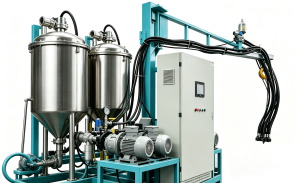
What Actually Changes When You Add Reinforcement to RIM?
RIM starts with two low-viscosity reactive streams that meet in a high-pressure mixing head and fill a mold under low clamping force. That gives fast cycles, good flow into complex shapes, and a smooth surface. RRIM keeps the same reaction, but one stream becomes a filled slurry before it reaches the pump. Milled glass or mineral flake raises the fill-side viscosity, makes the fluid abrasive, and gives it a settling tendency. The chemical reaction is not the main change. The handling path is.
| Factor | Conventional RIM | RRIM |
| Polyol-side fluid | Low-viscosity reactive liquid | Filled, abrasive, settling-prone slurry |
| Primary part benefit | Fast cycle, low mold tonnage | Higher modulus, HDT and stability under heat |
| Main process risk | Ratio drift from temperature or nucleation | Pump and mixhead wear plus filler settling |
| Typical machine change | Standard RIM layout | Hardened meter and mixhead parts, filled-side agitation |
| Surface finish | Usually good for painted skins | May need extra finishing on exposed surfaces |
| Indicative parts | Unpainted covers, fascias, low-load housings | Brackets, structural panels, dimensional supports |
That table is useful for a first cut, but it does not answer the production question. A plant can buy a machine that meets every catalog specification and still fail a process audit if the reinforcement settles. The comparison has to move beyond the data sheet and into the equipment.
When Do RRIM Parts Earn Their Cost Premium?
RRIM costs more because the material, pump components, and mixhead parts all carry reinforcement-related wear. The extra cost is justified when the part would fail without the reinforcement in a way that thicker sections cannot fix. The strongest signal is a large flat area that must hold flatness after a paint bake or heat soak. Unfilled RIM can relax above its heat deflection temperature and warp enough to open a seal gap. A second signal is a load-bearing part that runs hot, where creep and fastener loosening matter. A third signal is a thermal expansion requirement that must track metal or thermoset components in an assembly. If none of those conditions are present, RRIM is usually the wrong cost.
I have seen an unfilled RIM bracket pass ambient fitting, then warp after one paint bake because the polymer relaxed above its heat deflection point. The fix was not more mold clamping force; it was a mineral-filled RRIM formulation that held flatness through the thermal cycle.
How Do RRIM and RIM Differ at the Mixing Head?
At the point of mixing, both processes use high-pressure impingement. Two streams enter a mixing chamber, collide, and leave as a reacting mixture. The difference is what the polyol stream carries. In conventional RIM, the stream is a liquid. In RRIM, the same stream is a filled slurry that can cut pump seals, pack clearances, and settle inside dead legs during a short stop.
On a standard RIM machine, metering components are selected for a clean low-viscosity liquid. On an RRIM machine, the filled side needs pumps built for abrasive service, hard seats and plungers, larger mixhead passageways, and an agitation or recirculation loop that keeps fiber suspended. The mixing pressure may stay in the same range. On our RRIM equipment, impingement pressure remains 150-200 bar and dosing accuracy remains 0.3% across the full dynamic range, but pump and mixhead materials are not the same. If a plant swaps a filled formula onto an unfilled line without changing these parts, the first failure is rarely dramatic. It shows up as shot mass drift, soft first shots after a pause, or a mixhead that begins to leak at the seal gland.
Before you commit a filled polyol to an existing machine, the decision is simple to test but expensive to skip. Run the pilot with production tooling, not a sample mold, and record shot mass across a 30-minute stop and restart. If shot mass moves, the machine is not the right fit. For a structural bracket with a tight flatness callout, confirm fill-side viscosity after a production stop before freezing the BOM. Send the part drawing and your current line configuration to info@chinahaifeng.com, and we will tell you whether conversion or a dedicated RRIM machine is the lower-risk path.
Which Production Variables Decide Between RRIM and RIM?
Once the design conditions point one way or the other, the production variables make the final call. Annual volume comes first. Low-volume cosmetic covers rarely recover the cost of RRIM-grade wear parts. High-volume structural parts usually do, because the rejection and rework cost from unfilled RIM is paid at every batch. Tooling comes second. RRIM uses the same low clamping force philosophy as RIM, but the abrasive stream means runners and gates need wear-resistant inserts and the mold should be vented for a higher-viscosity flow. The installed base comes third. If the plant already owns a well-maintained RIM machine, a conversion may make sense. If the existing machine has no filled-side recirculation and no agitation, a dedicated RRIM machine is normally cheaper than rebuilding half the wet end.
Line speed and material temperature sit underneath those variables. A filled polyol needs more time to release entrained air and more stable tank temperature because viscosity shifts faster with cooling. Unfilled RIM tolerates a wider temperature window. If your shop runs cold in winter or shuts down for lunch, RRIM needs a startup procedure that verifies the filled side before the first shot.
How Do We Recommend a Starting Point for Your Part?
Start from the failure mode, not from a material name. If the part fails because it deforms, creeps, or changes dimension when it gets hot, RRIM is a serious candidate. If the part fails because impact peaks or cosmetic surfaces are the issue, stay with RIM and adjust the tooling or the formula. After that, audit the machine. A good RRIM decision includes the filled-side pump, mixhead clearances, recirculation, agitation, and a shot mass trend log from the pilot.
That audit is the step most plants skip, and it is the step that determines whether the budget goes to a useful upgrade or to a full rebuild next year. We would rather spend an hour checking your current wet end than see you buy a machine on catalog numbers. Send us your part drawing, annual volume, current tolerance failure, and a photo of the part. We will check the filled-side path and give you a straight answer on whether RRIM is the right call or whether a lower-cost change will do the job. Email info@chinahaifeng.com or WhatsApp at 86 13566296633.
What Production Teams Ask Before Choosing RRIM or RIM?
Is RRIM just RIM with glass fiber added?
RRIM is often shortened to “RIM with glass,” and that simplification hides the main risk. The chemistry is still two-component reaction injection molding, but the filled side behaves differently through the entire metering path. Milled glass or mineral flake raises viscosity, adds abrasion, and can settle during stops. The part also changes: modulus, heat deflection, and dimensional stability rise, while impact or elongation may move in the other direction depending on loading. Treating the change as a formula swap without checking the mixing train is how a machine becomes a scrap generator.
Can I run RRIM on an existing RIM machine?
Some machines can be converted, but it is not a software change. The answer depends on the filled-side pump, mixhead internal clearances, tank agitation, and recirculation path. A machine without filler-rated pumping components can make parts for a few weeks, then drift as the pump wears. If the frame, temperature control, and clamp tonnage are already adequate, a conversion may be less expensive than a new line. If the wet end uses standard orifices and has no way to keep fiber suspended, a dedicated RRIM machine is usually the lower-risk path.
Which process costs more per part?
RRIM normally carries a higher material and maintenance cost. The reinforcement adds raw material expense, filled-side pump components and mixhead parts wear faster, and some formulations need extra surface finishing. That cost only makes sense when the part cannot meet flatness, heat, or load requirements in unfilled RIM. We compare the two as a total over tool life: a reinforced part that reduces scrap, thermal rejects, or post-molding correction often ends up cheaper than a lower-cost material with high rework.
What reinforcement loading is typical for RRIM?
A single loading percentage is not a useful specification. Milled glass loadings commonly fall in a range of roughly 10-20% by weight on the filled side, but fiber length, surface treatment, and part thickness shift that range. The better number is the filled-side viscosity after a production stop, because that tells you whether the agitation system can keep the filler suspended. A formulation can look stable at 10% and still settle if the fiber is too long for the tank and recirculation design.
How do we confirm fiber will not settle between shots?
We validate it with a shutdown and restart test. Run the filled side in production, stop for 15 minutes, then take three consecutive shots and record shot mass and cut samples for fiber distribution. If shot mass moves outside tolerance and the first shots are resin-rich, the tank does not keep the reinforcement suspended. The fix is usually improved recirculation or agitation, not a change in mixing pressure. We run this check before tooling is released on every RRIM line. Share your part drawing and current scrap data at info@chinahaifeng.com or WhatsApp at 86 13566296633, and we will tell you whether your existing machine is worth converting.