On a casting line, the chain extender is not a minor additive. If a plant switches from MOCA to BDO without changing B-side temperature and mix ratio, the result is usually a scrap batch: parts that are too soft, too slow to gel, or full of dosing alarms. The right chain extender, by contrast, makes the difference between a stable, demoldable part and a sticky under-cured reject.
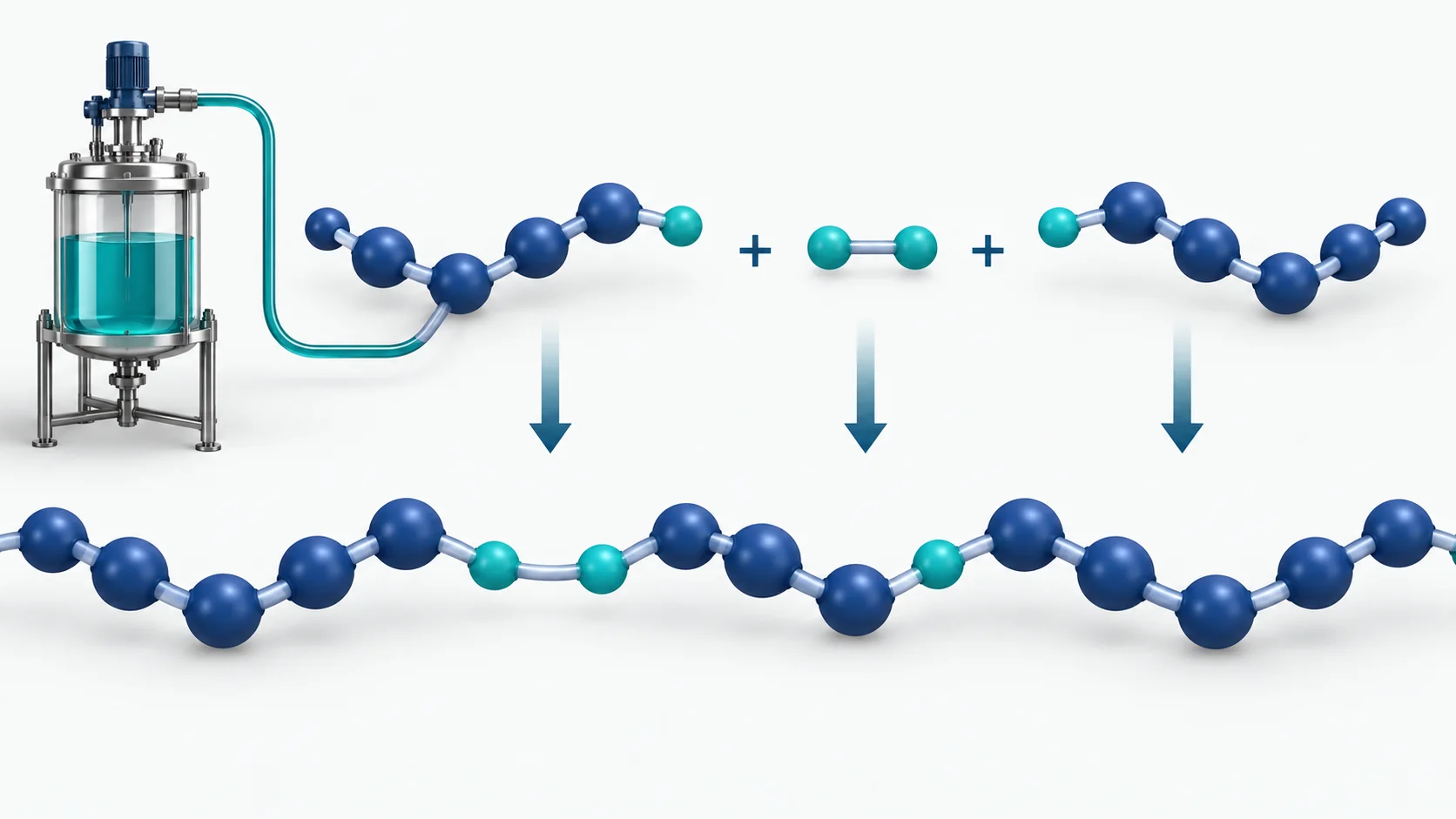
Chain extenders are low-molecular-weight compounds — typically diamines or diols — added on the B-side to react with isocyanate groups on the prepolymer. They extend the polymer chain and, most importantly, build the hard segments that drive hardness, modulus, tear strength, and compression set. They are not crosslinkers, although the processing language often confuses the two.
Why Chain Extenders Control Hardness and Processability
Chain extenders do two jobs at once. They increase molecular weight by forming urethane or urea linkages, and they raise the hard-segment fraction that determines stiffness. A higher hard-segment content generally pushes hardness higher and improves tensile and tear properties, but it also makes the reacting mixture more viscous and more exothermic. If the mixing head cannot deliver a homogeneous blend at the required temperature, hard segments form unevenly and the part fails in service long before a durometer test catches the problem.
The strong hydrogen bonding between hard segments produces the mechanically effective phase separation that gives cast elastomers their load-bearing and tear properties [1].
A crosslinker, by contrast, creates branch points through tri-functional or higher functionality. Crosslink density affects compression set, solvent resistance, and thermal stability. Chain extenders are overwhelmingly linear or low-functionality; that is why notation like MOCA and BDO appears in curative-side formulas rather than as a resin-side polyol component.
Amine Chain Extenders: MOCA and Diamine Alternatives
4,4′-Methylenebis(2-chloroaniline), commonly called MOCA or MbOCA, is the reference aromatic diamine chain extender for many TDI-based prepolymers. It is solid at room temperature and is usually processed from a heated B-side tank. Typical B-side temperature control falls in the 90–115 °C range because the curative must be kept molten and low enough in viscosity for precise metering. MOCA-based systems generally produce high hardness, high tear strength, low compression set, and excellent abrasion resistance. In practice, these properties make MOCA the default for printing rollers, industrial wheels, mining screen plates, and high-load cast elastomers.
Because MOCA is a health-hazard-classified solid, handling requires closed melters, local exhaust, jacketed transfer lines, and strict housekeeping. That operational burden is one reason liquid aromatic diamines such as DMTDA (dimethylthiotoluenediamine) and DETDA (diethyltoluenediamine) are used instead. They eliminate the melting step, allow lower B-side temperatures, and still deliver medium-to-high hardness with better flow in complex molds. The trade-off is usually a different reactivity window and, in some formulations, slightly lower dynamic performance than a well-processed MOCA system.
Diol Chain Extenders: BDO, HQEE, and Aliphatic Options
1,4-Butanediol (BDO) is the most common aliphatic diol chain extender in cast elastomer production. It is a low-viscosity liquid that is easy to meter and mixes quickly with MDI- or NDI-based prepolymers. BDO typically produces elastomers with lower hardness than MOCA but higher resilience and elongation, good hydrolysis resistance, and a softer, more flexible part. This makes BDO attractive for dynamic applications such as rollers, seals, and parts that need repeated flexing without cracking.
HQEE (hydroquinone bis(2-hydroxyethyl) ether) is an aromatic diol that offers a middle path. It is solid at room temperature, so its B-side must also be heated — commonly around 90–110 °C — but it can produce hard, high-performance elastomers with better dynamic properties than BDO in certain formulations. Aliphatic diamines such as IPDA (isophoronediamine) also appear in light-stable, aliphatic-isocyanate systems, although their reactivity and handling demands differ sharply from conventional aromatic curatives.
Chain Extender Selection Criteria for Cast Polyurethane
Selection must begin with the property target, not the curative name. The first question is what the part must do: hold a durometer range, resist abrasion, recover after compression, survive hot water, or stay transparent under UV. The second question is what the line can reliably process: which B-side temperatures are reachable, whether the mixing head can handle the viscosity, and whether the pot life leaves enough time for mold filling.
| Chain extender | Class | Typical B-side temperature | Typical property effect | Main equipment implication |
|---|---|---|---|---|
| MOCA | Aromatic diamine | 90–115 °C | High hardness, tear, and compression set resistance | Heated tank, jacketed lines, closed handling |
| DMTDA / DETDA | Aromatic diamine | 25–50 °C | Medium-to-high hardness, improved mold flow | Lower heat load, simpler melting setup |
| BDO | Aliphatic diol | 25–50 °C | Lower hardness, high resilience and elongation | Simple temperature control, fast molding |
| HQEE | Aromatic diol | About 90–110 °C | High hardness with good dynamic properties | Heated B-side, similar to MOCA setup |
| IPDA | Aliphatic diamine | Depends on formulation | Light-stable potential, different reactivity | Tight moisture and temperature control |
The choice is rarely solved by picking the highest-hardness option. A harder system often means shorter pot life and greater exotherm. If the mold is large, a fast aromatic diamine may gel before complete filling; if the part is thin, a soft BDO system may need a longer cure or post-cure to reach dimensional stability. This kind of optimization should be done with a full reaction-profile review rather than by a single Shore reading.
Final hardness is verified with a durometer under ISO 868 or ASTM D2240 methods [2], [3]. The test method matters because readings change with sample thickness, temperature, and indenter foot geometry. A chain extender selection based on a supplier data sheet alone — without checking the same test method on the actual part — often generates an out-of-spec batch.
Hardness is where chain extender choice becomes visible on the finished part. <Shore A Vs Shore D Hardness In Polyurethane> covers how durometer readings should guide your formulation target before you lock in a curative.
Equipment Requirements for MOCA/BDO Switching
MOCA and BDO place very different demands on the same casting machine. MOCA is heated to 90–115 °C and must travel through jacketed lines without cold spots. BDO runs lower, roughly 25–50 °C, and usually does not need the same heat tracing. Because the curative side is the smaller-volume side in most prepolymer systems, small temperature or metering errors are amplified. A deviation of even one percentage point in the ratio can shift final hardness and gel time enough to cause scrap.

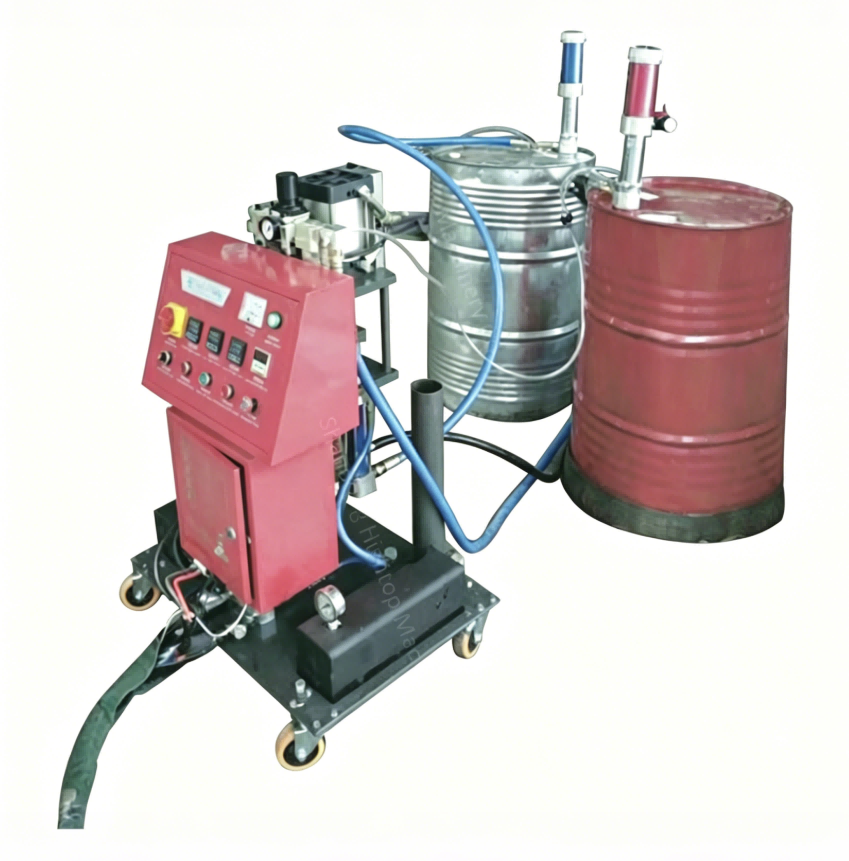
When both curatives must run on one line, the equipment should support MOCA/BDO switching: separate or switchable temperature zones, a two-component metering system with dynamic accuracy within ±0.3% of full range, and vacuum degassing below about −0.095 MPa for dense, bubble-free parts. These are not brochure features; they are the operational requirements that determine whether the same machine can make a hard MOCA roller in the morning and a resilient BDO seal in the afternoon. On the equipment side, stored ratio presets for MOCA formulas often begin around 100:9–12 and for BDO around 100:3–6; these are starting points, not universal recipes.
On a dual-curative cast line, tank temperature and mix ratio are not the only variables. <How Polyurethane Rollers Are Made From Casting To Cure> covers the full casting-to-cure sequence for roller production with MOCA and BDO formulas.
Shot weight also changes when moving between curatives because mixed density and fill pattern depend on the formulation and mold temperature.
Shot weight changes when you move between aromatic diamine and aliphatic diol curatives. <How To Calculate Shot Weight In Polyurethane> covers the calculation sequence for mold filling and mixed density.
If you are currently selecting between MOCA, DMTDA, BDO, or HQEE, send your target Shore A/D range, current tank temperature, and shot weight to info@chinahaifeng.com. A quantified review should identify whether the bottleneck is in the mixing head, the metering pump, or the temperature control loop before you commit to a formula change.
Get a Process-Level Equipment Recommendation
Zhejiang Haifeng Automation Equipment Co., Ltd. builds two-component and multi-component casting machines with independent tank temperature control, MOCA/BDO switching, and dynamic metering within ±0.3%. For a chain-extender-related machine review, contact Info@chinahaifeng.com or WhatsApp: 86 13566296633. Provide the curative type, target hardness, mold size, and estimated shot weight, and we will recommend the lowest-risk tank, pump, and mixing-head configuration for your line.
Frequently Asked Questions
What is the difference between a chain extender and a crosslinker in polyurethane?
A chain extender is typically a short-chain diol or diamine that reacts with isocyanate groups to extend linear chains and increase hard-segment content. A crosslinker has three or more reactive groups and creates chemical branch points. In practice, chain extenders mainly control hardness and dynamic properties; crosslinkers mainly control network density, compression set, and solvent/thermal resistance.
Why is MOCA processed at 90–115 °C while BDO is processed at 25–50 °C?
MOCA is a solid at room temperature and must be melted to a stable low-viscosity state for accurate metering. BDO is a liquid at those lower temperatures and can be metered without the same heat load. The exact set point depends on material purity, pump design, and line insulation [4].
Can I switch between MOCA and BDO on the same casting machine?
Yes, if the machine has separate or switchable B-side temperature control, jacketed or solvent-flushable lines, and a metering system that can adjust the mix ratio. Without those provisions, cross-contamination, cold spots, and ratio drift can occur. The cleanest arrangement is a two-component system with separate tanks and automatic cleaning.
How does chain extender choice affect Shore A and Shore D hardness?
Higher hard-segment content generally raises hardness, but the actual reading depends on test method, sample thickness, and cure state. Durometer testing under ISO 868 or ASTM D2240 provides a comparable number only when the same method and conditioning are used [2], [3].
Which chain extender is better for hydrolysis-resistant parts?
There is no single best choice. Polyol backbone, isocyanate type, and curative all contribute. BDO-based formulations are often paired with hydrolysis-resistant polyol backbones in water-contact applications, but the full system must be specified; the chain extender alone does not determine hydrolysis resistance. The relative property trade-offs of diamine and diol curatives are compared in [5].
References
[1] G. Oertel, Ed., Polyurethane Handbook: Chemistry – Raw Materials – Processing – Application – Properties, 2nd ed. Munich, Germany: Hanser Publishers, 1994.
[2] ISO 868:2003, Plastics and ebonite — Determination of indentation hardness by means of a durometer (Shore hardness). Geneva, Switzerland: International Organization for Standardization, 2003.
[3] ASTM D2240-15, Standard Test Method for Rubber Property—Durometer Hardness. West Conshohocken, PA, USA: ASTM International, 2015.
[4] U.S. Environmental Protection Agency, “4,4′-Methylenebis(2-chloroaniline) (MOCA) Hazard Summary.” Washington, DC, USA, Jan. 2000.
[5] C. Hepburn, Polyurethane Elastomers, 2nd ed. London, U.K.: Elsevier Applied Science, 1992.
If you’re interested, check out these related articles:
RRIM Vs RIM Which Process Suits Your Structural Part
Causes Of Shrinkage In Polyurethane Foam How To Control It
What Is Spray Polyurethane Foam Composition And Application
SRIM Explained Structural Reaction Injection Molding Basics