
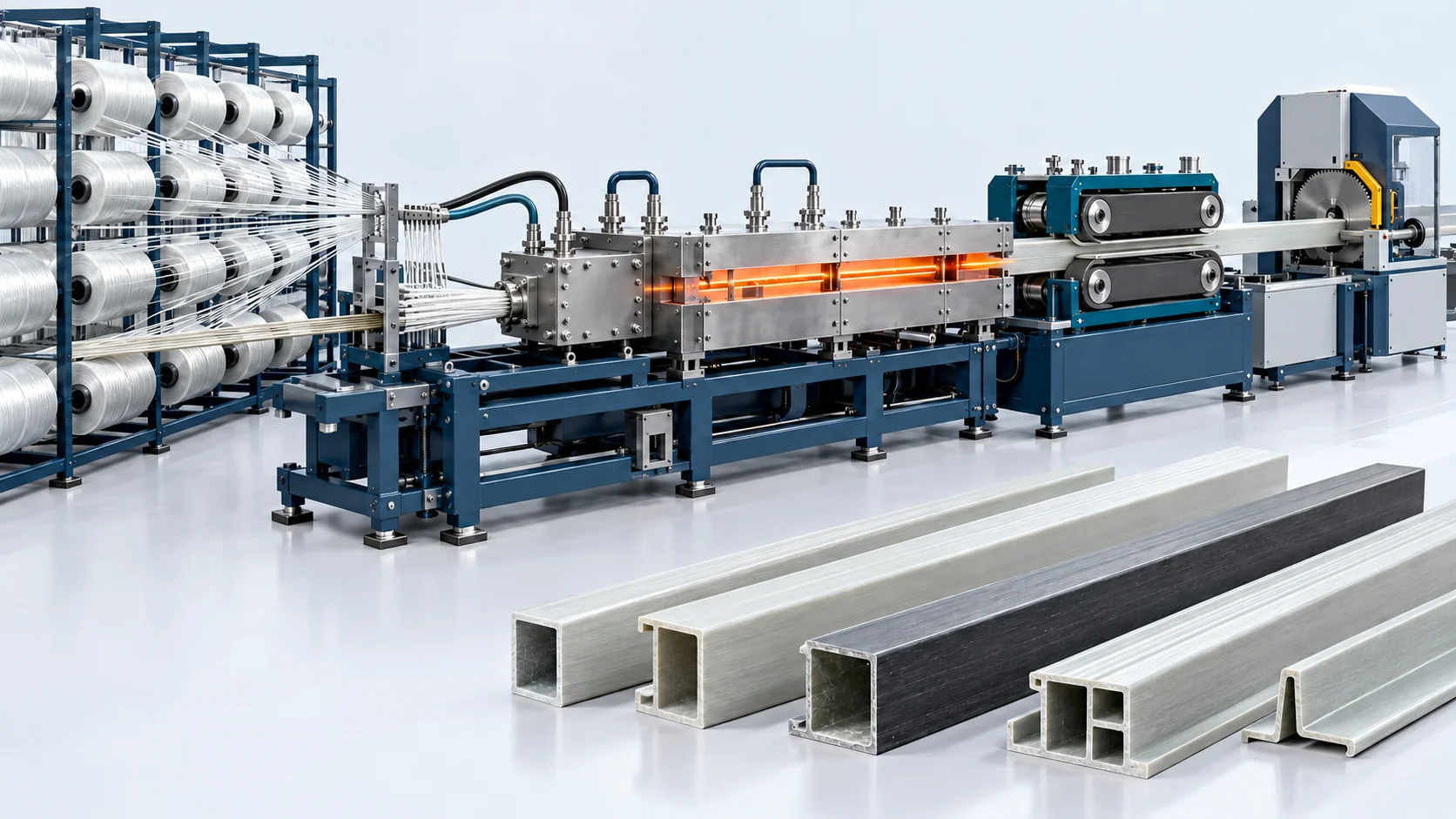
Offshore Marine Solar Frame Solution
Develop closed-die injection pultrusion for marine solar framing profiles with conditioned resin supply, dense-fiber wet-out, die control and qualification planning.
Heavy Structural Composite Framing for Offshore Floating Solar
Develop closed-die injection pultrusion for marine solar framing profiles with conditioned resin supply, dense-fiber wet-out, die control and qualification planning. Core scope includes sealed resin conditioning, high-pressure metering and mixing, closed-box impregnation interfaces and controls. Die heating, pulling, cutting and dry-gas supply are configured interfaces. Finished-frame marine loading, weathering, electrical behavior and mounting hardware require separate qualification.
Product, material and tooling
Core scope includes sealed resin conditioning, high-pressure metering and mixing, closed-box impregnation interfaces and controls. Die heating, pulling, cutting and dry-gas supply are configured interfaces. Finished-frame marine loading, weathering, electrical behavior and mounting hardware require separate qualification.
Capacity and acceptance
Review all preparation, dispensing, curing, handling and inspection stages. Material and component results require separate original test records.
Configuration references are reviewed for the selected material, product geometry and acceptance conditions. A January 2026 implementation cannot establish a completed 12-month offshore follow-up by October 2026. A 9,000-hour continuous exposure is 375 days and its start/end dates must be supplied. Burn-off resin loss is not directly a fiber-volume measurement; strength retention and modulus retention differ.
Turnkey Marine Solar Frame Pultrusion Process
The supplied process sequence is a configuration reference. Temperature, pressure, output and cure settings are confirmed for the selected material and tooling. A January 2026 implementation cannot establish a completed 12-month offshore follow-up by October 2026. A 9,000-hour continuous exposure is 375 days and its start/end dates must be supplied. Burn-off resin loss is not directly a fiber-volume measurement; strength retention and modulus retention differ.
Hermetic Conditioning & Nitrogen Blanketing
Configured reference: Low-hydrolysis polyol and isocyanate are conditioned in stainless tanks under 0.05 MPa dry nitrogen blankets to strip moisture below 30 ppm.
Hastelloy High-Pressure Metering
Configured reference: Axial piston pumps with Hastelloy-coated fluid ends meter chemicals at 14.5 MPa, holding mix ratio accuracy within ±0.2% via mass flow tracking.
Impingement Mixing & Gel-Time Sensor Tracking
Configured reference: Chemicals collide inside a compact impingement head; in-die ultrasonic sensors monitor reaction kinetics to dynamically trim die heating zones.
Reference Solution Engineering Envelope
Values transcribed from the supplied configuration brief. Material properties and finished-product benchmarks are separate validation targets, not general equipment guarantees.
| Parameter | Value / Unit | Applicable Configuration / Conditions |
|---|---|---|
| Dosing Output Capacity | 1.0 to 10.0 kg/min | Hastelloy-coated servo-driven axial piston metering skid; supplied reference requiring configuration or test verification |
| Fluid Working Pressure | 12.0 to 15.0 MPa | Continuous high-pressure closed-die impingement injection; supplied reference requiring configuration or test verification |
| Supported Fiber Volume | Up to 83% (Vf) | E-CR glass, basalt, or carbon fiber dense structural packing; supplied reference requiring configuration or test verification |
| Salt Spray Durability Limit | Greater than 9,000 hours | ASTM B117 testing with flexural retention > 92%; supplied reference requiring configuration or test verification |
| Profile Wall Thickness | Up to 4.5 mm (Heavy section) | Engineered for 4-meter wave slap and typhoon wind loads; supplied reference requiring configuration or test verification |
| Continuous Pulling Speed | 0.8 to 1.2 m/min | Synchronized heavy hydraulic caterpillar puller; supplied reference requiring configuration or test verification |
Core Equipment for This Solution
The linked pages describe shared preparation or feed-system families, not proof of delivery of the dedicated models listed in the case. Core scope includes sealed resin conditioning, high-pressure metering and mixing, closed-box impregnation interfaces and controls. Die heating, pulling, cutting and dry-gas supply are configured interfaces. Finished-frame marine loading, weathering, electrical behavior and mounting hardware require separate qualification.
Core Advantages of Haifeng Offshore Systems
Engineering functions and interfaces developed for the specified product and material system.
Sealed Resin Conditioning
Configure and validate sealed resin conditioning for the selected product, formulation, tooling and production conditions.
Closed-Box Fiber Wet-Out
Configure and validate closed-box fiber wet-out for the selected product, formulation, tooling and production conditions.
Die and Puller Coordination
Configure and validate die and puller coordination for the selected product, formulation, tooling and production conditions.
Marine Qualification Planning
Configure and validate marine qualification planning for the selected product, formulation, tooling and production conditions.
Related Project Draft
Review the project configuration described in the supplied brief. Project records and reported results require verification before public use.
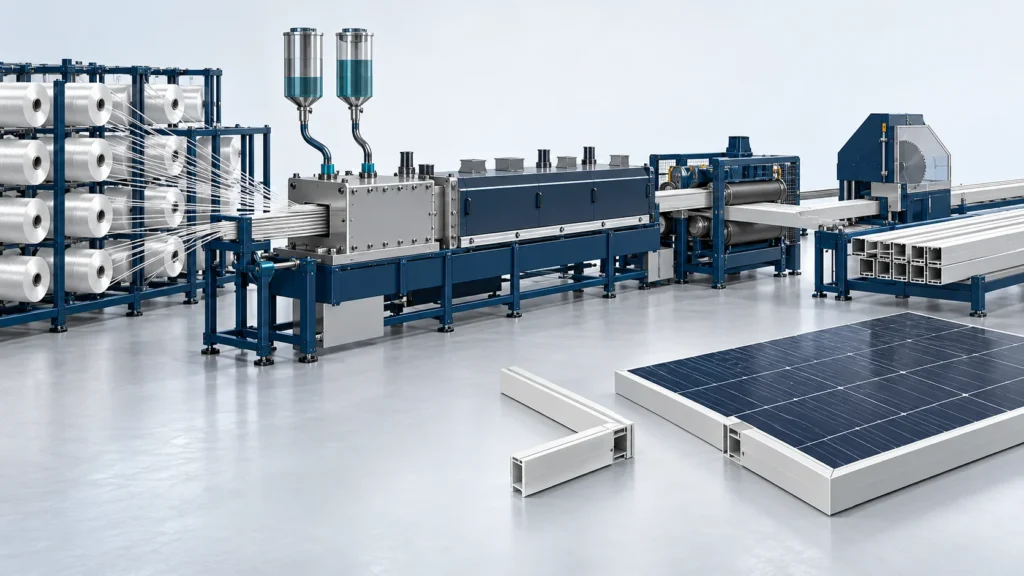
Frequently Asked Questions
Technical questions to establish the equipment scope, material window and validation plan.
How are marine corrosion and electrical risks assessed?
How is dense-fiber wet-out developed?
How are dry-gas supply and drum changes configured?
Do metering pumps handle fibers or resin?
Request an Offshore Marine Solar Frame Proposal
Share your finished product or drawing, material system, target capacity, automation requirements and factory conditions to discuss the line configuration.


