
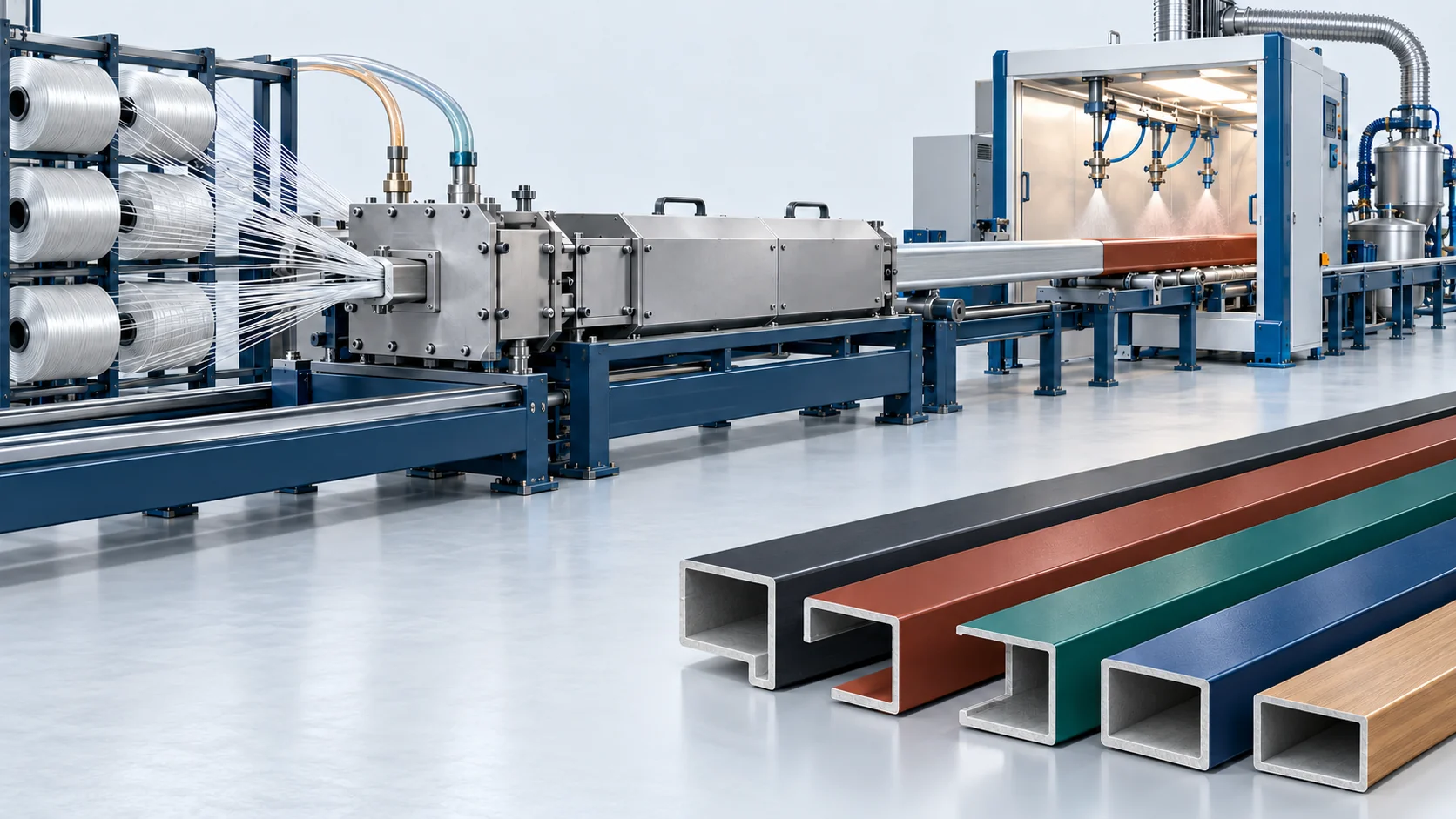
Colored BIPV Composite Solar Frame Molding Solution
Coordinate polyurethane glass-fiber pultrusion with a separately metered polyaspartic surface-coating stage for colored architectural solar framing profiles.
Architectural Aesthetics & Long-Term Weatherability for BIPV Frames
Coordinate polyurethane glass-fiber pultrusion with a separately metered polyaspartic surface-coating stage for colored architectural solar framing profiles. The scope combines structural-resin supply, high-pressure mixing and a closed injection-box interface with surface-coating metering and colorant controls. Pulling, die heating, cooling and cutting are coordinated interfaces. Chemistry, substrate preparation, coating cure and architectural approval are validated separately. Concept illustration: generated process visualization, not a photograph of delivered equipment, a customer facility or a completed project.
Product, material and tooling
The scope combines structural-resin supply, high-pressure mixing and a closed injection-box interface with surface-coating metering and colorant controls. Pulling, die heating, cooling and cutting are coordinated interfaces. Chemistry, substrate preparation, coating cure and architectural approval are validated separately.
Capacity and acceptance
Structural-resin supply and reactive surface-coating application have separately specified die and cure requirements. Profile color stability is not independently certified by a solar-module qualification reference. Fiber fraction is specified with its weight/volume measurement basis.
Structural-resin supply and reactive surface-coating application have separately specified die and cure requirements. Profile color stability is not independently certified by a solar-module qualification reference. Fiber fraction is specified with its weight/volume measurement basis.
Continuous In-Line Co-Extrusion Pultrusion Process
The sequence describes the supplied configuration. Final settings, cycle boundaries and acceptance are defined for the selected material and tooling. Structural-resin supply and reactive surface-coating application have separately specified die and cure requirements. Profile color stability is not independently certified by a solar-module qualification reference. Fiber fraction is specified with its weight/volume measurement basis.
Roving Guidance & Structural Preforming
Configured reference: Continuous high-modulus E-glass roving bundles (80% volume) are guided through preform plates into the closed injection die entry.
High-Pressure Structural Direct Injection
Configured reference: The primary metering unit injects fast-curing polyurethane at 12 MPa, thoroughly saturating fiber bundles under 1.5 MPa die backpressure.
Multi-Colorant Servo Micro-Metering
Configured reference: Inorganic color paste is metered into aliphatic polyaspartic resin via dedicated servo gear pumps to maintain precise architectural color match.
Reference Solution Engineering Envelope
Values transcribed from the supplied configuration brief. Material properties and finished-product benchmarks are separate validation targets, not general equipment guarantees.
| Parameter | Value / Unit | Applicable Configuration / Conditions |
|---|---|---|
| Structural Injection Output | 0.8 to 8.0 kg/min | Primary servo-hydraulic axial piston proportioning skid; supplied reference requiring configuration or test verification |
| Co-Extrusion Coating Output | 0.1 to 1.2 kg/min | High-precision secondary polyaspartic dosing unit; supplied reference requiring configuration or test verification |
| Protective Skin Thickness | 50 µm ± 5 µm | Precision slotted co-extrusion die block at main tool exit; supplied reference requiring configuration or test verification |
| Accelerated UV Aging Stability | Δ E < 1.0 (CIE Lab) | Supplied 120 kWh/m² Xenon/UV exposure reference; dose and color-measurement conditions apply to the profile/coating test, not an independent module qualification |
| Surface Pencil Scratch Hardness | Greater than or equal to 4H | ASTM D3363 testing on fully crosslinked skin; supplied reference requiring configuration or test verification |
| Continuous Pultrusion Speed | 0.8 to 1.5 m/min | Synchronized caterpillar haul-off and flying cut; supplied reference requiring configuration or test verification |
Core Equipment for This Solution
The linked pages describe shared preparation or feed-system families, not proof of delivery of the dedicated models listed in the case. The scope combines structural-resin supply, high-pressure mixing and a closed injection-box interface with surface-coating metering and colorant controls. Pulling, die heating, cooling and cutting are coordinated interfaces. Chemistry, substrate preparation, coating cure and architectural approval are validated separately.
Core Advantages of Haifeng BIPV Frame Systems
Engineering functions and interfaces developed for the specified product and material system.
Structural Injection Pultrusion
Configure and validate structural injection pultrusion for the selected product, formulation, tooling and production conditions.
Separate Surface-Coating Feed
Configure and validate separate surface-coating feed for the selected product, formulation, tooling and production conditions.
Colorant Metering
Configure and validate colorant metering for the selected product, formulation, tooling and production conditions.
Coating Cure Coordination
Configure and validate coating cure coordination for the selected product, formulation, tooling and production conditions.
Related Project Draft
The related BIPV frame brief describes its own structural-resin, surface-coating, exposure and cost-comparison conditions.
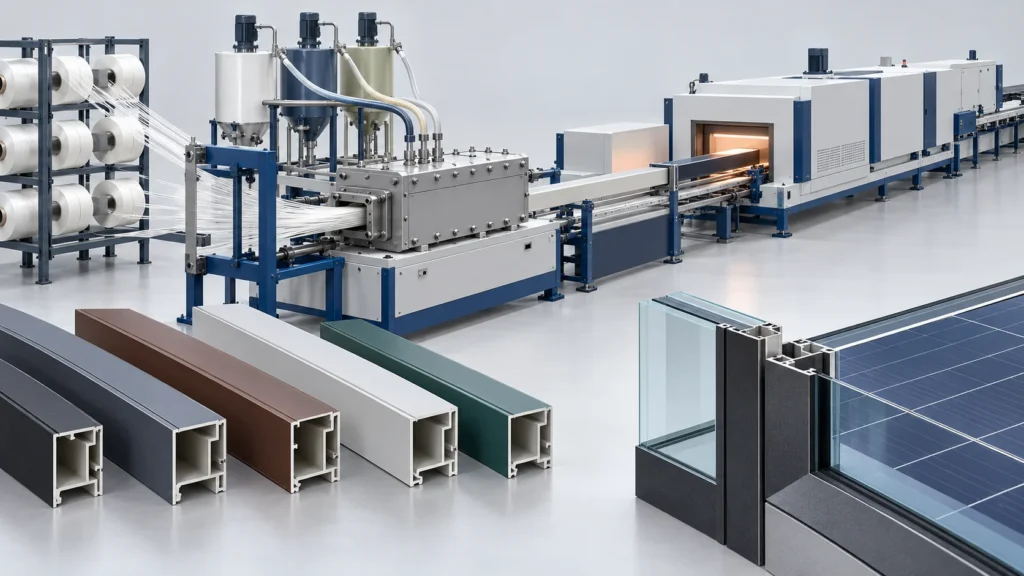
Frequently Asked Questions
Technical questions to establish the equipment scope, material window and validation plan.
How is coating adhesion and weathering verified?
Can different surface textures be developed?
How are color-change time and scrap estimated?
How should pencil-hardness results be interpreted?
Request a BIPV Colored Frame Solution Proposal
Share your finished product or drawing, material system, target capacity, automation requirements and factory conditions to discuss the line configuration.


