
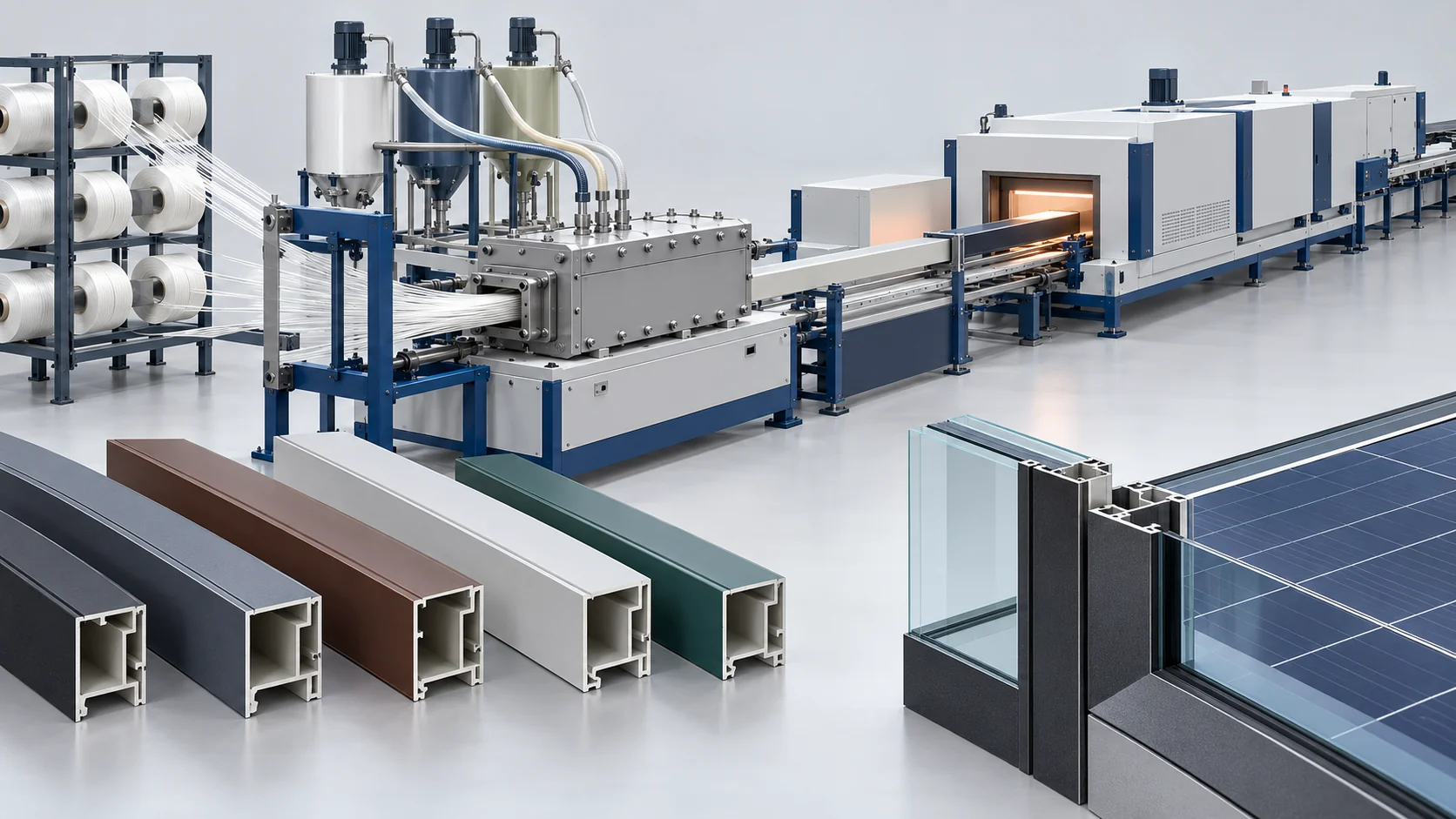
BIPV Composite Solar Frame Line Project in China
Equipment configuration and application-specific outcomes reported in the supplied brief for BIPV Composite Solar Frame Line. Banner: generated concept illustration, not a photograph of a delivered project.
Project Overview
Illustration notice. Process illustrations are not verified photographs of this installation.
Project reference basis. Figures and configuration details are reported in the supplied project brief. They are reference values for the stated application, rather than verified acceptance results or a guarantee for another installation. Confirm the source records, material, tooling, operating schedule and test method when assessing a comparable project.
Project configuration and outcomes described in the supplied project brief.
The supplied brief describes the following project context.
A leading integrated renewable energy module manufacturer in Sichuan partnered with Haifeng to upgrade its composite framing infrastructure for shingled BIPV (Building-Integrated Photovoltaics) solar modules. The project was commissioned to supply high-strength, architecturally colored composite frames matching regional building facade codes without secondary spray painting.
Previously, the client outsourced pultruded profiles for manual offline sanding and liquid fluorocarbon painting. This secondary chain added over 20% to profile processing expenses, created volatile organic compound (VOC) compliance liabilities, and suffered from transport chipping. Worse, accelerated climatic aging revealed severe color fading (Δ E > 3.5) after just 24 months of outdoor exposure, threatening major municipal facade contracts.
Haifeng deployed an in-line co-extrusion framing line centered on the HF-PVI50-UV platform. By integrating mold-exit liquid aspartic topcoating with continuous polyurethane fiberglass pultrusion, the line produced monolithic terracotta-colored profiles with a 50 µm bonded protective skin, with the supplied brief reporting Δ E < 1.0 for its exposure/color-measurement conditions and a 22% per-meter cost comparison. These profile results do not independently establish solar-module qualification.
Concept illustration: Generated process visualization, not a photograph of delivered equipment, a customer facility or a completed project.
Solutions Delivery
Reported equipment configuration from the supplied brief:
Haifeng engineered and commissioned an in-line dual-resin pultrusion cell that integrates core composite forming with architectural surface finishing. Structural E-glass roving bundles (4800tex) receive fast-curing polyurethane through a 12.0 MPa metering/mixing circuit and a separately controlled closed injection box before advancing through multi-zone steel heating dies (160°C).
Mounted directly to the exit face of the pultrusion tool is a secondary co-extrusion die block. As the fully cured, hot composite profile emerges, the HF-PVI50-UV co-extrusion metering unit delivers aliphatic polyaspartic resin blended with inorganic terracotta red colorant at 14.0 MPa.
The liquid aspartic mixture wraps the 150°C profile in a 50 µm continuous veil, chemically fusing with residual reactive sites on the polyurethane matrix before entering a 1.5-meter non-contact air-chilling tunnel. Reciprocating pullers grip the scratch-resistant profile (4H hardness) at 1.2 m/min, advancing it to high-precision flying saws. The entire offline spray paint shop was completely decommissioned, replacing the specified offline paint-baking and solvent-handling operations. Site emissions remain formulation- and control-dependent.
| Equipment | Model | Qty | Function |
|---|---|---|---|
| In-Line Aspartic Co-Extrusion Pultrusion Unit | HF-PVI50-UV | 2 sets | Core structural pultrusion injection and in-line polyaspartic co-extrusion. |
| Die-Mounted Precision Co-Extrusion Block | HF-CEB-35 | 2 units | Precision slotted manifold applying 50 µm uniform skin at tool exit. |
| Multi-Channel Servo Colorant Station | HF-SCS-04 | 2 units | Continuous micro-metering of architectural color pigments at ±0.1% accuracy. |
| Non-Contact Profile Air-Chilling Tunnel | HF-ACT-15 | 2 sets | Rapid convective cooling consolidating 4H surface hardness prior to pulling. |
Reported Results — Records Pending Verification
Scale Your Architectural BIPV Frame Manufacturing
Share your finished product, material, target capacity, automation needs and factory conditions to discuss the proposed production line.


