
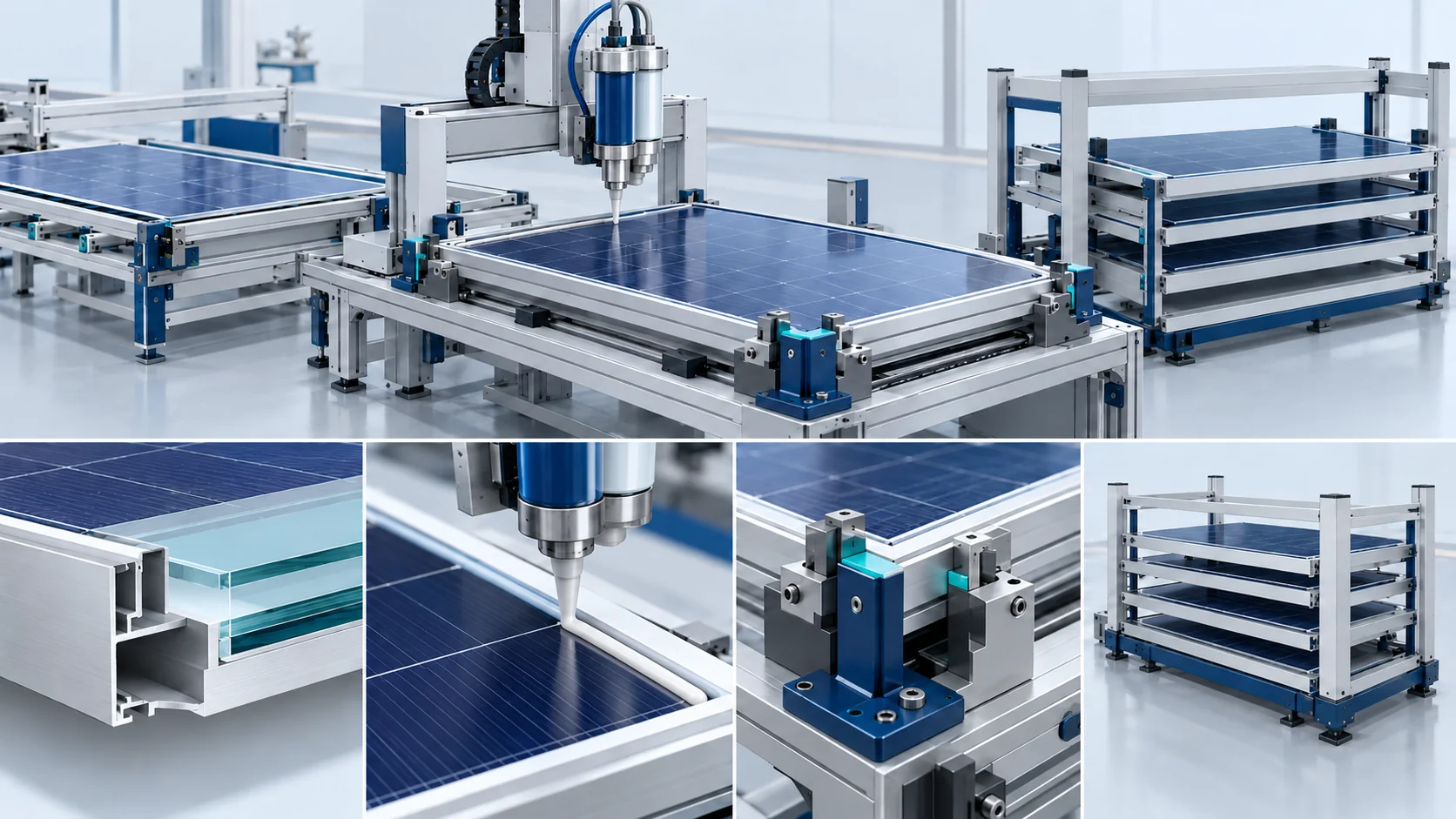
HJT Module Frame Structural Grouting Solution
Coordinate four-edge solar module frame positioning, two-component adhesive dispensing, corner assembly and a separately verified green-cure handling stage.
Buffer-Free Fast Structural Framing for Large-Format Dual-Glass Modules
Coordinate four-edge solar module frame positioning, two-component adhesive dispensing, corner assembly and a separately verified green-cure handling stage. The described scope includes frame positioning and pressing, proportioning, multi-head dispensing and conveyor interfaces. Adhesive, extrusions, glass, handling fixtures and cure residence are confirmed for the module. This assembles existing frames; it is distinct from manufacturing composite profiles.
Product, material and tooling
The described scope includes frame positioning and pressing, proportioning, multi-head dispensing and conveyor interfaces. Adhesive, extrusions, glass, handling fixtures and cure residence are confirmed for the module. This assembles existing frames; it is distinct from manufacturing composite profiles.
Capacity and acceptance
Review all preparation, dispensing, curing, handling and inspection stages. Material and component results require separate original test records.
Configuration references are reviewed for the selected material, product geometry and acceptance conditions. A 25-second framing cycle precedes the stated 180-second green-cure handling threshold; protected parallel residence or fixtures are needed rather than immediate unrestricted palletizing. At least eight 25-second positions are required to cover 180 seconds before downtime allowances. Weight and volume 1:1 ratios cannot be equated without density data. ASTM D1002 covers metal-to-metal specimens and does not directly establish glass-to-aluminum joint performance. The stated 100,000 modules in 15 days of two 8-hour shifts also needs reconciliation: two cells at 23.8 seconds each can produce at most about 72,605 modules in that period before downtime.
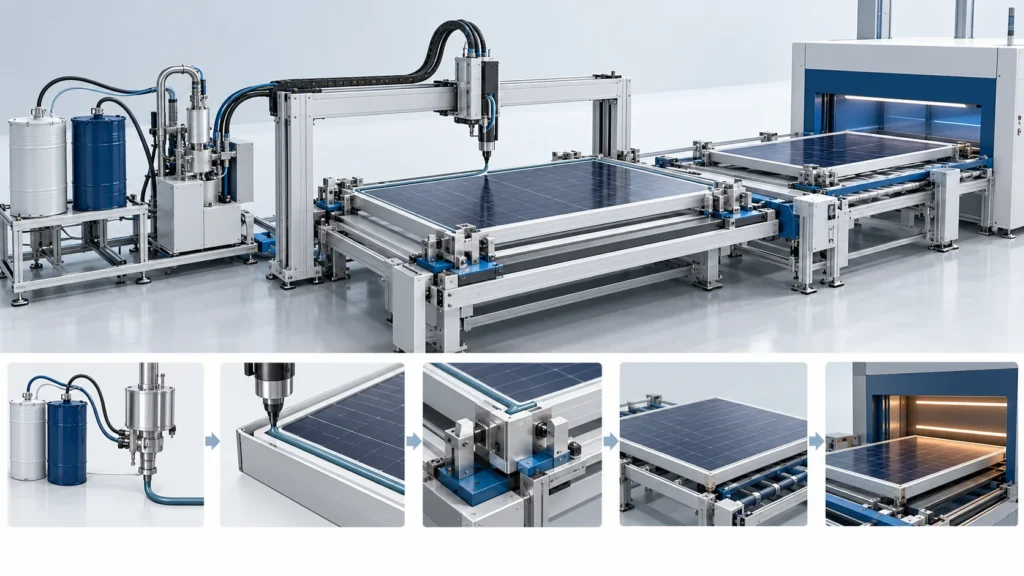
Turnkey Automated Dual-Glass Framing Workflow
The supplied process sequence is a configuration reference. Temperature, pressure, output and cure settings are confirmed for the selected material and tooling. A 25-second framing cycle precedes the stated 180-second green-cure handling threshold; protected parallel residence or fixtures are needed rather than immediate unrestricted palletizing. At least eight 25-second positions are required to cover 180 seconds before downtime allowances. Weight and volume 1:1 ratios cannot be equated without density data. ASTM D1002 covers metal-to-metal specimens and does not directly establish glass-to-aluminum joint performance. The stated 100,000 modules in 15 days of two 8-hour shifts also needs reconciliation: two cells at 23.8 seconds each can produce at most about 72,605 modules in that period before downtime.
Dual-Glass Infeed & Automatic Centering
Configured reference: Laminated G12 dual-glass panels transfer via motor rollers into the machine bed, centered within ±0.5 mm by pneumatic aligning pushers.
4-Corner Synchronous Hydraulic Pressing
Configured reference: Four servo-hydraulic cylinders drive corner keys into frame extrusions under 50 kN force, squaring the frame around glass edges.
Closed-Loop Two-Component High-Pressure Metering
Configured reference: Servo gear pumps displace structural polyol and modified isocyanate at 9.0 MPa under Coriolis mass flow measurement within ±0.2% accuracy.
Reference Solution Engineering Envelope
Values transcribed from the supplied configuration brief. Material properties and finished-product benchmarks are separate validation targets, not general equipment guarantees.
| Parameter | Value / Unit | Applicable Configuration / Conditions |
|---|---|---|
| Single-Module Framing Tact Time | Less than or equal to 25 seconds | Synchronous 4-corner pressing and 4-head cavity grouting; supplied reference requiring configuration or test verification |
| Handling Green Cure Duration | Less than or equal to 180 seconds | Room-temperature chemical crosslinking (25°C ambient); supplied reference requiring configuration or test verification |
| Combined Chemical Injection Rate | 15.0 to 60.0 g/s | Four independent servo-controlled dynamic mixing channels; supplied reference requiring configuration or test verification |
| Cured Matrix Lap Shear Strength | Greater than 12.0 MPa | Material/joint target; appropriate substrate-specific test needed. ASTM D1002 metal-to-metal specimens do not directly establish aluminum-to-glass bond performance. |
| Module Mechanical Wind/Snow Load | Up to 8,500 Pa static load | reported under IEC 61215-2 mechanical load sequence; supplied reference requiring configuration or test verification |
| Factory Floor Space Savings | Up to 1,500 m² saved | Elimination of multi-tier 4-hour silicone curing buffers; supplied reference requiring configuration or test verification |
Core Advantages of Haifeng HJT Framing Systems
Engineering functions and interfaces developed for the specified product and material system.
Four-Edge Frame Positioning
Configure and validate four-edge frame positioning for the selected product, formulation, tooling and production conditions.
Two-Component Adhesive Feed
Configure and validate two-component adhesive feed for the selected product, formulation, tooling and production conditions.
Balanced Multi-Head Dispensing
Configure and validate balanced multi-head dispensing for the selected product, formulation, tooling and production conditions.
Separate Green-Cure Residence
Configure and validate separate green-cure residence for the selected product, formulation, tooling and production conditions.
Related Project Draft
Review the project configuration described in the supplied brief. Project records and reported results require verification before public use.
Frequently Asked Questions
Technical questions to establish the equipment scope, material window and validation plan.
How does green strength differ from final adhesive cure?
Can different frame substrates be considered?
How is delivery balanced across four heads?
How are interruption and purge limits configured?
Request an HJT Module Structural Framing Proposal
Share your finished product or drawing, material system, target capacity, automation requirements and factory conditions to discuss the line configuration.


