

Perovskite Solar Frame Molding Solution
Configure low-stress perimeter dispensing for thin-glass or flexible perovskite modules with vision alignment, micro-metering and controlled material curing.
Low-Stress Edge Protection for Fragile Thin-Film Photovoltaics
Configure low-stress perimeter dispensing for thin-glass or flexible perovskite modules with vision alignment, micro-metering and controlled material curing. Core scope includes sealed feed conditioning, micro-metering and mixing, configured gantry motion, vision alignment and support tooling. Resin and barrier-film compatibility, cleanroom qualification, moisture protection and finished-module reliability are separate validation tasks.
Product, material and tooling
Core scope includes sealed feed conditioning, micro-metering and mixing, configured gantry motion, vision alignment and support tooling. Resin and barrier-film compatibility, cleanroom qualification, moisture protection and finished-module reliability are separate validation tasks.
Capacity and acceptance
Review all preparation, dispensing, curing, handling and inspection stages. Material and component results require separate original test records.
Configuration references are reviewed for the selected material, product geometry and acceptance conditions. A 0.048% failure rate from exactly 10,000 modules implies 4.8 failures and cannot be an exact simple count ratio; reconcile denominator and rounding. WVTR needs specimen thickness, temperature and humidity. Neither low exotherm nor polyurethane alone establishes module moisture protection.
Turnkey Perovskite Micro-Framing Process
The supplied process sequence is a configuration reference. Temperature, pressure, output and cure settings are confirmed for the selected material and tooling. A 0.048% failure rate from exactly 10,000 modules implies 4.8 failures and cannot be an exact simple count ratio; reconcile denominator and rounding. WVTR needs specimen thickness, temperature and humidity. Neither low exotherm nor polyurethane alone establishes module moisture protection.
Cleanroom Air-Float Infeed & Vision Alignment
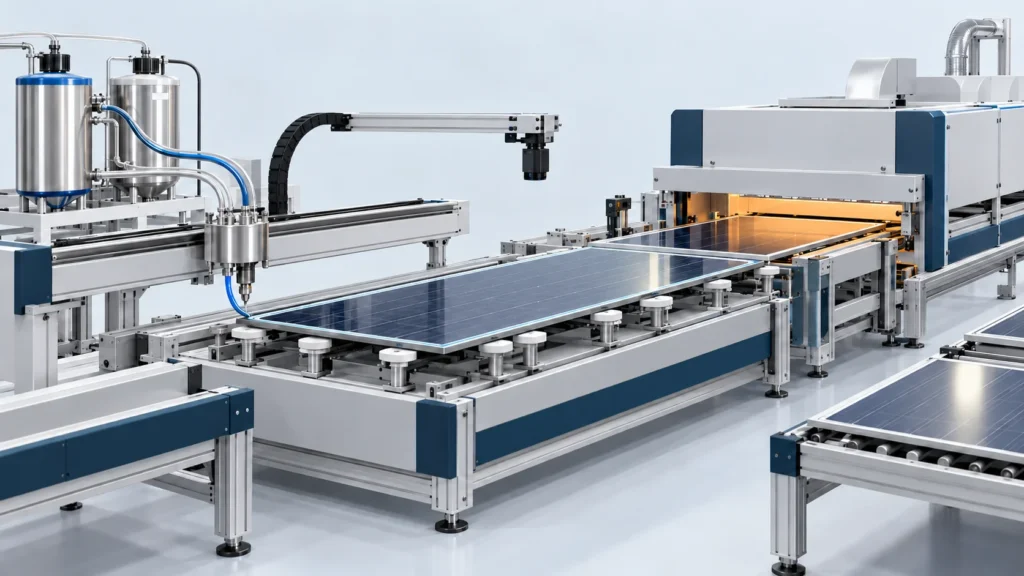
Configured reference: Thin-glass modules transfer onto an air-cushion table where CCD cameras map 4-corner coordinates to compensate for placement offsets.
Sealed Micro-Degassing & Servo Metering
Configured reference: Polyol and crosslinker are conditioned under 0.05 kPa vacuum in 30 L tanks and metered by micro-gear pumps with ±0.3% ratio accuracy.
Micro-Volume Dynamic Mixing & Snuffer Shutoff
Configured reference: Chemicals blend inside a miniature dynamic rotor head, with pneumatic snuffer needles providing sharp, string-free cutoffs at corners.
Reference Solution Engineering Envelope
Values transcribed from the supplied configuration brief. Material properties and finished-product benchmarks are separate validation targets, not general equipment guarantees.
| Parameter | Value / Unit | Applicable Configuration / Conditions |
|---|---|---|
| Dispensing Flow Output | 0.5 to 5.0 g/s | Continuous variable servo micro-gear pump skid; supplied reference requiring configuration or test verification |
| Gantry Motion Repeatability | Within ±0.02 mm | 4-Axis high-speed servo Cartesian robot; supplied reference requiring configuration or test verification |
| Chemical Reaction Peak Exotherm | Less than 80°C | Formulated low-exotherm polyurethane sealant; supplied reference requiring configuration or test verification |
| Moisture Barrier Level (WVTR) | Less than 0.1 g/(m²·24h) | MOCON test on cured elastomeric barrier; supplied reference requiring configuration or test verification |
| Module Breakage Failure Rate | Less than 0.05% | Cushioning perimeter frame absorbing mechanical shocks; supplied reference requiring configuration or test verification |
| Weight Reduction vs Aluminum | 60% lighter frame weight | Ultra-thin polymer profile vs 30 mm metal frame; supplied reference requiring configuration or test verification |
Core Advantages of Haifeng Perovskite Framing
Engineering functions and interfaces developed for the specified product and material system.
Vision-Aligned Perimeters
Configure and validate vision-aligned perimeters for the selected product, formulation, tooling and production conditions.
Micro-Flow Metering
Configure and validate micro-flow metering for the selected product, formulation, tooling and production conditions.
Low-Stress Support Tooling
Configure and validate low-stress support tooling for the selected product, formulation, tooling and production conditions.
Cure and Barrier Validation
Configure and validate cure and barrier validation for the selected product, formulation, tooling and production conditions.
Related Project Draft
Review the project configuration described in the supplied brief. Project records and reported results require verification before public use.
Frequently Asked Questions
Technical questions to establish the equipment scope, material window and validation plan.
How is frame design selected for thin-glass modules?
How is dispensing cutoff quality controlled?
What is required to qualify cleanroom compatibility?
How is dispensing on curved substrates assessed?
Request a Perovskite Solar Framing Proposal
Share your finished product or drawing, material system, target capacity, automation requirements and factory conditions to discuss the line configuration.


