
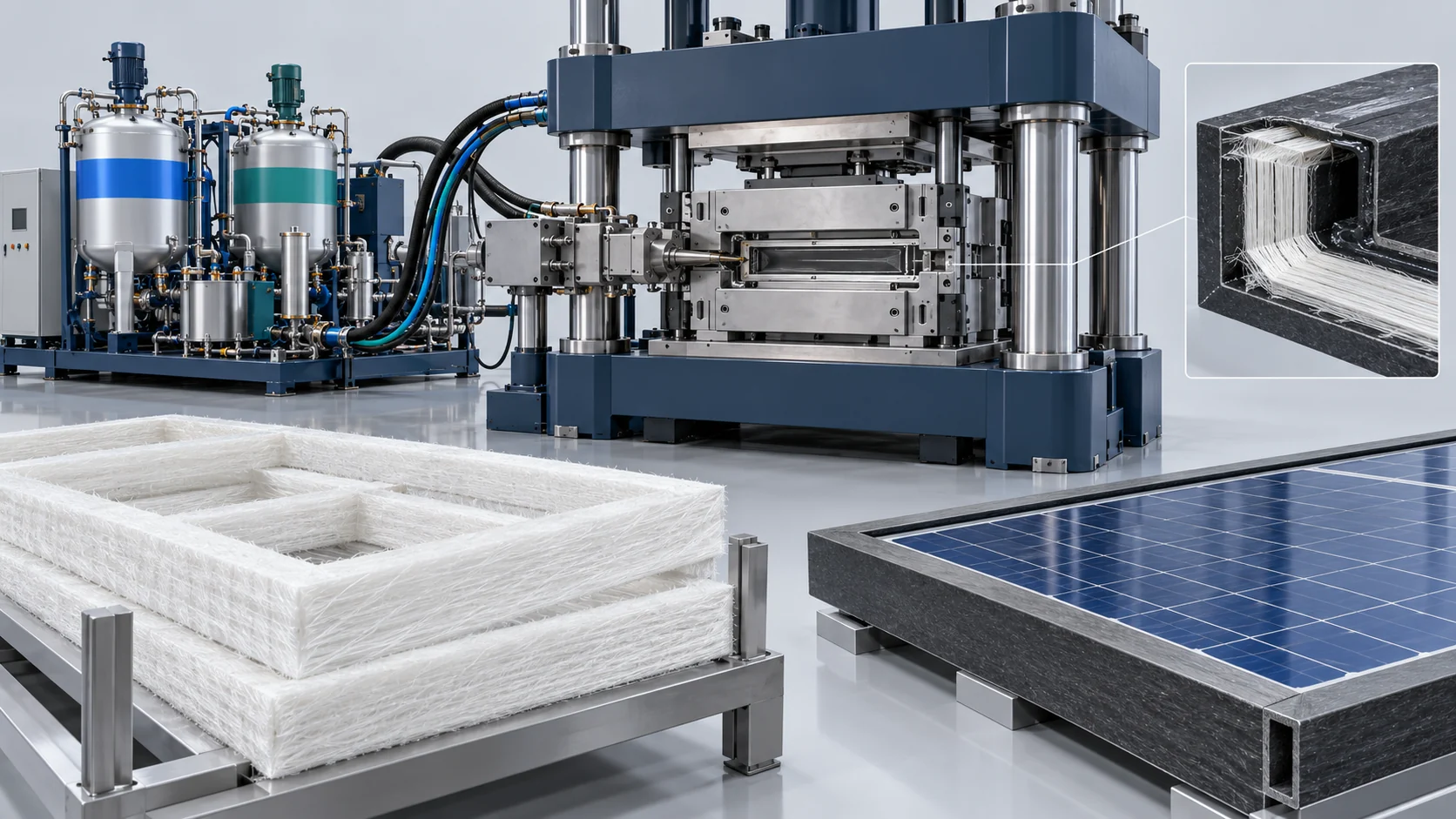
Glass-Fiber-Reinforced PV Frame Closed-Mold Injection Solution
Develop the specified high-glass-fiber impregnation and high-pressure closed-mold injection route for composite photovoltaic frames.
Build the Process Around Your Product
Develop the specified high-glass-fiber impregnation and high-pressure closed-mold injection route for composite photovoltaic frames.
Product and material first
Start with the finished-product drawing, material system and acceptance requirements. The process route and equipment configuration are assessed together.
Capacity across the whole process
Define output with preparation, forming/reaction, curing, handling and inspection included. The slowest stage and product changes determine practical line capacity.
Treat the closed-mold reinforced PV-frame route as a defined development and validation task. Identify reinforcement introduction, resin delivery and the frame/module connections; distinguish it from continuous pultrusion before assigning a machine.
From Preparation to Qualified Product
A planning sequence for the specified route. Final settings and acceptance conditions are established through material and part review.
Freeze frame and reinforcement design
Confirm cross-section, corner/joint strategy, resin chemistry and whether reinforcement enters as a preform or through a filled feed.
Validate impregnation
Evaluate viscosity, fiber architecture, permeability and resin flow using trial tooling; high fiber loading alone does not define a workable process.
Prepare material delivery
Specify conditioning, ratio control and mixing around the approved resin and reinforcement introduction method.
Information Needed to Configure the Line
Provide these inputs so the equipment range, interfaces and validation plan can be defined.
| Design input | Information required |
|---|---|
| Frame design | Dimensions, section, corners, mounting and module interface |
| Reinforcement | Glass fraction with mass/volume basis, form, sizing and orientation |
| Resin process | Chemistry, viscosity/temperature, reaction window and injection trial data |
| Validation plan | Fill study, void assessment, dimensional and module qualification tests |
Coordinate the Equipment With the Process
Evaluate repeatability, handling and acceptance across the full workflow.
Route definition
Separate discrete closed-mold frames from continuously pulled profiles.
Reinforcement evidence
State fiber form, orientation and mass/volume basis with actual wet-out trials.
Frame/module validation
Inspect the laminate, corners and mounts against the intended component tests.
Industry patent reference
The linked item is an industry patent reference, not a Haifeng customer installation or qualification report.
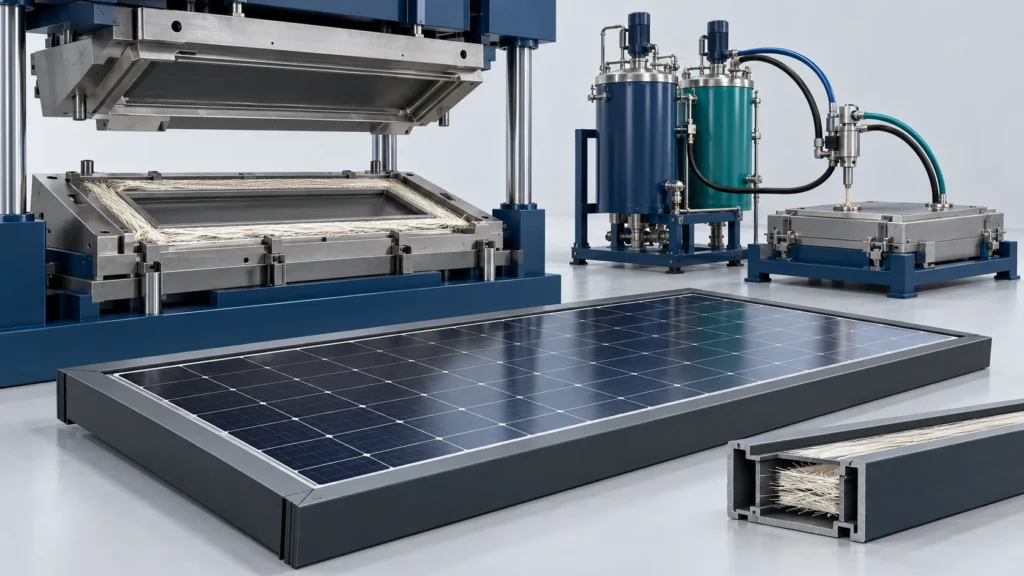
Frequently Asked Questions
Clarify the production route before selecting a machine.
Does a public PU frame patent validate this exact line?
What information is needed to size the production line?
What is included in the equipment package?
Are cycle time and finished-product performance fixed?
What evidence is needed beyond an industry patent?
Submit Your Production Goals
Share the following for this application: Frame/corner CAD, reinforcement form/sizing/content basis, resin data, fill concept, mounts and module tests. Our team will reply within one business day. Once requirements are clear, we provide a preliminary proposal within two business days.


