
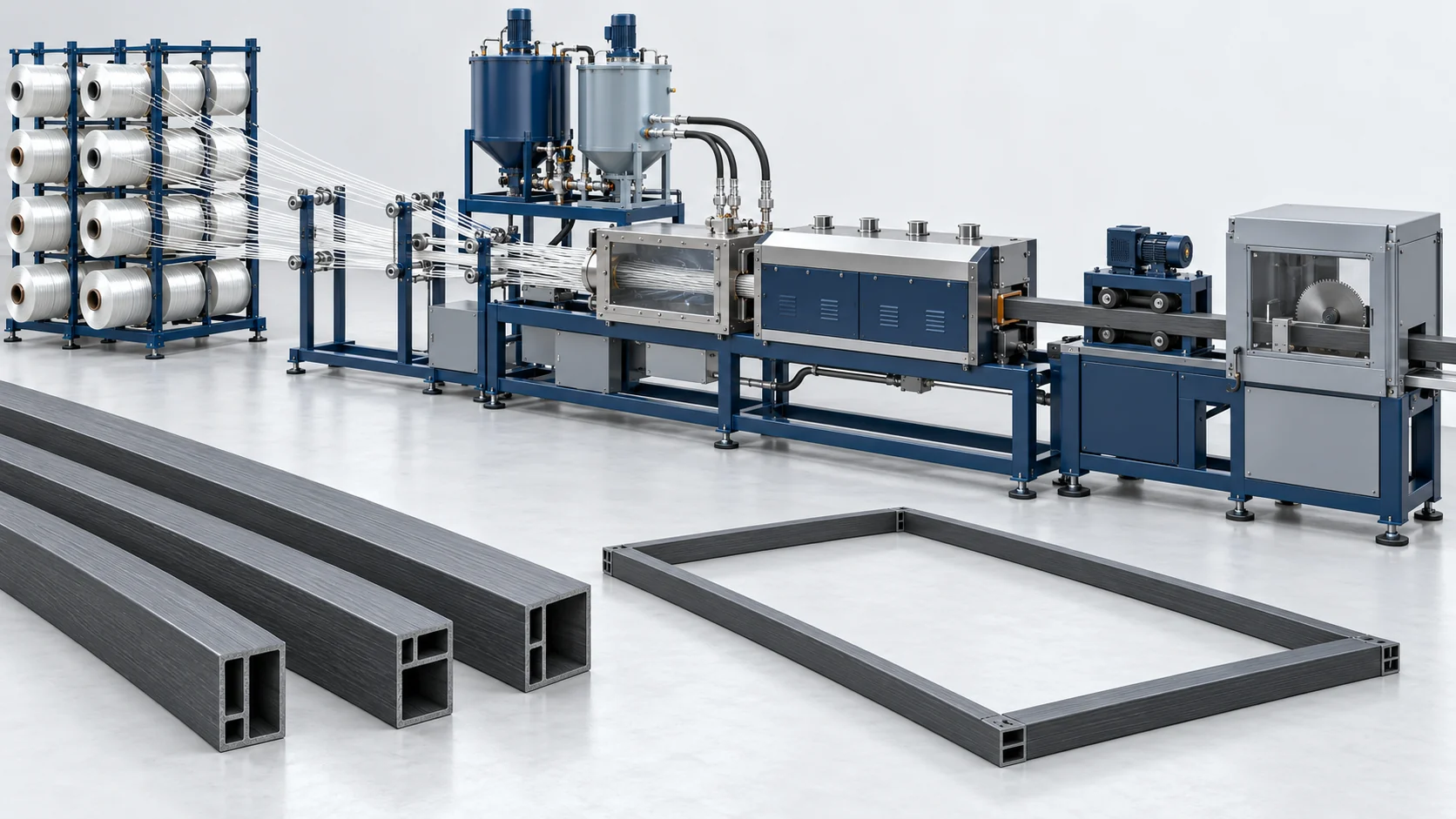
Composite PV Frame Direct Injection Solution
Continuous closed-die injection pultrusion with line-synchronized metering and separate injection-box pressure control.
Engineered Composite Framing for Next-Generation Solar Modules
Photovoltaic installations are rapidly expanding into high-humidity coastal zones, offshore floating arrays, and chemical-heavy industrial rooftops. Conventional aluminum frames face severe corrosion, electrical leakage (PID), and heavy carbon footprint penalties. Polyurethane fiberglass composite frames offer high structural stiffness, outstanding electrical insulation, and superior anti-corrosion properties. Haifeng’s Composite PV Frame Direct Injection Solution resolves the processing hurdles of fast-reacting polyurethanes through closed high-pressure die injection, dynamic speed tracking, and automated process stabilization.
High-Pressure Closed Impregnation
The supplied 10–15 MPa refers to metering/impingement, not injection-box cavity pressure. Closed-die feed supports controlled impregnation; the stated high fiber-volume reference and internal defects require defined measurements.
Dynamic Pull-Speed Slaving
Line-speed encoder signals adjust chemical feed during speed changes. Ratio and feed stability are assessed for the agreed line-speed and formulation window.
This package uses a closed injection box on a continuous pultrusion line. It is a separate process branch from matched-mold injection. Reported fiber volume fraction requires confirmation of the measurement basis and specimen conditions.
End-to-End Composite PV Frame Pultrusion Process
An automated, continuous engineering workflow from dry roving guidance to finished composite solar frame cutting.
Roving Guidance & In-Die Preforming
Continuous fiberglass roving bundles (4800tex) and structural surface mats are guided through ceramic preform plates into the sealed die entrance.
Sealed Thermal Conditioning & Blanketing
Polyol and isocyanate raw materials are heated to 35°C in jacketed stainless steel vessels under dry nitrogen blankets to prevent moisture-induced micro-foaming.
Closed-Loop Ratio-Lock Metering
High-precision servo axial piston pumps displace components through reinforced lines, with mass flow sensors tracking volume to keep stoichiometric ratio within ±0.3%.
Standard Engineering Parameters for Solar Pultrusion
Reference technical capability envelope for Haifeng turnkey composite PV frame injection packages.
| Parameter | Value / Unit | Applicable Configuration / Conditions |
|---|---|---|
| Resin Dosing Output | 0.8 to 8.0 kg/min (Custom up to 15 kg/min) | Servo-driven continuous high-pressure piston pumps |
| Mixing Pressure | 10.0 to 15.0 MPa | High-pressure impingement mixing without dynamic rotor |
| Stoichiometric Precision | Ratio tolerance within ±0.3% | Dynamic closed-loop encoder tracking across pull speeds |
| Pultrusion Line Speed Range | 0.5 to 1.5 m/min (Standard) | Matched to polyurethane resin gelation and die length |
| Supported Fiber Content | Up to 82% (Fiber volume fraction) | High-pressure closed injection box with roving pre-seal |
| Frame Profile Tensile Modulus | Greater than 45 GPa | ASTM D638 testing on cured glass/polyurethane matrix |
Core Equipment for This Solution
The package covers high-pressure metering and mixing, a closed injection box, line-synchronized feed control and controls for continuous pultrusion. Pulling, cutting and heating equipment are optional interfaces. Resin, fibers, nitrogen and site utilities are agreed external interfaces. This continuous route is distinct from the existing matched-mold injection solution.
Core Advantages of Haifeng PV Frame Solutions
Engineering features designed to solve voiding, line speed limitations, and workshop environmental compliance.
Line-Synchronized Metering
The feed-control interface follows the continuous pultrusion line speed and agreed ratio setpoints.
Closed Injection Box
A closed-die feed arrangement replaces the open resin bath; emissions and exposure controls remain material- and site-dependent.
Fiber Impregnation Control
Metering/mixing circuit pressure and injection-box pressure are controlled separately. Fiber fraction and void content require defined measurements.
Head Shutoff and Cleaning
The specified head shutoff reduces retained mixed resin; the cleaning sequence is established for the selected formulation.
Related Project Draft
Related pultrusion project briefs describe their own resin, reinforcement, tooling and process window; their component results are distinct from equipment ratings.
Frequently Asked Questions
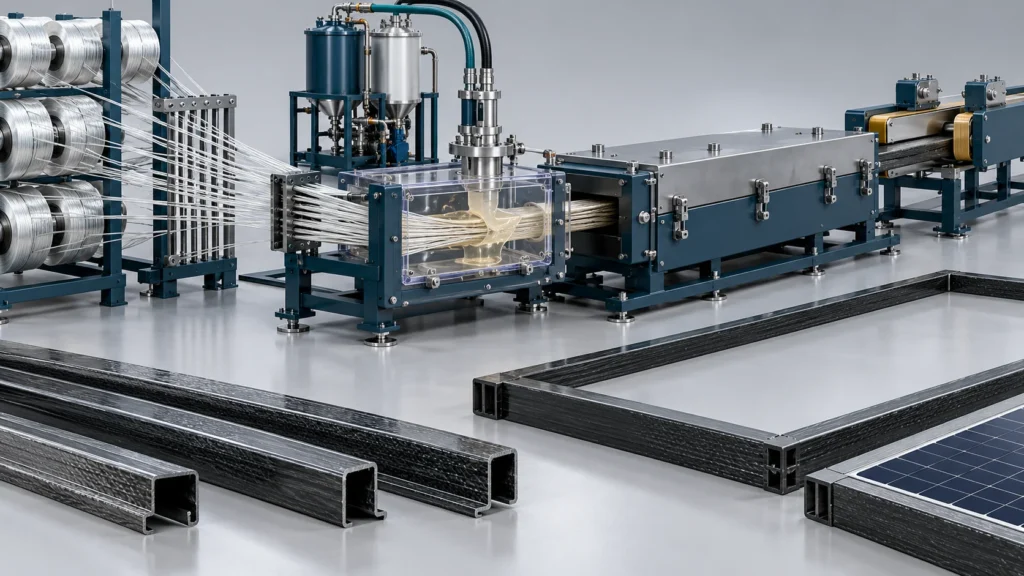
Find answers about Composite PV Frame Direct Injection Solution, including material selection, equipment configuration and the information needed to plan a production line.
How does closed direct injection control impregnation?
Can the system automatically synchronize with different pultruder brands?
What prevents moisture contamination of the isocyanate raw material?
How does composite frame pultrusion compare to aluminum extrusion economics?
Request a Composite Solar Frame Equipment Proposal
Submit your profile dimensions, line speed targets, and resin specifications to receive a direct injection proposal.


