Long-stator encapsulation turns a segmented linear-motor stator into a sealed, dimensionally stable assembly. It works only when two parts of the production cell are specified together: the metering system that fills a long, narrow cavity and the fixture that holds the lamination stack, windings, and connection details in position during gel and cure. A buying decision built around pour rate alone usually misses at least one of those requirements.
For the wider production route and equipment interfaces, explore our rail transportation PU component systems.
What Long-Stator Encapsulation Asks of the Casting Process
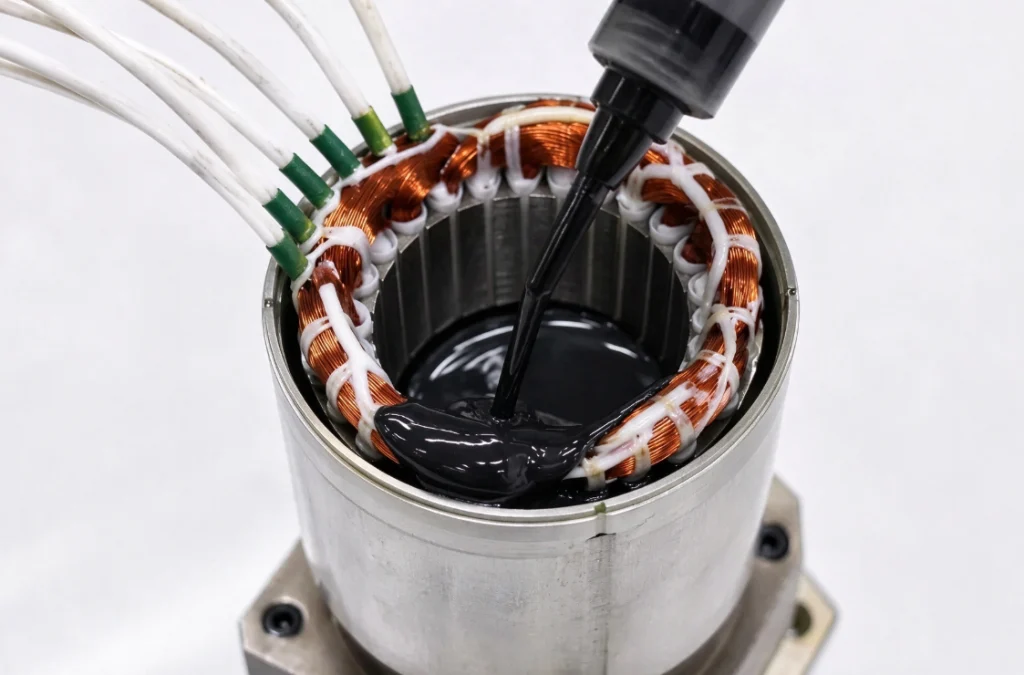
A long stator is not a simple block mold. The cavity is long relative to its cross-section, and the polyurethane must move through slots, around conductors, and across insulation surfaces before it reaches the far end. That makes encapsulation a wet-out problem as much as a filling problem.
For the long cavity, material delivery and fixture interfaces, review the long-stator encapsulation solution.
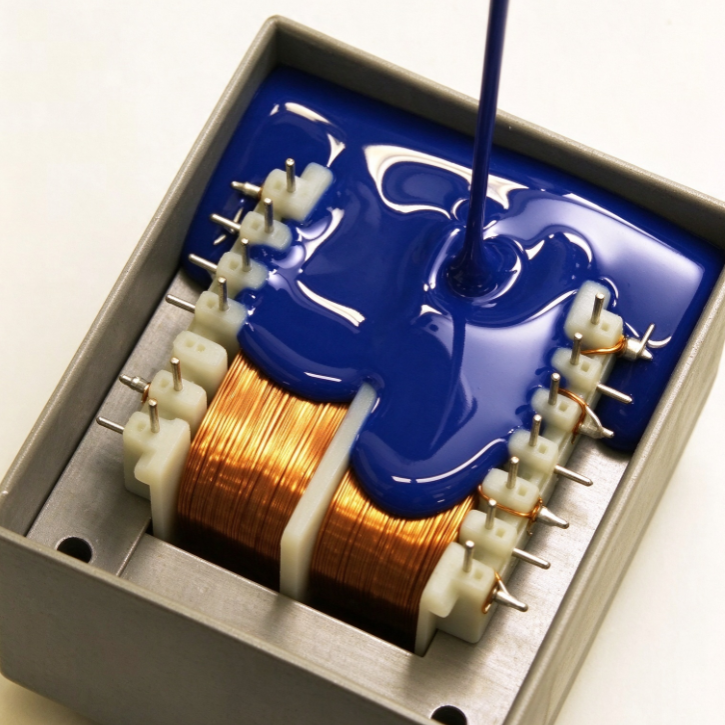
The encapsulant usually works in three ways at once. It seals the winding against moisture and contamination, it provides mechanical support for conductors and lead exits, and it creates a stable outer envelope for mounting or alignment. If the resin gels before it has wet the slot bottom, the part may look filled on the outside and still contain voids beside the copper.
This means the process has to be specified from the cavity geometry, not from a generic casting machine rating. The fill length, slot depth, venting path, and the position of the stator inside the mold all affect whether the shot can be delivered without trapping air or creating a density gradient.
Metering Requirements for Long and Variable Shot Lengths
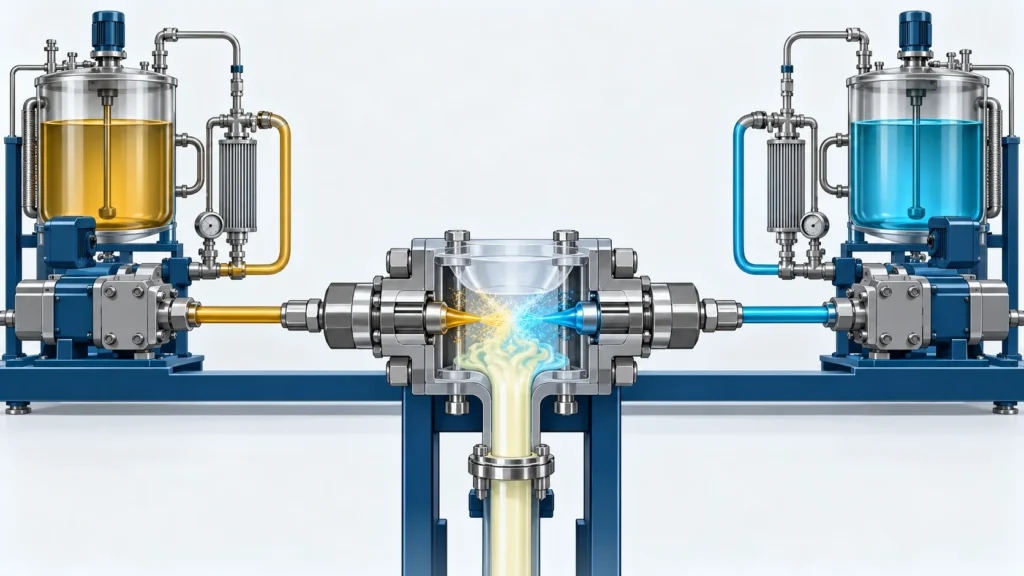
The metering unit has to do two things that a standard small-shot caster may not handle well. First, it must hold the A/B ratio and shot size stable across a long fill. Second, it must repeat that stability when the segment length changes from one product to another.
A small ratio drift can produce soft zones, uneven cure, or different shrinkage along the part. The defect is often invisible until the stator is cut open or tested. For that reason, metering should be controlled by closed-loop feedback where possible, not by assuming that a fixed pump speed equals a fixed output.
Shot size is also more important than the nominal cavity volume suggests. The calculation must include the runner, riser, gate residue, and any retained material in the mix head or feed line. A short shot leaves the far end unfilled. An overpack can lift the stator, distort thin insulation, or force material into areas that should remain open.
Shot weight is not a guess from segment length. <How To Calculate Shot Weight In Polyurethane> covers the inputs that produce a reliable fill weight.
For a long stator, the metering unit should also be checked at the shortest and longest planned shot sizes, not only at a nominal mid-range output. A machine can hold its ratio at one pour rate and drift when the shot becomes very small or very long. If the product family spans several segment lengths, the trial plan should include those extremes.
Mixing, Degassing, and Fill Path Control
Good metering does not help if air is mixed into the material or trapped in the cavity. Air entrained in either component tends to collect against the winding insulation and stay there through cure. Vacuum degassing of the resin and curative before metering is normally required, and the feed lines should be arranged to avoid re-introducing air after the degassing step.
The fill path matters as much as the mixer. A long cavity should normally be filled from a low point or through a series of gates that push air toward a vent at the far end. If the mold is filled from one end only, the resin front can close over a pocket before the air escapes.
For filled or high-viscosity systems, the mixing head and nozzle need enough shear to homogenize the stream without creating a pressure spike at the gate. The gate size and position should be matched to the shot rate so the material enters evenly instead of jetting into the cavity and splashing the windings.
Fixture Design for Holding the Stator Without Locking Stress
The fixture is the part of the cell that most often determines whether a good casting becomes a bad stator. It must hold the lamination stack and windings in the correct position, seal the ends, and allow the resin to cure without building stress into the assembly.
Clamping force should be applied away from bare copper and thin insulation. If the fixture presses on the active face or on lead wires, it can create a dielectric weakness that only appears later. Support points should also be close enough to prevent sag across the cavity length, especially when the mold is heated.
| Fixture requirement | Failure it prevents |
|---|---|
| Supports at short enough centers | Bow or sag across the cavity length |
| End seals and vent geometry at the far end | Short fill and trapped air |
| Clamping away from bare copper and leads | Conductor or insulation damage |
| Locating from the mounting face | Envelope shift that changes alignment |
| Controlled mold temperature | Early skin cure that blocks wet-out |
| Parting line away from the active face | Demolding damage on a critical surface |
The fixture should also allow thermal movement without forcing the stator to fight the mold. If the stator and mold expand at different rates, the result can be a bowed part or residual stress that releases after demolding.
Dimensional and Cure Control Across the Stator Length
Cure is where metering and fixture decisions become final dimensions. A long encapsulation can move after demolding when gel and shrinkage are not uniform from one end of the cavity to the other. The mold temperature should be consistent along the fill length, and demolding should occur only after the part has developed enough strength to hold its shape.
Post-cure may need to happen while the stator remains supported, especially for harder encapsulant grades or long thin sections. If the part is removed too early and laid on a flat surface, it can take a set that no later machining can fully correct.
The same cast-to-cure discipline applies to a long encapsulation. <How Polyurethane Rollers Are Made From Casting To Cure> covers the casting and cure sequence used for this class of polyurethane parts.
Record the shot weight, ratio, material temperature, mold temperature, and demold time for each segment. A dimensional issue on a long stator is much easier to diagnose when the process history shows whether the problem came from the mix, the fill, or the cure.
Trial and Acceptance Checks Before Release
Before committing to production, run the trial on the shortest and longest stator segments in the planned range. A single trial on a medium-length part can hide both the small-shot metering problem and the long-fill venting problem.
Cut open first-article parts and inspect the slot bottoms, conductor-to-core interfaces, and lead exits. Surface appearance alone is not enough. The cross-section should show full wet-out at the deepest point of the cavity and no porosity concentrated around the windings.
Measure the finished envelope before and after post-cure, then again after the part has cooled free on a surface plate. Compare those dimensions to the fixture position. If the part moves significantly after post-cure, the cure schedule or the support arrangement needs correction before production begins.
Planning Your Long-Stator Encapsulation Cell
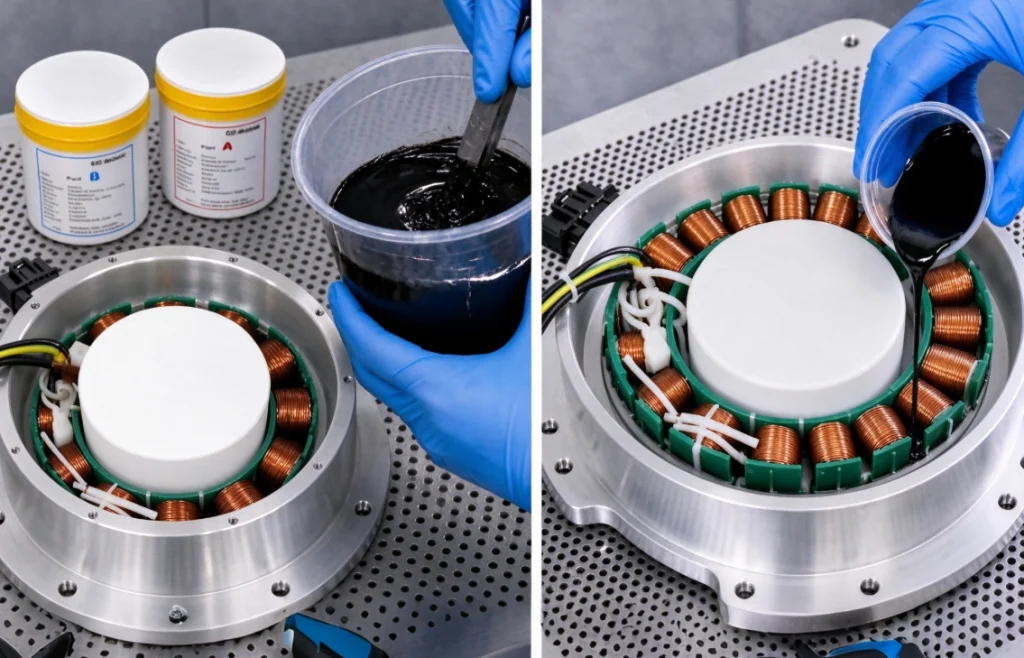
Send the stator drawing, the shortest and longest segment dimensions, the slot depth, the encapsulant system, and the target cycle time. Include the lead exit and mounting face details, because those control the fixture design. With that information, Haifeng Polyurethane Machinery can help define the metering range, shot-size limits, degassing arrangement, fixture clamping plan, and first-article trial matrix for the cell.
Contact email: Info@chinahaifeng.com
WhatsApp: 86 13566296633
FAQ
Does long-stator encapsulation require high-pressure or low-pressure metering?
It depends on the material viscosity, filler content, shot size, and whether the system is solid or microcellular. High-pressure impingement mixing is often preferred for fast, repeatable fills with difficult wet-out, while low-pressure continuous mixing can be suitable for slower gel systems or smaller shots. The decision should follow the resin system and the cavity geometry, not the machine type alone.
How do we stop air entrapment in a long narrow cavity?
Use vacuum degassing before the material reaches the mix head, fill from a low point or through a gated sequence, and design a vent at the far end of the cavity. The mold temperature should also be controlled so the resin does not skin over before the air has moved out. First-article cross-sections are the most reliable confirmation.
Should the stator stay in the fixture during post-cure?
Usually yes for long or thin sections, especially with harder encapsulant grades. Keeping the part supported during post-cure prevents bow and lets shrinkage proceed in a controlled position. The exact demold point depends on the resin system and the part stiffness at temperature.
What shot-size margin should we plan for long segments?
Plan from the filled cavity, runner, riser, gate residue, and any retained material in the feed path, then add a small trial margin for mix-head loss. The more useful check is to verify the formula on both the shortest and longest segments rather than applying one percentage across all lengths.
If you’re interested, check out these related articles:
Measuring Polyurethane Foam Resilience A Practical Test Guide
SRIM Explained Structural Reaction Injection Molding Basics
How To Calculate Shot Weight In Polyurethane
How Polyurethane Rollers Are Made From Casting To Cure