
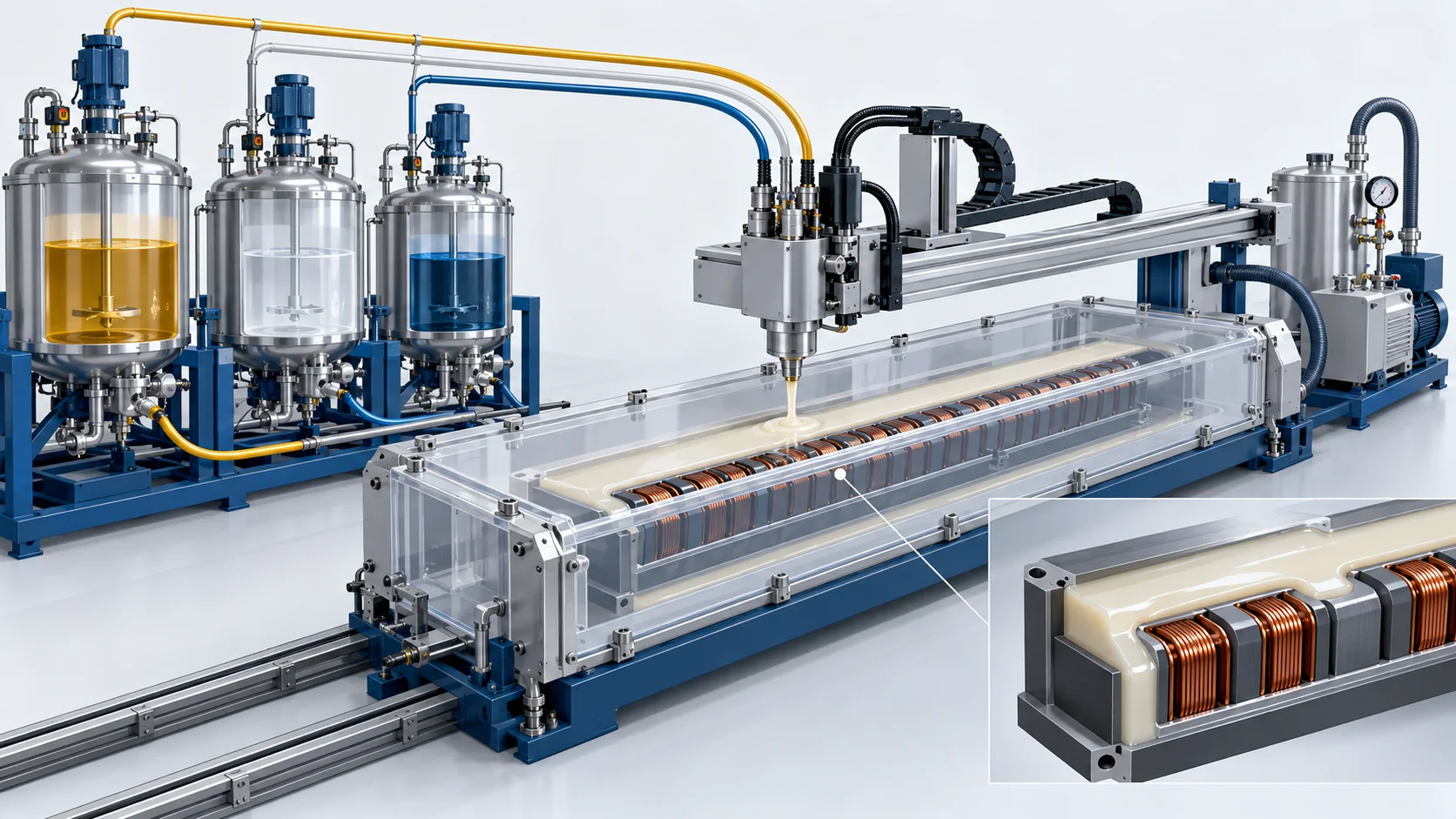
Maglev Long-Stator Encapsulation Solution
Configure filled-polyurethane preparation, three-stream metering, vacuum dispensing and material-specific curing for long-stator electrical components.
Dielectric Integrity & Thermal Dissipation for 600 km/h Maglev Propulsion
Configure filled-polyurethane preparation, three-stream metering, vacuum dispensing and material-specific curing for long-stator electrical components. Core interfaces cover filled-resin conditioning, wear-resistant metering and dynamic mixing, a configured vacuum chamber and process controls. Stator preheating and electrical testing are separate options. Powder, resin, dry gas, utilities and final insulation qualification are agreed separately.
Product, material and tooling
Core interfaces cover filled-resin conditioning, wear-resistant metering and dynamic mixing, a configured vacuum chamber and process controls. Stator preheating and electrical testing are separate options. Powder, resin, dry gas, utilities and final insulation qualification are agreed separately.
Capacity and acceptance
Review all preparation, dispensing, curing, handling and inspection stages. Material and component results require separate original test records.
Configuration references are reviewed for the selected material, product geometry and acceptance conditions. The brief varies between a 38–40 minute potting cycle and a two-hour cure. Do not call the short cycle a completed cure/demold cycle. Destructive dielectric-breakdown testing and non-destructive partial-discharge testing are different measurements. Commercial operation at 600 km/h is not established by this brief.
Turnkey Maglev Stator Encapsulation Workflow
The supplied process sequence is a configuration reference. Temperature, pressure, output and cure settings are confirmed for the selected material and tooling. The brief varies between a 38–40 minute potting cycle and a two-hour cure. Do not call the short cycle a completed cure/demold cycle. Destructive dielectric-breakdown testing and non-destructive partial-discharge testing are different measurements. Commercial operation at 600 km/h is not established by this brief.
Alumina Vacuum Dehydration & High-Shear Mixing
Configured reference: Micronized alumina powders are inducted into polyol streams under 0.05 kPa vacuum and dispersed via turbine blades to break all agglomerations.
Three-Component Heated Circulation & Nitrogen Blanketing
Configured reference: Filled polyol, isocyanate, and liquid catalyst are circulated through thermal oil jackets at 65°C ± 0.5°C under dry nitrogen blankets.
Core Preheating & Vacuum Chamber Evacuation
Configured reference: The 3-meter stator core is preheated to 75°C in an infrared tunnel, loaded into the vacuum potting chamber, and evacuated down to 0.05 kPa.
Reference Solution Engineering Envelope
Values transcribed from the supplied configuration brief. Material properties and finished-product benchmarks are separate validation targets, not general equipment guarantees.
| Parameter | Value / Unit | Applicable Configuration / Conditions |
|---|---|---|
| Potting Vacuum Level | Absolute pressure ≤ 0.05 kPa | Dual-stage rotary vane vacuum system with cold trap; supplied reference requiring configuration or test verification |
| Cured Thermal Conductivity | Greater than 1.1 W/(m·K) | 50 wt% micro-scale alumina dispersion matrix; supplied reference requiring configuration or test verification |
| Dielectric Breakdown Strength | Greater than 22.0 kV/mm | Tested under 50 Hz high-voltage electrical field; supplied reference requiring configuration or test verification |
| Metering Delivery Capacity | 2.0 to 18.0 kg/min | Tungsten-carbide abrasive-resistant gear pump skid; supplied reference requiring configuration or test verification |
| Flame Retardancy Standards | DIN 5510-2 Class S4 / SR2 / ST2 | Zero-halogen railway passenger transit compliance; supplied reference requiring configuration or test verification |
| Stator Component Length | Up to 3,200 mm | Long vacuum chamber with motorized mold carriage; supplied reference requiring configuration or test verification |
Core Equipment for This Solution
The linked pages describe shared preparation or feed-system families, not proof of delivery of the dedicated models listed in the case. Core interfaces cover filled-resin conditioning, wear-resistant metering and dynamic mixing, a configured vacuum chamber and process controls. Stator preheating and electrical testing are separate options. Powder, resin, dry gas, utilities and final insulation qualification are agreed separately.
Core Advantages of Haifeng Maglev Potting Systems
Engineering functions and interfaces developed for the specified product and material system.
Filled-Resin Preparation
Configure and validate filled-resin preparation for the selected product, formulation, tooling and production conditions.
Wear-Resistant Metering
Configure and validate wear-resistant metering for the selected product, formulation, tooling and production conditions.
Vacuum Chamber Potting
Configure and validate vacuum chamber potting for the selected product, formulation, tooling and production conditions.
Electrical Test Interfaces
Configure and validate electrical test interfaces for the selected product, formulation, tooling and production conditions.
Related Project Draft
Review the project configuration described in the supplied brief. Project records and reported results require verification before public use.
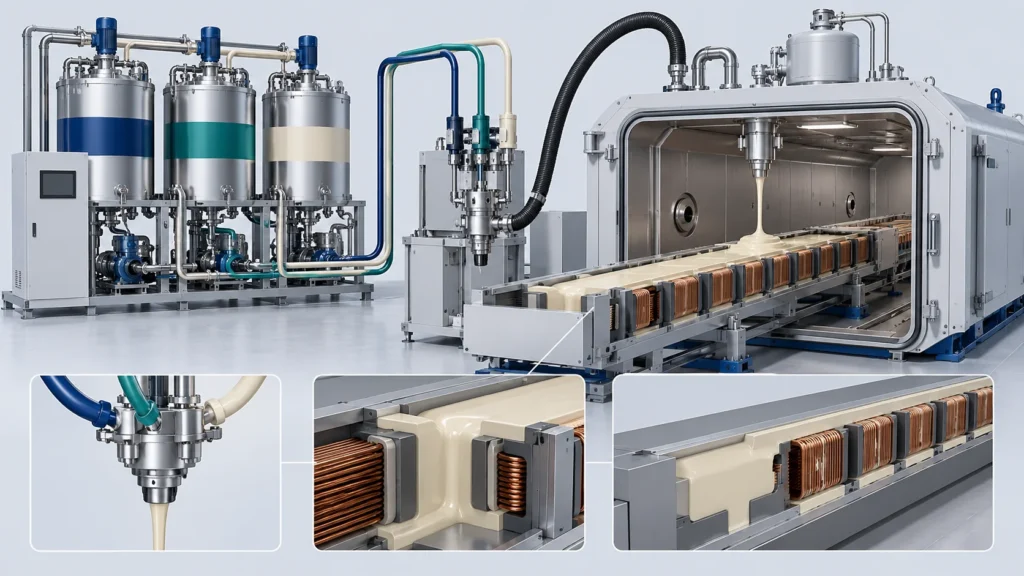
Frequently Asked Questions
Technical questions to establish the equipment scope, material window and validation plan.
How is the thermal-conductivity target verified?
Why is a vacuum chamber considered for stator potting?
How is filler settling managed?
How are metering components selected for filled resins?
Request a Maglev Motor Encapsulation Proposal
Share your finished product or drawing, material system, target capacity, automation requirements and factory conditions to discuss the line configuration.


