Most ratio problems on a two-component polyurethane line are not caused by pump failure. They are caused by treating both components as if they were the same liquid. Both sides flow through metering pumps, both sides need heating, and both sides enter a mixing head, so it is easy to assume the machine should be symmetrical. It should not be. The B-side and A-side are chemically different, rheologically different, and failure-prone in different ways [3]. If you are auditing an existing line or specifying a new one, the sections below work as B side-by-side field guide.
What “Side” Means in a Polyurethane Process
In Haifeng polyurethane foaming documentation, A is the formulated polyol blend and B is the isocyanate, such as MDI, TDI or a specified isocyanate grade. Other suppliers may use different letters. Confirm actual material labels and the machine manual before connecting tanks or setting a ratio.
In cast-elastomer equipment, identify the streams by material: prepolymer and curative, such as MOCA or BDO. Their tank letters are machine-specific and should not be inferred from foaming-system conventions. A solid curative requires the actual grade’s melting and holding conditions.
The B-side and A-side behave so differently because isocyanates react with moisture while the polyol blend carries the reactive package. What Is Spray Polyurethane Foam? Composition and Application covers how those components come together in a practical system.
Why the Equipment Is Not Symmetrical
The two sides are managed as separate process streams, not as duplicate halves of the same circuit.
| Machine function | B-side: isocyanate | A-side: polyol blend |
|---|---|---|
| Moisture sensitivity | High; reacts with water and can dimerize or form solids | Lower in general, but some catalysts and blowing agents lose activity when wet or aged |
| Viscosity | Usually lower, but rises sharply if too cold or if MDI crystallizes | Often higher; MOCA and other chain extenders may need elevated temperature |
| Solids and fillers | Usually none; filtration mainly catches urea or particulate contamination | Frequent; pigments, fillers, flame retardants, or solid curatives settle or stratify |
| Heating | Keeps viscosity stable and prevents dimerization | Zoned heating for tank, hoses, and metering unit |
| Agitation | Not normally required; gentle recirculation or dry-air/nitrogen blanketing is used instead | Required; keeps additives homogeneous and fillers suspended |
| Pump and seal focus | Prevent moisture ingress and urea scoring | Resist abrasive wear and handle high-viscosity flow |
These differences come from the reaction chemistry: isocyanate plus water forms an amine and carbon dioxide, then urea [5]. The handling risk is also higher on the B-side. Uncontrolled isocyanate exposure is a well-documented workplace sensitizer, and EU REACH requires training before industrial and professional use of diisocyanates [1]. NIOSH similarly treats isocyanates as respiratory irritants and sensitizers [2].
Equipment-Level Differences That Matter
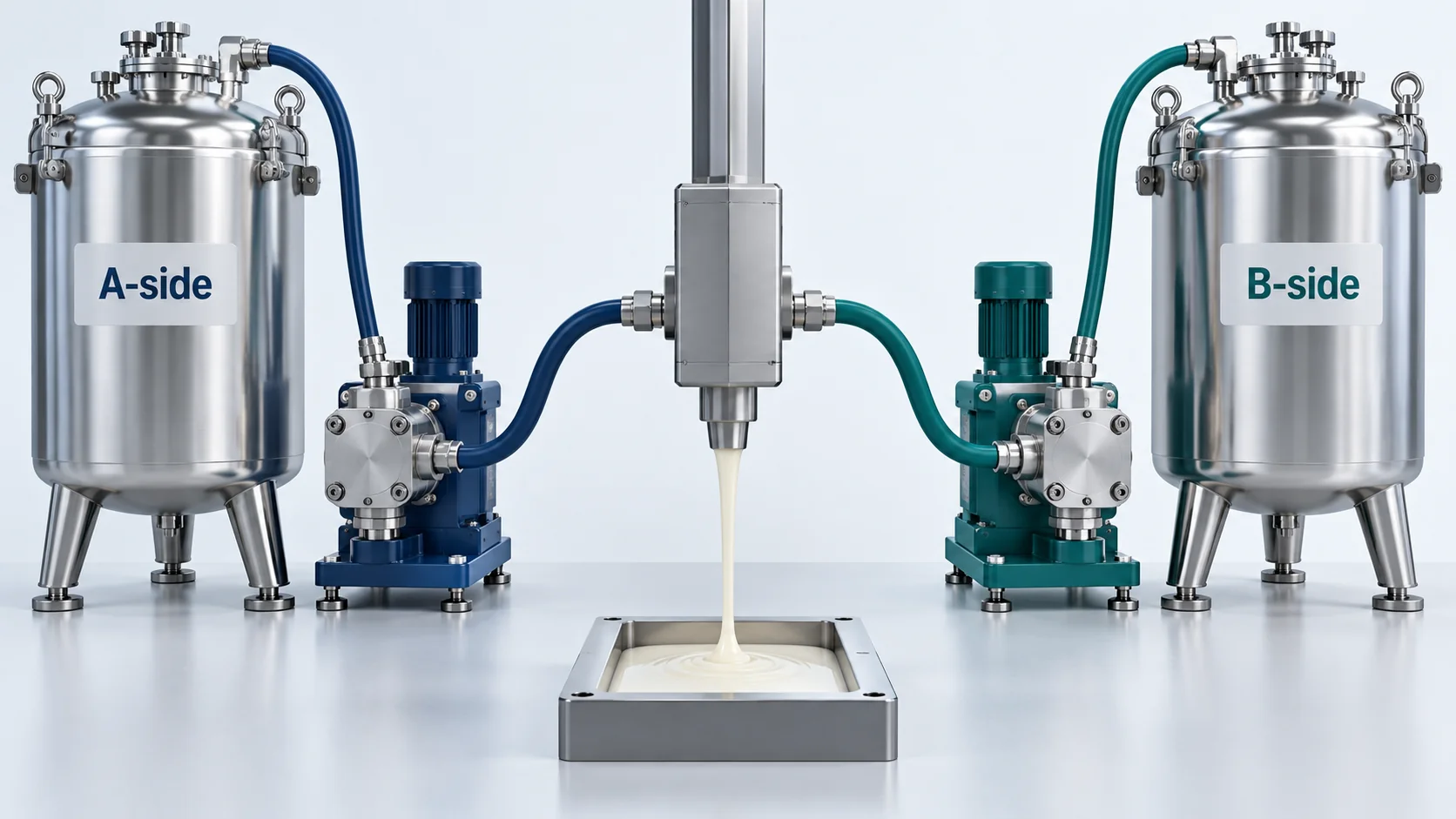
On the B-side, the goal is to protect the isocyanate from moisture and keep it at a stable processing temperature. That usually means a sealed day tank with a dry-air desiccant or nitrogen pad, low-pressure recirculation so material does not sit in dead legs, heated hoses, and fine filtration before the metering pump. Any trapped moisture quickly becomes urea, which scores pump surfaces and plugs narrow clearances.
On the A-side, the goal is homogeneity. The blend may contain fillers, pigments, surfactants, catalysts, and a chain extender, so it must be continuously agitated or recirculated before metering. High-end systems often use separate jacketed additive tanks so a color paste or MOCA stream can be conditioned at its own temperature and injected only where it is needed.
The mixing head then has to reconcile both streams. If the two sides arrive at different temperatures or with unequal pressure profiles, the displayed ratio can look stable while the delivered mix varies. That is one reason a machine with precise individual metering loops outperforms a machine with a single generic pump strategy.
The Mistakes That Look Like Hardware Faults
Most side-related failures are diagnosed as “bad pump” or “bad mixing head,” but the cause is usually earlier in the circuit.
- Shared hoses or filters: Cross-contamination between A and B can form urea or localized gels that do not dissolve.
- Open or poorly sealed B-side tank: Moisture pickup changes isocyanate reactivity and creates particles.
- A-side agitation turned off overnight: Pigments and fillers settle, so the first shots of the morning are off-ratio.
- Volume metering without temperature compensation: Density changes with temperature, so the actual weight delivered can drift even if the pump command is constant.
- Using identical pumps to reduce spare parts: One side may need tighter clearances for moisture control, while the other needs more wear resistance for fillers.
Before adjusting a metering pump or blaming the flow meter, verify what the shot actually weighs. A mechanical pump command may be repeatable while the delivered weight drifts because density and temperature changed, or because a check valve no longer seals.
Before adjusting the ratio, verify the actual shot size: B pump command is not the same as the weight that enters the mold. How to Calculate Shot Weight in Polyurethane covers the calculation and the variables that change it on a real line.
A Quick Field Checklist
If a two-component line is drifting, work through these points before changing pump calibration.
- Confirm which chemical is actually in each tank; do not trust old labels after retrofits.
- Inspect the B-side tank for moisture ingress and check the desiccant or nitrogen supply.
- Confirm the A-side agitator is running and sample the tank top versus bottom if settling is suspected.
- Verify B-side and A-side heating zones separately; a heated chain extender should not be controlled by the same profile as the isocyanate.
- Check filters for gel, urea particles, or pigment accumulation.
- Compare pump command, mass flow reading, and actual shot weight across five consecutive cycles.
- Look for pressure spikes or pump cavitation as a sign of viscosity mismatch or blocked feed.
Once the ratio and shot size are right, watch the reaction timing. A change in cream time or rise time is often the first signal that B side temperature or additive stream has moved, even when the machine still reports stable pressure.
Once the ratio is under control, the next process variable is how the reacting mixture builds viscosity and rises in the mold. The Role of Rise Time in Polyurethane Foaming covers why rise time shifts with formulation and machine conditions.
Get a Process-Level Answer
The B-side/A-side split is not a labeling question; it is a process design question. If you are selecting a foaming or cast-elastomer line, provide the material temperatures, viscosity behavior, whether the A-side contains fillers or solid chain extenders, shot size, and target ratio. Those details change pump selection, heating zones, agitation, filtration, and mixing head design far more than the machine’s nominal output.
Email your process details or TDS to info@chinahaifeng.com, or send a WhatsApp inquiry to +86 135 6629 6633. For each side, include:
- Material type: MDI, TDI, PMDI, prepolymer, polyol blend, MOCA, BDO
- Viscosity at processing temperature
- Fillers or abrasive content
- Target ratio by weight or volume
- Shot size and cycle time
Frequently Asked Questions
Which A/B convention does Haifeng use?
Haifeng uses A for the polyol blend and B for the isocyanate in PU foaming documentation. Tank letters are not a universal chemical standard, so verify labels and documentation on equipment from other suppliers.
Can I use identical pumps for both sides?
Only in rare cases where both materials have similar viscosity and no solids. Even then, the B-side needs seals and wetted parts that resist moisture ingress, while the A-side often needs more wear resistance for fillers or solid curatives.
Why does the B-side need dry air or nitrogen?
Isocyanates react with water to form urea and carbon dioxide [5]. Small amounts of moisture can create crystals that score pumps, block filters, and shift the NCO content enough to change part quality.
Why is agitation more important on the A-side?
The A-side often contains fillers, pigments, surfactants, catalysts, and chain extenders. These can settle, stratify, or degrade unevenly without agitation, so the blend is no longer homogeneous when it reaches the metering pump.
Does B-side/A-side mean the same thing in cast elastomer machines?
No universal tank-letter convention applies to every cast-elastomer system. Identify the prepolymer and curative from the actual machine documentation; condition each material to its approved processing requirements.
What is the quickest way to find which side is drifting?
Measure actual output weight from each side, inspect filters and pump clearances, and compare material temperature with the mass flow reading. A stable pump command combined with a changing delivered weight usually points to temperature, viscosity, or feed pressure on one side.
References
[1] European Chemicals Agency, “Diisocyanates — restriction and training requirements under REACH,” ECHA, https://echa.europa.eu/hot-topics/diisocyanates.
[2] National Institute for Occupational Safety and Health, “Isocyanates,” CDC, https://www.cdc.gov/niosh/topics/isocyanates/.
[3] M. Szycher, Szycher’s Handbook of Polyurethanes, 2nd ed., CRC Press, 2012.
[4] M. Ionescu, Chemistry and Technology of Polyols for Polyurethanes, 2nd ed., Smithers Rapra, 2016.
[5] G. Oertel, Polyurethane Handbook, 2nd ed., Hanser Publishers, 1994.
If you’re interested, check out these related articles:
Measuring Polyurethane Foam Resilience A Practical Test Guide
What Is Semi Rigid Polyurethane Foam
RRIM Vs RIM Which Process Suits Your Structural Part
SRIM Explained Structural Reaction Injection Molding Basics
Causes Of Shrinkage In Polyurethane Foam How To Control It