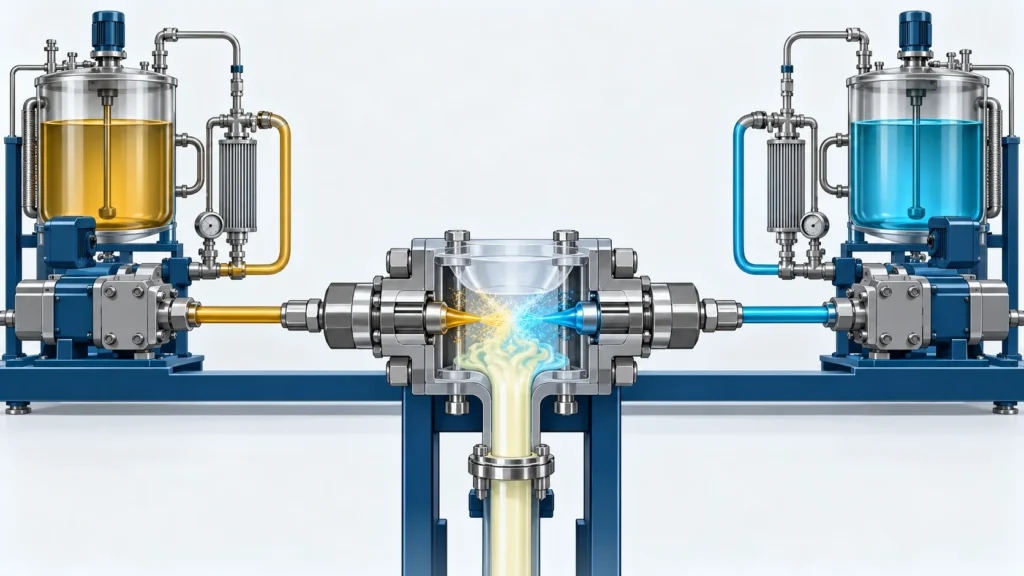
Multi-component PU metering is not a default upgrade. A third stream earns its place only when a formulation, changeover pattern, or material-stability problem cannot be solved inside the two-component A/B pair. The extra pump brings a tank, line, calibration routine, cleaning step, and another ratio that can drift. The useful question is therefore not how many streams a machine can carry, but which material must stay separate from the polyol or isocyanate until the mixing head. In most plants, the answer comes from the reaction profile and the additive’s storage behavior, not from a brochure’s stream count.
What Counts as an Extra Stream in PU Metering?
Two-component PU metering usually means an isocyanate side (A) and a polyol side (B). The B side is often a formulated blend of polyol, surfactant, catalyst, blowing agent, and flame retardant. When a material is moved out of that blend and given its own tank, pump, line, and injection point, it becomes an extra stream. The term covers more than a third pump on a three-component machine. A second B-side pump feeding a different polyol, a color paste line, or a chain-extender circuit can all be extra streams.
Not every auxiliary tank is a metered stream. A day tank that supplies the main B pump is storage, not a third component. The distinction matters because a true extra stream adds a controlled ratio, a calibration point, and a cleaning path. It also adds a new failure mode: the pump can be running, the tank can be full, and the part can still be off-ratio if the stream is not calibrated against the others.
Start With the Reaction and Pot Life, Not the Pump Count
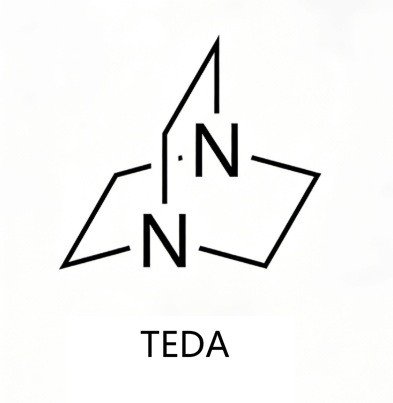
The reaction is the first constraint. In a two-component system, the A/B ratio sets the available isocyanate against the polyol’s hydroxyl groups and any chain extender or water. If a third stream carries a material that consumes or supplies isocyanate-reactive groups, that stream belongs in the ratio calculation, not in a separate add-on percentage. A catalyst stream usually changes speed rather than stoichiometry, but it still changes cream time, gel time, and rise time. A chain extender changes hard-block content and hardness. A blowing agent changes density. Each one has a different reason to be separate.
In elastomer casting, the two main streams may be a prepolymer and a chain extender such as MOCA or BDO rather than a polyol and an isocyanate. The third stream in that layout is often color paste or an additive. That is why copying a stream count from a foam line into a casting line is unreliable. The chemistry behind the ports decides what must be metered.
Pot life is the next constraint. If an additive shortens the B-side pot life below the tank residence time, premixing turns every tank into a race with the clock. Separation can extend working life, but it also means the additive must be metered accurately at a small fraction of the total. If the additive is stable in B for the full residence time and the dosage is high enough to blend uniformly, a third stream may solve a problem the plant does not have.
Reaction speed and stream count are separate decisions, but they meet at the mixing head. <The Role Of Rise Time In Polyurethane Foaming> covers how rise time responds to formulation and process conditions.
Five Cases Where a Third Stream Is Justified
The decision becomes clearer when each candidate is tested against a specific failure mode. The table below is a screening aid, not a justification by itself. The evidence column names what to measure before adding hardware.
| Extra-stream candidate | Why separation can help | Evidence to collect first | First alternative |
|---|---|---|---|
| Catalyst or activator | Premixed catalyst can shorten B-side pot life or cause viscosity drift. | Premix viscosity and reaction profile over the expected tank residence. | Smaller B batches, blocked catalyst, or a dedicated day tank. |
| Color paste | Frequent color changes make a full B-side cleanout expensive. | Changeover frequency, purge volume, and color accuracy target. | Pre-colored B or a small batch color mixer. |
| Chain extender | Melting, reactivity, or ratio control makes a single B blend impractical. | Melt-feed stability, line temperature, and ratio range. | A prepolymer grade with the extender already built in, where the supplier offers it. |
| Filler or flame-retardant slurry | Settling or high loading makes a uniform B blend hard to hold. | Settlement rate, recirculation requirement, and viscosity at the tank. | An agitated B tank with a filled polyol grade. |
| Physical blowing agent | Volatility or incompatibility makes storage in B unsafe or unstable. | Storage pressure, temperature, and material compatibility. | A closed preblended B system designed for that blowing agent. |
The rows are not equally common. Color and catalyst are frequent reasons on multi-color or fast-cycle lines. Filler slurries and physical blowing agents are more often a line-design question than a simple pump addition. In every case, the evidence column should be filled before the purchase order, because a third stream is easier to justify with a measured problem than with a future option.
When Two Components Are Enough
Two components are enough when the additive is compatible, stable, and present at a level that can be blended uniformly in the B tank. That is not a low-tech choice. A well-instrumented two-component machine with temperature control, recirculation, and gravimetric ratio checks can hold a formulation more reliably than a three-stream machine with an oversized third pump and a weak calibration routine.
The hidden cost of an extra stream is not only the hardware. It is the extra calibration, the extra purge, the extra spare pump, and the extra operator decision at changeover. Each stream also adds a ratio that can drift. A plant that already struggles to verify A/B ratio by weight will not fix that problem by adding a third ratio to the same control system.
Ratio drift in the main pair can change density, hardness, and dimensional stability. A third stream can mask the symptom if it is adjusted to compensate, which makes the root cause harder to find. The better sequence is to stabilize A/B metering first, then decide whether a separate stream removes a real constraint.
Ratio errors rarely stay inside the metering cabinet; they show up in density, hardness, and dimensions. <Causes Of Shrinkage In Polyurethane Foam How To Control It> covers the common causes and control points for foam shrinkage.
Sizing the Extra Stream for Ratio and Turndown
Size the third stream from the dosage range and the shot time, not from the tank capacity. The pump must hold the smallest required dose at the shortest shot, and it must reach the largest dose without running out of control range. If the stream is a small fraction of the total, an oversized pump will spend its life at the bottom of its stroke, where pulses and slip are more visible.
Flow range and turndown
Calculate the third-stream flow from the required mass per shot divided by the injection time. Then check the minimum and maximum against the pump’s controllable turndown. A pump that is accurate at the maximum but unstable at the minimum is the wrong choice for a formulation that uses the additive sparingly.
Temperature and viscosity
Viscosity affects pump slip, pressure drop, and mixing. A third stream that is cold, shear-sensitive, or filled may need its own temperature control and recirculation. Do not assume the main B-side temperature is correct for the additive. A material that crystallizes or settles in the line will not be fixed by a larger pump.
Control and alarms
Each stream needs a feedback signal that the control system can act on: flow, pressure, or weight loss, depending on the machine. At minimum, the machine should alarm on ratio deviation, low tank level, and loss of circulation. The alarm should stop the shot or mark the part, not wait for the operator to notice a visual defect.
For a three-stream shot, total shot mass is the sum of each stream’s volume multiplied by its density: (A volume × A density) + (B volume × B density) + (C volume × C density). The A/B ratio can remain correct while the total shot is wrong if the third stream is not included in the calculation.
Shot size is the sum of every metered stream, so a third stream changes the calculation even when the A/B ratio stays fixed. <How To Calculate Shot Weight In Polyurethane> covers how to calculate shot weight from part geometry, density, and metering ratio.
Layout, Cleaning and Changeover Costs
Layout decides whether the third stream is controllable in practice. The tank should be close enough to hold temperature and pressure, but far enough to allow safe access. The line should be sized for the additive’s viscosity, not for the largest stream on the machine. A narrow line reduces residence time but raises pressure drop; a wide line lowers pressure but increases purge volume. The injection point must be designed for the mixing head, with the stream entering before the mixing action rather than dribbling into the outlet.
Cleaning is the recurring cost. A color stream may change over in minutes, but the purge volume and cleaning validation still count. A catalyst or chain-extender stream may require a different cleaning solvent and a separate waste route. If the changeover procedure takes longer than the production run, the extra stream has not solved the changeover problem.
Ask for the cleaning procedure as part of the machine scope. It should name the sequence, the solvent or purge medium, the minimum flush volume, and the check that confirms the line is clean. A machine that meets the ratio specification but cannot be cleaned within the production window is not a good match.

Commissioning Checks Before You Accept the Machine
Acceptance should be based on weighed samples and repeated shots, not on the display. Run the machine with the production formulation at the lowest, middle, and highest flow the plant expects to use. Then repeat the shot several times and check for trend, not just the average. A stream that drifts over ten shots will look acceptable in a single sample.
| Check | Method | What it proves | Release condition |
|---|---|---|---|
| Low-flow ratio | Collect timed samples from each stream and weigh them. | The third pump can control the smallest dose. | Ratio within the agreed band at the minimum shot. |
| High-flow ratio | Repeat the timed sample at maximum demand. | No starvation or cavitation at the top of the range. | Ratio within band and pressure stable. |
| Shot repeatability | Run consecutive production shots and weigh each. | The control loop is stable over time. | No upward or downward trend beyond the agreed band. |
| Mix quality | Cut or inspect representative parts. | The additive is dispersed, not streaked. | No visible streaks, voids, or unmixed regions. |
| Temperature stability | Log tank, line, and head temperature through a production cycle. | Viscosity and reaction are held at the intended condition. | Temperature stays within the agreed band. |
| Changeover and purge | Time a color or additive change on the production line. | Cleaning and waste are compatible with the schedule. | Changeover fits the planned window and purge loss is accepted. |
Use the production formulation for these checks. A trial mix that sits in a small tank for an hour does not reproduce the residence time, temperature, or recirculation of the real line. If the machine cannot pass the low-flow ratio check with the actual additive, the stream count is not the problem; the pump or control range is.
Send the Formulation Before You Specify the Streams
If you are deciding between a two-component machine and a three-stream platform, send the resin system, current A/B ratio, additive dosage range, required output, shot size, and changeover frequency. Haifeng Polyurethane Machinery can review the metering scope against those inputs. Email Info@chinahaifeng.com or WhatsApp 86 13566296633.
FAQ
Does adding a third stream always improve ratio accuracy?
No. It can reduce premix instability, but it adds another ratio to verify. If the additive is stable in B and the dosage is high enough to blend uniformly, a well-controlled two-component machine with gravimetric checks is simpler. Add a stream when separation solves a specific problem, not because more streams look more capable.
Can a color paste be metered as the third stream?
Yes, when color changes are frequent or the paste cannot be preblended reliably. The tradeoff is purge volume, a dedicated low-flow pump, and extra cleaning. If colors change infrequently, pre-colored B or a small batch mixer may cost less and introduce fewer calibration points.
How do I size the third-stream pump?
Start with the minimum and maximum dosage as a share of total shot, the shortest shot time, and the additive viscosity. Size for the minimum flow with enough turndown to reach the maximum. An oversized pump running at the bottom of its range is harder to control than a smaller pump with a stable calibration range.
What should be checked at acceptance?
Run gravimetric ratio checks at low, middle, and high flow with the production formulation, then repeat shots and inspect mix quality. Confirm temperature stability, alarm response, and changeover purge loss. A display value is not acceptance evidence; a weighed sample is.
If you’re interested, check out these related articles:
How To Calculate Shot Weight In Polyurethane
Shore A Vs Shore D Hardness In Polyurethane
The Role Of Rise Time In Polyurethane Foaming
RRIM Vs RIM Which Process Suits Your Structural Part