
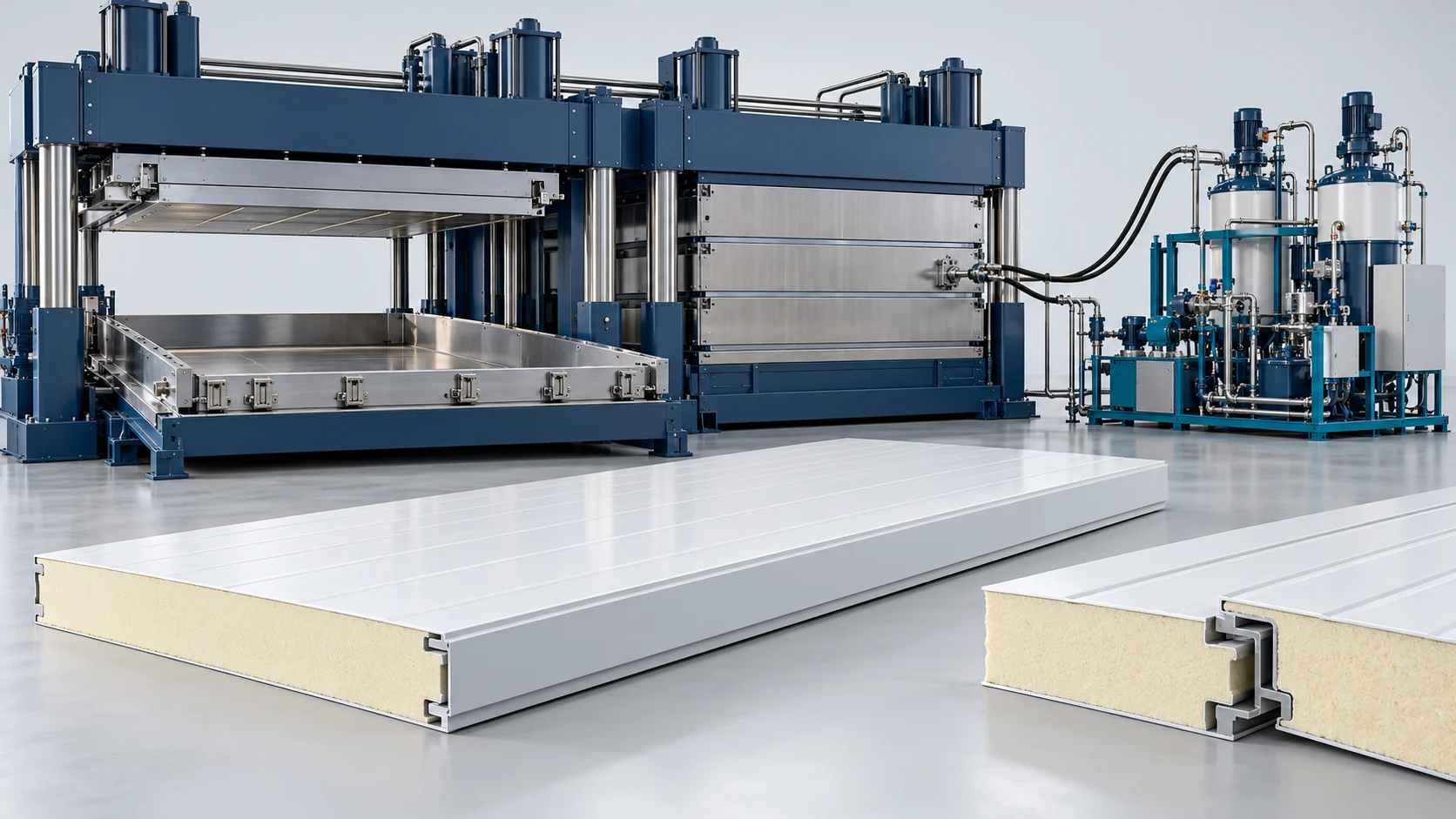
Discontinuous PU Sandwich Panel Molding Solution
Flexible hydraulic press foaming systems engineered for customized cold room panels, freezer doors, and modular walk-in coolers. Concept illustration — not a photograph of delivered equipment or a customer installation.
Highly Flexible Discontinuous PU Panel Molding Solutions
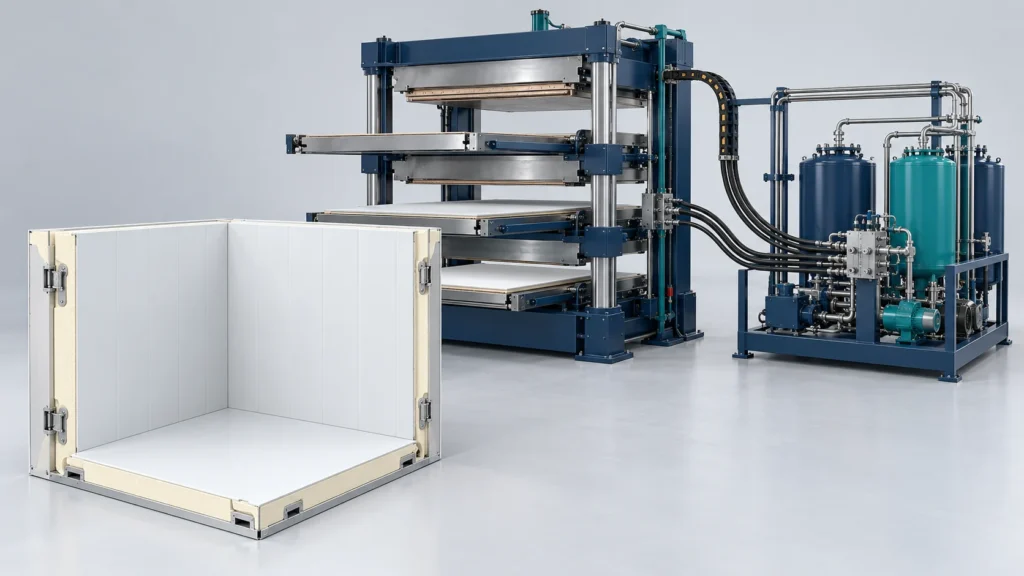
While continuous lines excel at massive standard volumes, regional cold room builders, refrigerated display manufacturers, and specialty vehicle upfitters need versatility to produce custom dimensions, variable thicknesses (50–250mm), and panels with embedded eccentric cam-locks. Haifeng’s discontinuous sandwich panel solution utilizes high-pressure injection machines synchronized with multi-daylight 2+2 hydraulic presses, allowing independent loading, injection, curing, and unloading cycles with separate loading, curing and changeover allowances.
2+2 Alternating Daylight Productivity
While one set of platens undergoes pressurized curing, operators load sheet boxes and cam-locks on the opposite platens, maximizing press cycle utilization.
Precision Embedded Cam-Lock Integration
Magnetic positioning side bars hold eccentric male and female cam-locks securely inside the mold, producing walk-in cold room panels ready for instant site latching.
Foaming core and the agreed press/handling interfaces are itemized in the proposal.
Discontinuous Hydraulic Panel Pressing Workflow
A synchronized four-stage workflow delivering custom-dimension insulated panels with high density uniformity.
Sheet Box Loading & Cam-Lock Positioning
Pre-cut metal sheet boxes are placed onto the open platen; perimeter boundary bars embedded with magnetic cam-lock locators are clamped securely around the edges.
High-Pressure Multi-Port Foam Injection
A high-pressure PU dosing unit injects a metered chemical shot through side-edge injection holes; the liquid formulation spreads evenly across the closed, tilted cavity.
Hydraulic Clamping & Heated Oil Curing
The configured hydraulic press confines the expanding foam while platen circuits control temperature. The supplied reference is 50–60°C; bond quality and cure require material and panel validation.
Technical Specifications
Review the equipment and process parameters for Discontinuous PU Sandwich Panel Molding Line. Final values depend on the material, tooling, production target and agreed configuration.
| Technical Parameter | Standard Specification / Value | Engineering Context & Verification |
|---|---|---|
| Target Application | Walk-in Cold Rooms, Freezer Doors, Specialty Vehicles | Custom-sized insulated panels with cam-locks |
| Core Insulation Material | Polyurethane (PUR) / PIR Rigid Foam | In-situ pressurized cavity injection |
| Press Bed Dimensions | 6.5m / 8.5m / 12.0m (Length) × 1.3m – 1.5m (Width) | Accommodates oversized walk-in panels |
| Panel Thickness Range | 50 mm – 250 mm (Adjustable boundary bars) | Quick manual or motorized gap changeover |
| Press Daylight Configuration | 2+2 Daylights (Optional 3+3 Daylights) | Alternating load/cure work cycle |
| Clamping Force | 150 – 300 Tons (Hydraulic cylinder network) | Resists internal high foaming expansion pressure |
| Foam Density Range | 40 – 45 kg/m³ | High structural core density |
Equipment for This Solution
The related project describes a 2+2, 6.5 m workcell and a 15 min reference cadence for two 100 mm panels. Linked product 910 lists a separate 3–10 min single-mold reference and 20–300 mm range; those figures are not the acceptance specification of this project. Core material, mold volume, shot flow and cure must be matched.
Batch PU Sandwich Panel Line | Custom Panels
Batch‑type rigid foam system for custom sandwich panels & special‑shaped panels, with hydraulic mold clamping, 20‑300 mm thickness range, and solvent‑free air purge cleaning.
High-Pressure PU Foaming Machine | Sandwich Panels
High-pressure continuous foaming system for building insulation sandwich panels with large-flow precise mixing
Key Discontinuous Engineering Advantages
For Discontinuous PU Sandwich Panel Molding Line, assess material compatibility, process control, equipment interfaces and changeover needs against your production brief.
Configured Dimensions
Length, width and thickness depend on platens and tooling; the reference range is 50–250 mm.
Cam-Lock Positioning
Fixtures locate locks; inspect engagement and keep foam out of mechanisms.
Layout Planning
The related project uses a 450 m² workcell reference; allow site-specific maintenance and handling space.
Batch Shot Control
Metered shots support variable orders; startup, rejects and changeovers remain part of production planning.
Related Project Records and Industry References
Review the evidence type on each record. Haifeng project figures describe their own configuration; public industry references identify third-party sources and are not Haifeng deliveries.
Frequently Asked Questions
Find answers about Discontinuous PU Sandwich Panel Molding Line, including material selection, equipment configuration and the information needed to plan a production line.
When is a batch route useful?
How does the alternating press work?
What cycle time is reported?
Can freezer doors be produced?
Submit Your Production Goals
Share the finished product, material, target capacity, automation requirements and factory conditions to discuss a project-specific line configuration.


