
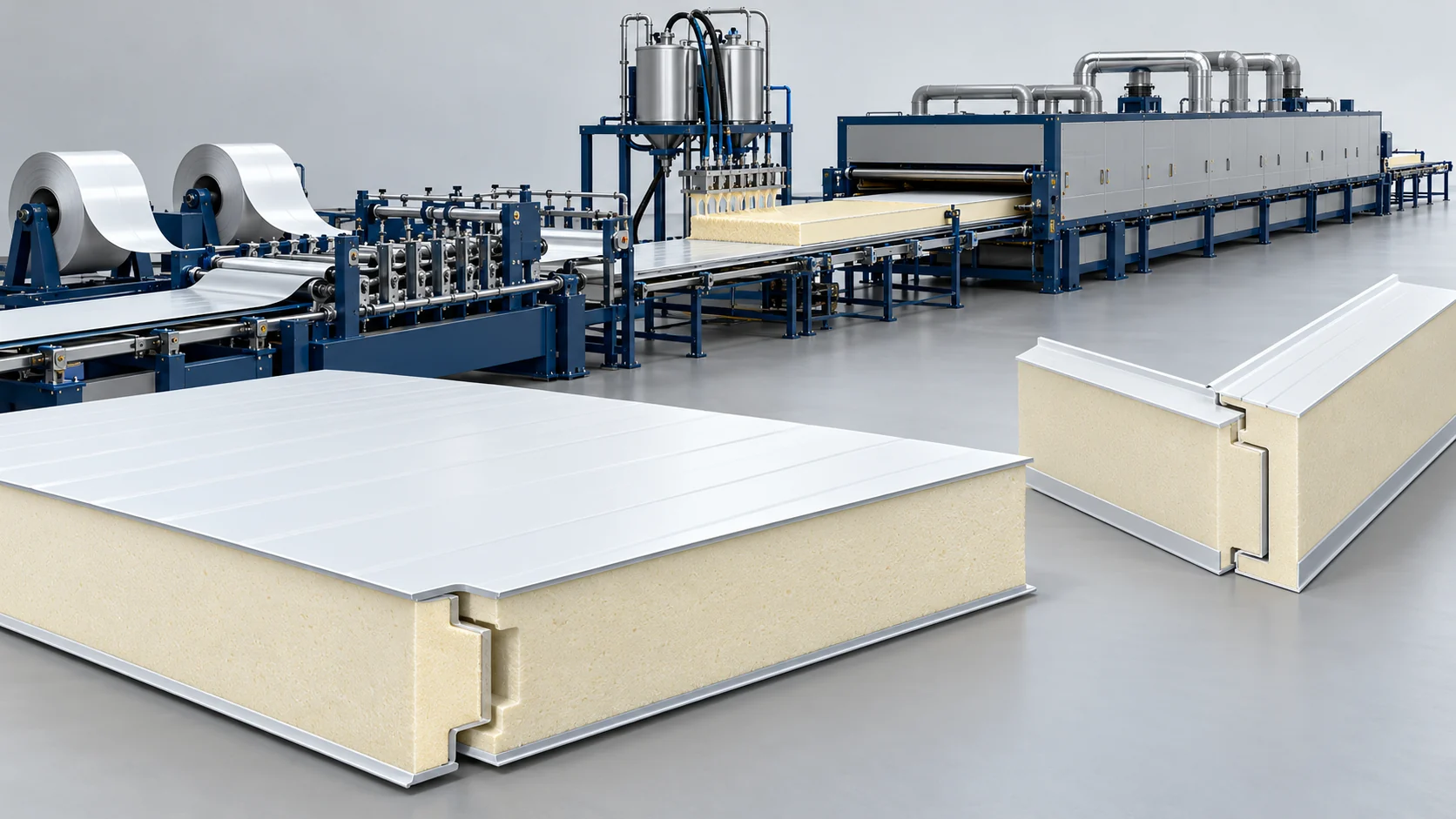
Cold Storage PU and PIR Sandwich Panel Production Solution
Continuous and batch PU/PIR panel-production configurations for cold rooms and freezers. Panel thickness, joint design, formulation and tested insulation performance guide equipment selection. Concept illustration — not a photograph of delivered equipment or a customer installation.
Precision PU/PIR Sandwich Panel Solutions for Cold Storage & Refrigeration
Plan thick insulated wall and ceiling panels around the facing, core chemistry, joint structure and production target. The supplied brief describes a 36 m continuous reference line and batch press alternatives for embedded cam-locks. Thermal conductivity, closed-cell content, fire reaction and installed-envelope performance require testing of the actual panel construction.
Core and Joint Planning
Select thickness, facing, seals and joint geometry for the intended cold-room envelope.
Continuous or Batch Production
Compare order mix, curing time, handling and embedded components before selecting the route.
Core foaming equipment and integrated forming/lamination/cutting interfaces are defined in the project scope.
Step-by-Step Cold Storage Panel In-Situ Foaming Process
A reference sequence for thick-core PU/PIR panels; validate recipe, temperature, cure residence and finished joints.
Precision Labyrinth Joint Cold Rolling
Heavy-gauge pre-painted steel coils pass through multi-station precision forming cassettes, shaping multi-step tongue-and-groove joint contours designed to halt convective cold air bypassing.
Substrate Preheating & Chemical Thermal Balancing
Formed metal skins traverse long hot-air tunnels heated to 45°C–55°C to activate metal adhesion, while dynamic TCU skids stabilize raw polyol and isocyanate precursors within ±0.5°C.
High-Pressure Pentane In-Situ Pouring
High-pressure axial pumps meter pentane-blown PIR chemicals through a servo-driven oscillating pouring head, depositing a uniform chemical film onto the bottom sheet under closed-loop Ratio Lock control.
Technical Specifications
Review the equipment and process parameters for Cold Storage PU/PIR Sandwich Panel Production Line. Final values depend on the material, tooling, production target and agreed configuration.
| Technical Parameter | Standard Specification / Value | Engineering Context & Verification |
|---|---|---|
| Target Application | Cold Rooms, Freezer Warehouses, Blast Freezers, Chillers | Deep cold thermal insulation (-40°C to +10°C) |
| Core Insulation Material | Polyurethane (PUR) / Polyisocyanurate (PIR) | In-situ high-density rigid foam matrix |
| Panel Thickness Range | 100 mm – 250 mm (Heavy cold storage standard) | Adjustable motorized double-belt track |
| Production Modes | Continuous Double Belt / Discontinuous Press Lines | Tailored to mass volume or specialized sizes |
| Core Foam Density | 40 – 45 kg/m³ | Reference core density; moisture behavior requires testing |
| Thermal Conductivity (λ) | 0.019–0.021 W/(m·K), supplied recipe reference | Recipe reference only; confirm test method, mean temperature, conditioning and aging |
| Joint Profile Structure | Multi-Labyrinth Tongue-and-Groove / Cam-lock | Joint and sealing design; validate the installed envelope |
| Continuous Line Speed | 2.5 – 8.0 m/min (Thickness dependent) | Extended curing time for 150–250mm panels |
Equipment for This Solution
The 36 m solution reference is separate from the linked 30 m product and the two-component PU equipment. Select component count, dosing capacity, belt length and press configuration for the required recipe; a PU equipment link does not by itself establish PIR capability.
Continuous PIR Sandwich Panel Line | Insulation Panels
30 m continuous PIR panel configuration with metering, laydown, heated lamination and synchronized cutting. Finished-panel fire classification depends on the tested construction.
Cyclopentane Safety and Premixing System | PU Foaming
Cyclopentane storage/feed, premixing or inline blending and monitoring interfaces configured for a PU/PIR panel line. The project schedule defines supply boundaries and equipment documentation.
Continuous PU Sandwich Panel Line | Insulation Panels
Fully‑continuous rigid foam system for building insulation & cold storage panels, with stepless speed regulation (1‑15 m/min), 30‑200 mm thickness, and full‑line linkage control.
High-Pressure PU Foaming Machine | Sandwich Panels
High-pressure continuous foaming system for building insulation sandwich panels with large-flow precise mixing
Key Cold Storage Engineering Advantages
Why commercial refrigeration contractors select Haifeng cold storage sandwich panel lines.
Recipe and Thermal Review
Panel conductivity and closed-cell content are material and test quantities; equipment alone does not guarantee them.
Joint and Seal Configuration
Specify joint geometry and seals against envelope requirements and installation tolerances.
Thick-Core Cure Control
Review dwell time, temperature and exotherm for each thickness and formulation.
Pentane-Handling Interfaces
Define enclosure, gas detection, ventilation, stop actions and site responsibilities in the ordered configuration.
Related Project Records and Industry References
Review the evidence type on each record. Haifeng project figures describe their own configuration; public industry references identify third-party sources and are not Haifeng deliveries.
Frequently Asked Questions
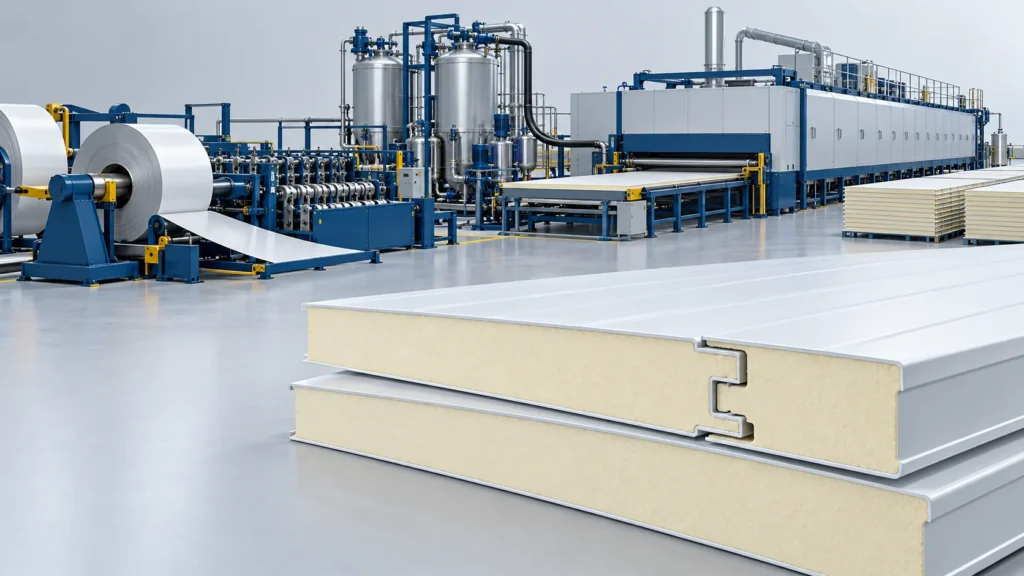
Find answers about Cold Storage PU/PIR Sandwich Panel Production Line, including material selection, equipment configuration and the information needed to plan a production line.
How is thick-core cure selected?
Is conductivity or closed-cell content guaranteed by this line?
How are cam-lock panels produced?
How are pentane safety functions defined?
How much space and commissioning time are required?
Submit Your Production Goals
Share the finished product, material, target capacity, automation requirements and factory conditions to discuss a project-specific line configuration.


