
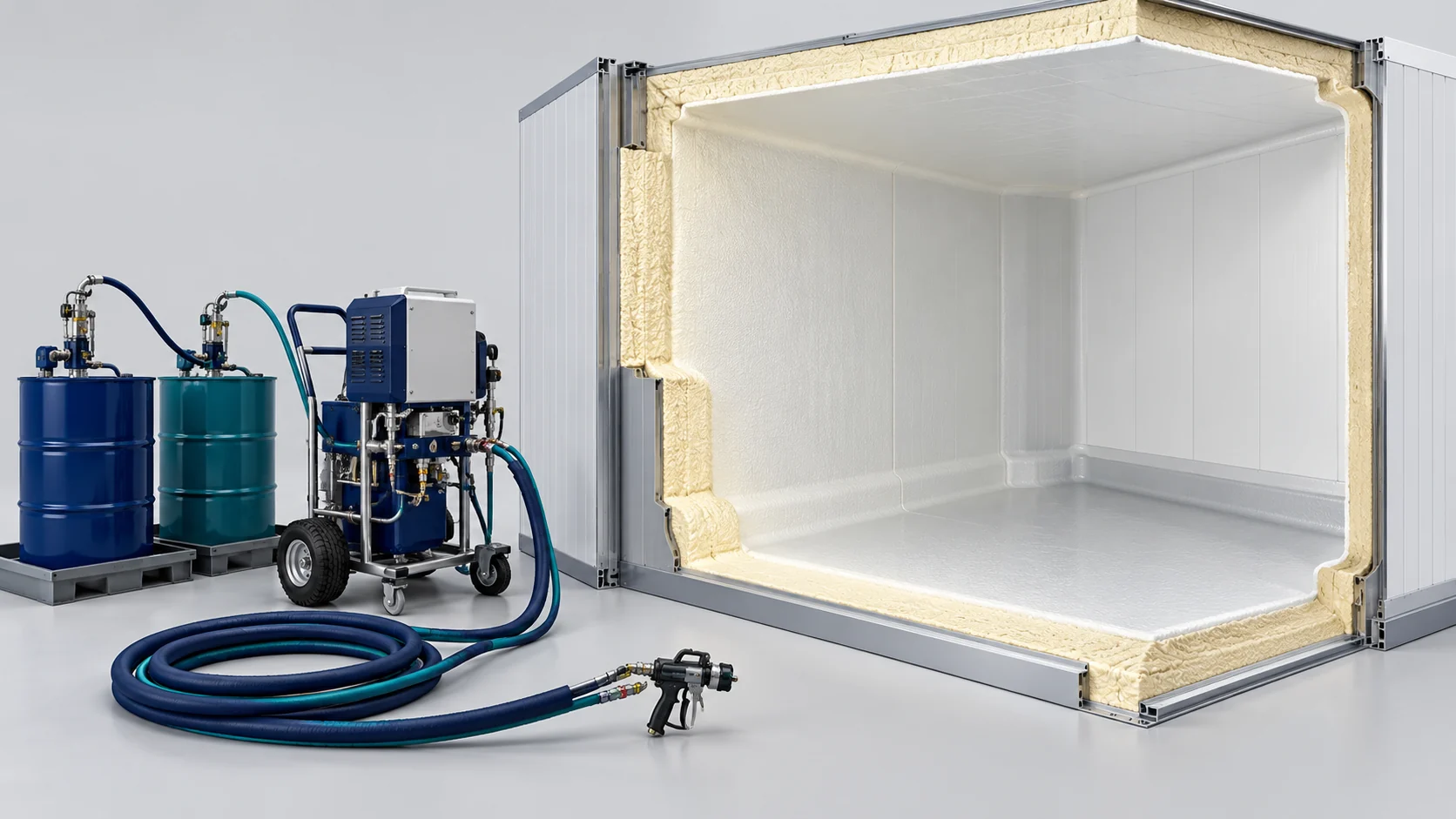
Cold Storage PU Foam Insulation Solution
High-pressure in-situ polyurethane insulation systems for commercial cold rooms and deep-freeze facilities, delivering seamless hermetic barriers down to -40°C.
Seamless In-Situ Polyurethane Solutions for Cold Storage & Freezers
Extreme temperature differentials in commercial cold storage facilities (-20°C to -40°C) generate severe vapor drive forces that degrade conventional insulation. Prefabricated sandwich panel assemblies rely on joint gaskets and silicone seals that eventually shrink, crack, and leak under continuous thermal cycling, resulting in heavy frost accumulation, ice bridging, and soaring refrigeration power bills. Haifeng’s high-pressure in-situ spray and pour polyurethane solution applies a continuous, jointless insulation mantle directly onto cold room floors, walls, and ceilings. Solidifying in seconds with a closed-cell ratio exceeding 96%, the monolithic barrier permanently stops vapor infiltration and guarantees thermal conductivity down to λ ≤ 0.020 W/(m·K).
100% Frost-Free Monolithic Integrity
Eliminates mechanical joint gaps and thermal bypass channels around ceiling joists and wall intersections, permanently preventing ice build-up.
Severe Vapor Barrier Durability (λ ≤ 0.020)
A 96%+ closed-cell microcellular structure resists intense water vapor transmission, ensuring decades of uncompromised refrigeration performance without moisture logging.
Spraying equipment is configured with installation and inspection responsibilities agreed for the site.
Production Workflow for Cold Storage PU Foam Insulation Machine System
The workflow for Cold Storage PU Foam Insulation Machine System covers Substrate Cleaning, Thermal Conditioning, Monolithic Spraying, Polyurea Topcoat. Confirm the sequence and equipment interfaces against the selected material system and product design.
Substrate Drying & Primer Activation
Concrete or masonry walls are dried and swept; specialized moisture-barrier primers are rolled onto surfaces to promote high chemical bonding strength.
High-Pressure Precursor Thermal Regulation
High-output proportioner heaters and heated hoses maintain chemical precursors at 50°C–58°C, lowering fluid viscosity for complete impingement atomization.
Multi-Pass In-Situ Cold Room Spraying
Formulated chemicals are sprayed in successive 20–30mm passes; exothermic heat crosslinks the rigid core, creating an unbroken 100–200mm envelope across corners.
Technical Specifications
Configuration and application values from the supplied engineering brief. Material properties and project results apply to their stated conditions.
| Technical Parameter | Standard Specification / Value | Engineering Context & Verification |
|---|---|---|
| Target Application | Cold Rooms, Deep Freezers, Blast Freezers, Cold Logistics | Extreme cold temperature containment (-40°C) |
| Material Matrix | Rigid Closed-Cell Polyurethane Foam (SPF) | High-index formulation for refrigeration |
| Core Foam Density | 40 – 48 kg/m³ | Optimized for thermal efficiency and compression |
| Thermal Conductivity (λ) | ≤0.019 – 0.021 W/(m·K) | ASTM C518 steady-state thermal test |
| Closed-Cell Content | ≥96% | Eliminates vapor migration & frost absorption |
| Compressive Strength | >250 kPa (Floor grade >350 kPa) | Supports concrete topping and heavy pallet loads |
| Proportioner Fluid Output | 8 – 16 kg/min | Continuous hydraulic displacement output |
Reference Haifeng Insulation Equipment
Spraying equipment is configured with installation and inspection responsibilities agreed for the site.
PU Spray Machine | Cold Storage Insulation
PU spraying machine designed for cold storage and refrigerated facility insulation, delivering high adhesion and closed-cell structure for superior thermal performance. Ideal for large cold rooms and pipe insulation.
High-Pressure PU Foaming Machine | Cold Rooms
High-pressure PU foaming machine designed for cold room rigid foam insulation, delivering superior thermal performance and high closed-cell content. Ideal for cold storage and refrigerated facility construction.
Low-Pressure PU Foaming Machine | Cold Storage
2A2B polyurethane foaming machine for cold storage rigid foam insulation, featuring high-precision metering for low thermal conductivity and high closed-cell content. Ideal for insulated panels and pipe insulation.
Key Engineering Advantages
Application-specific process controls, tooling and equipment integration.
Zero Seam Thermal Bypass
Completely seals internal columns, hangers, and floor junctions, eliminating perimeter frosting and ice buildup.
35% Refrigeration Energy Savings
Outstanding thermal barrier efficiency (λ ≤ 0.020) reduces runtime on commercial compressor racks.
Zero Vapor Migration (96%+ Closed-Cell)
Microcellular structure repels moisture vapor transmission, preventing core rot over decades.
Heavy-Duty Floor Load Bearing (>350 kPa)
High-density formulation withstands heavy concrete floor toppings and loaded forklift traffic.
Related Project Records and Industry References
Review the evidence type on each record. Haifeng project figures describe their own configuration; public industry references identify third-party sources and are not Haifeng deliveries.
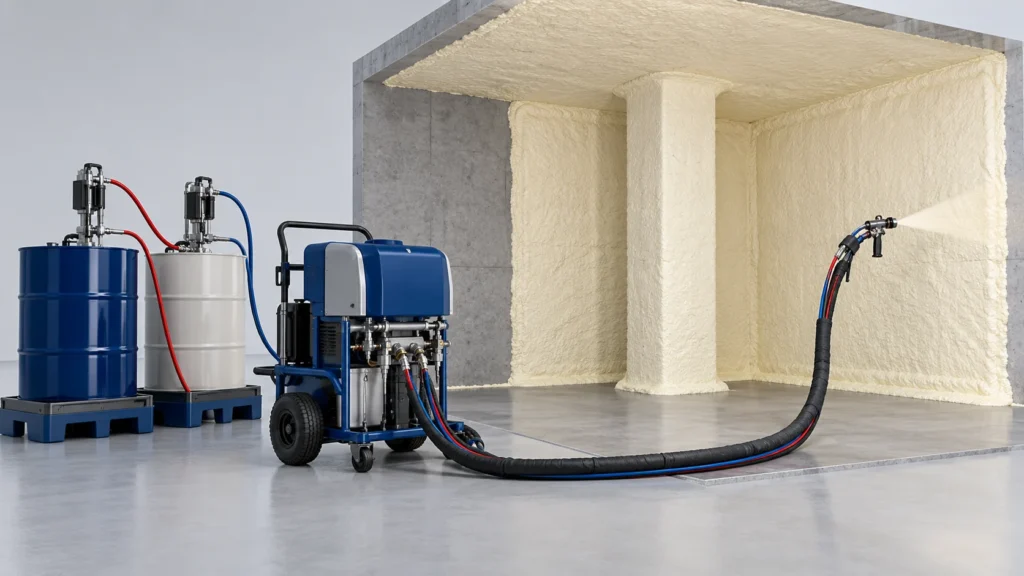
Commercial Cold Room In-Situ PU Line Project in Morocco
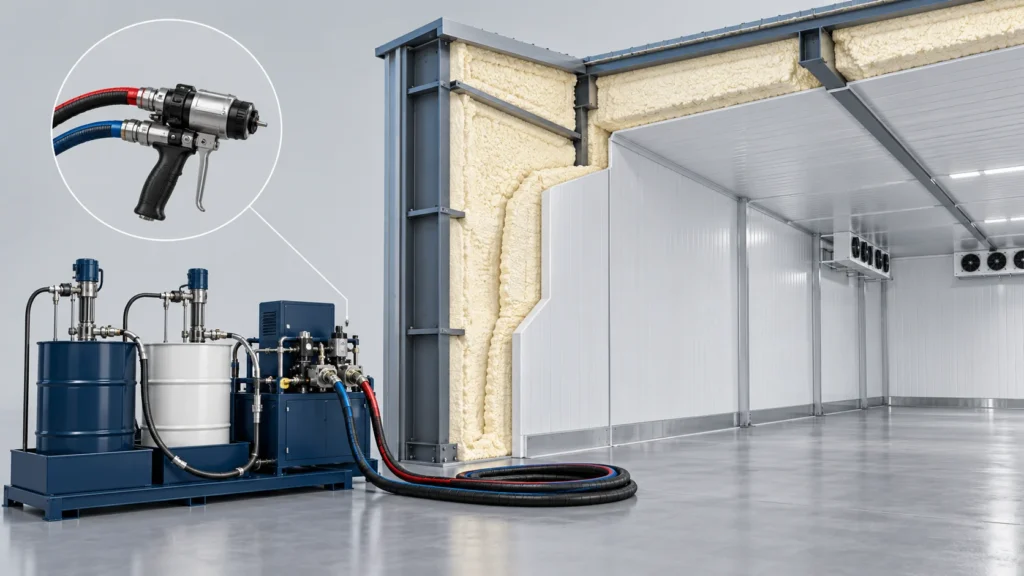
Deep-Freeze Warehouse PU Insulation Project in Kazakhstan
Frequently Asked Questions
Process selection, site conditions and equipment integration.
Why is in-situ spray foam better than sandwich panels for deep-freeze storage?
Can spray foam be used on cold storage concrete subfloors?
How is air tightness verified on the completed cold room?
What is the typical installation and commissioning timeline on-site?
Is insulation spray the same as corrosion coating?
What information is needed to size the production line?
What is included in the equipment package?
Are cycle time and finished-product performance fixed?
Submit Your Production Goals
Share the finished product, material, target capacity, automation requirements and factory conditions to discuss a project-specific line configuration.


