Cold-storage insulation is usually compared on thermal conductivity, but the number that decides most projects is not lambda. Spray rigs and panel manufacturing put similar rigid polyurethane chemistry through two very different production systems. One mixes and rises on site against whatever substrate the building offers. The other forms the foam between facings in a factory and ships a finished element with its own vapour barrier and its own repeating joint. The choice changes your capital exposure, your programme, your labour model, and who carries the risk when a joint leaks. It is a capacity and responsibility decision before it is a materials decision.
Why the same foam chemistry behaves differently on site and in a factory
Both routes start with a two-component system and end with rigid closed-cell foam. What separates them is where the foam rises, what confines it, and what happens where one pour meets the next.
In a panel line the foam is injected into a closed cavity between two facings and deliberately overpacked. More material goes in than free rise would need, so the foam fills the cavity, presses against the facings and bonds to them. In spray application the foam rises in the open against a substrate. Density is set by how much material the gun lays down per pass, at what distance, and how warm the previous pass still is.
Direction matters as well. Foam that rises freely against a flat surface tends to elongate its cells in the rise direction, and both compressive strength and thermal conductivity become directional as a result. Confined panel foam is shaped by the belt gap and the facing bond. Sprayed foam is shaped by the applicator’s pass.
Then there is the boundary. A panel brings a repeating joint at every panel width. Sprayed foam brings terminations at penetrations, at structural connections and at the edge of each build. Neither boundary is free, and neither shows up in a lambda value.
A product data sheet therefore says less about a finished cold room than the assembly drawing does. The foam is one layer in a system that also includes facings, sealants, fixings and the vapour barrier.
How sprayed insulation behaves inside a cold room
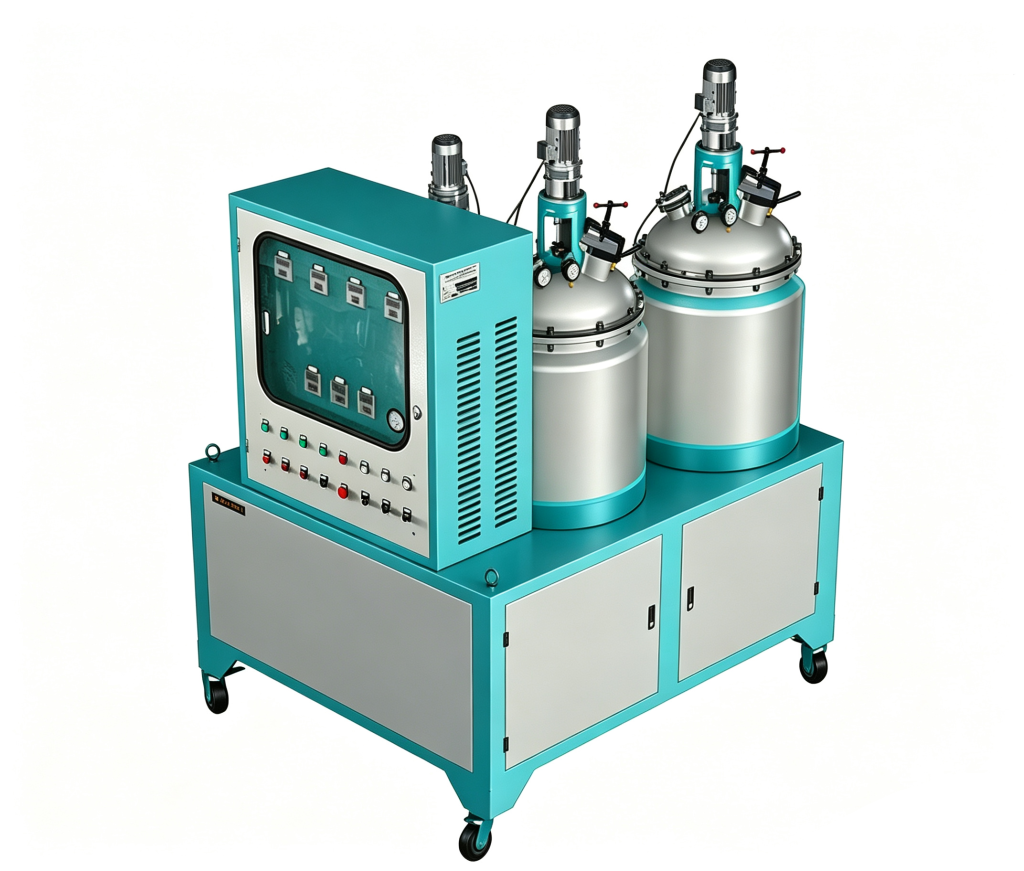
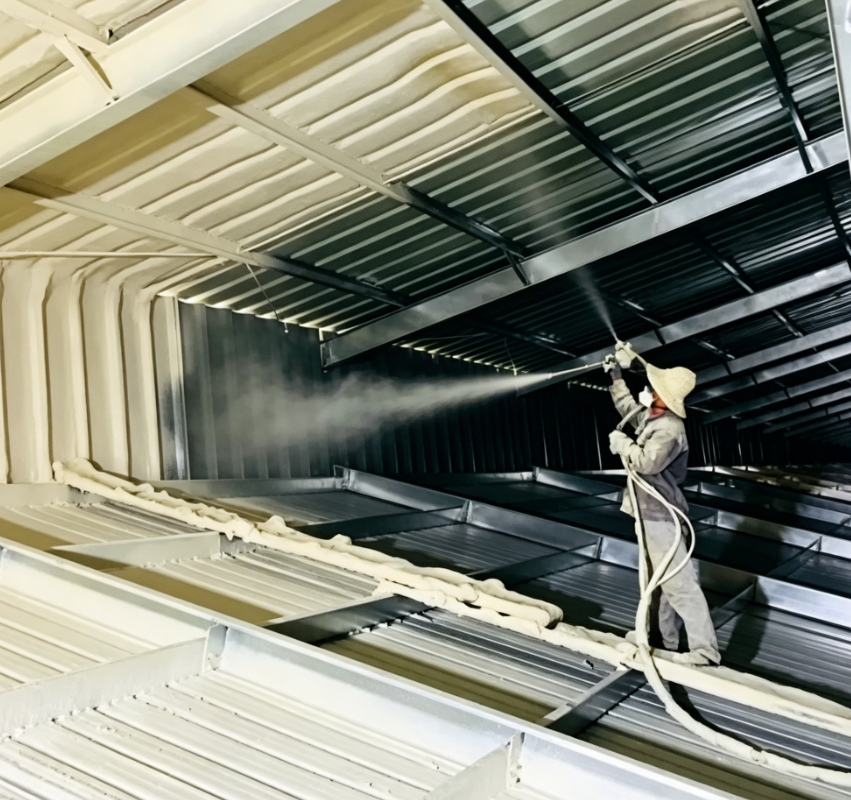
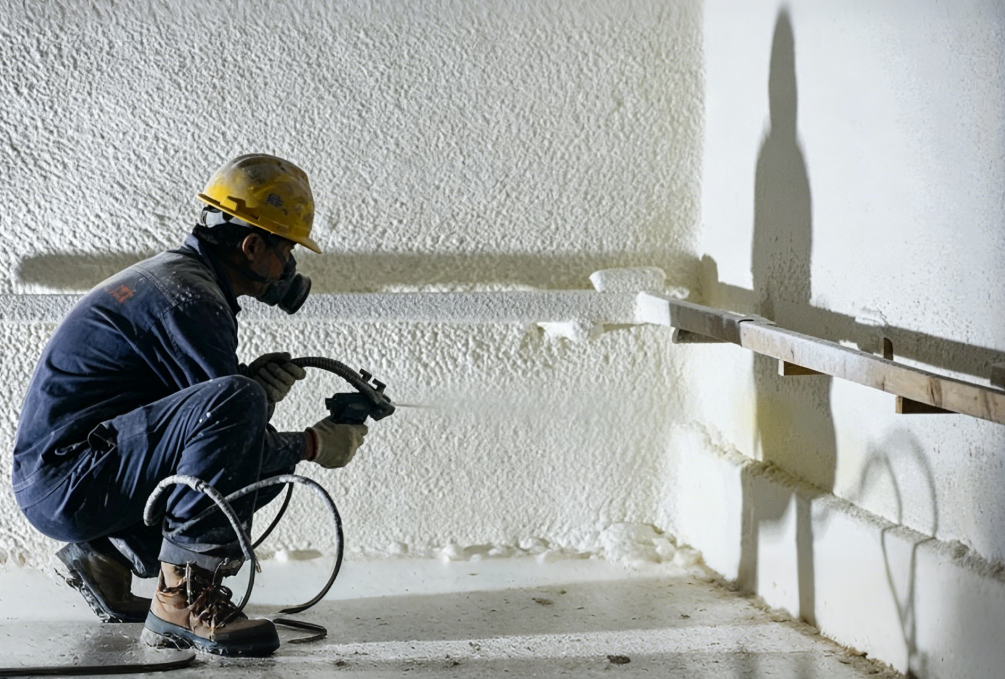
The equipment side is straightforward. A hydraulic proportioner heats both components, pumps them at pressure through a heated hose, and the impingement gun mixes them at the tip. A cold-storage machine such as the HF-SP-03 delivers up to 10 kg/min at 110 bar or 5 kg/min at 160 bar, with a 6 kW heater and up to 93 m of heated hose. Those numbers decide how fast a pass can be laid and how far a wall can sit from the rig before the material’s own reaction time forces a stop.
Thick builds go on in successive passes. A single heavy pass traps exotherm in the core, which can scorch the foam, open cells, or leave a soft layer at the interface. The workable pass thickness belongs to the system, and the supplier’s process data should state it rather than leaving it to habit.
A sprayed system’s behaviour in a thick build is set by the formulation long before the gun is adjusted. <What Is Spray Polyurethane Foam Composition And Application> covers how spray polyurethane foam is composed and where the system is applied.
Adhesion is a surface property. Dust, release agent, condensation, rust and a cold substrate all reduce it. Substrate temperature has to stay above the dew point by the margin the foam supplier specifies, otherwise moisture condenses at the interface and the bond is lost before the foam finishes rising. Sprayed rigid foam is specified as a system rather than a material, and EN 14315-1 covers that system before installation [1], which is why substrate condition, thickness and pass schedule belong in the specification.
The route earns its place where panels cannot go: curved soffits, dense penetrations, plant rooms with irregular shapes, existing structures that cannot take panel weight or lifting access, and repair work.
The finish is the part buyers underestimate. In food and pharmaceutical cold stores the sprayed face is rarely the final surface. The foam acts as insulation and air barrier, and the room still needs a cleanable, vapour-tight face. A wall sprayed on its cold face still needs the vapour barrier on the warm side, however good the foam is. Add weather, wind, ventilation, PPE, overspray containment and a structure that must be watertight and dry before the rig arrives, and the real constraint on this route becomes the site rather than the machine.
How a panel line controls what the room actually gets
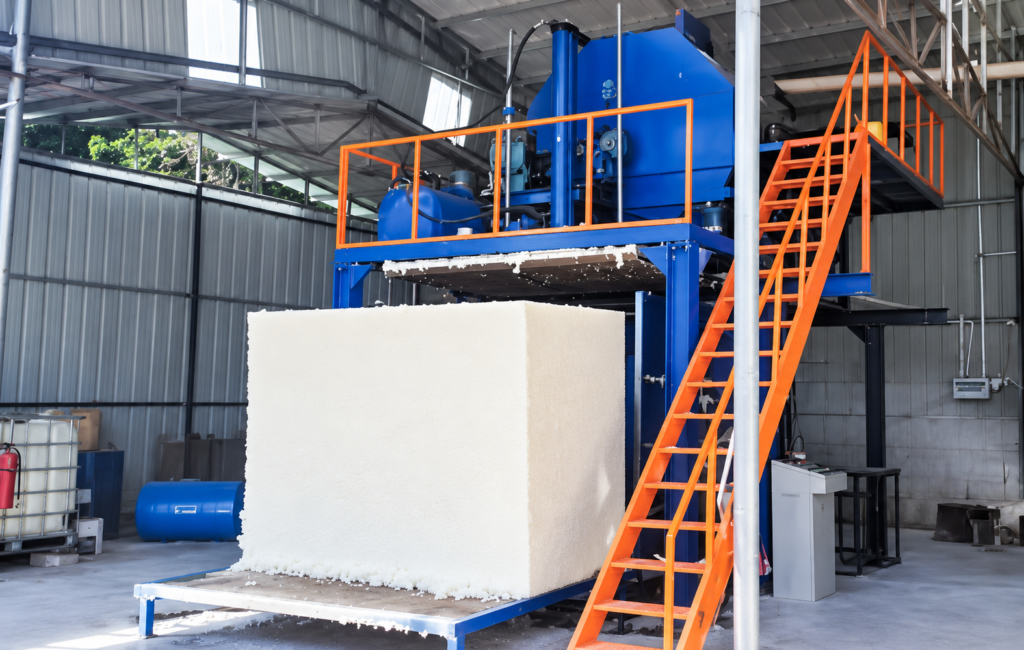
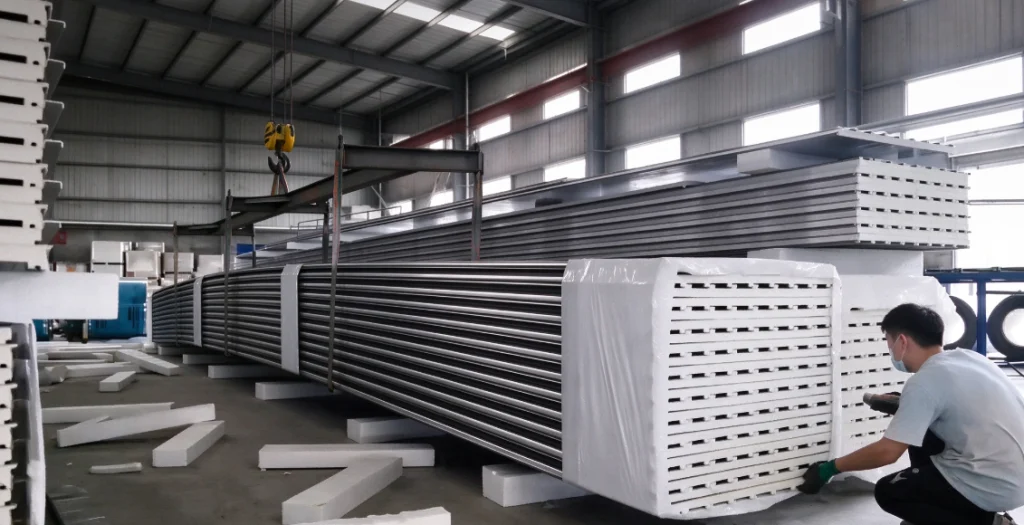
A continuous line feeds facings from coils, injects foam at the head, sets thickness with the double belt and cuts length with the saw. A representative specification for a continuous PU sandwich panel line reads 1 to 15 m/min, 30 to 200 mm panel thickness, 10 to 18 MPa mixing pressure and metering within 0.3% across the range. A batch line works differently: fixed molds in a hydraulic press, 20 to 300 mm thickness, and a cycle measured in minutes per panel rather than metres per minute.
That difference is the whole argument. The factory controls density through overpack, thickness through the belt gap or mold cavity, flatness, facing bond, and the record attached to each panel.
How thickness and density are held
On a continuous line the belt gap sets thickness and the cut-off saw sets length, so a panel leaves at the dimension the line was set for. Density comes from overpack: the head injects more material than free rise would need, the foam fills the cavity and presses against the facings, and that excess pressure is what produces the bond. Under-fill leaves voids at the edges and a panel that looks acceptable until it is cut. On a batch press the mold cavity does the same job, with cycle time deciding how many panels a shift produces.
Cavity filling depends on the reaction profile staying matched to the line speed. <The Role Of Rise Time In Polyurethane Foaming> covers where rise time sits inside that profile.

What the facings do for the vapour barrier
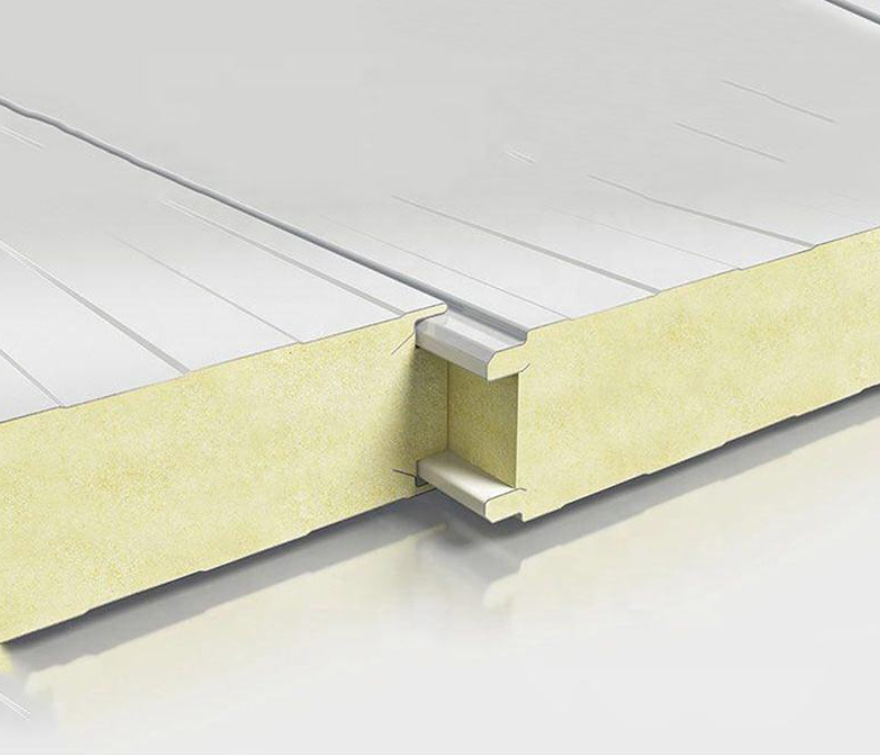
A steel or foil facing is a vapour barrier, and in a cold room it is usually the hygienic surface as well. The barrier is only as continuous as the joint: tongue-and-groove edges, cam locks and a sealant bead are part of the insulation system, not accessories. A facing that debonds at the edge leaves a path behind the foam. Factory-made metal-faced panels are declared as complete elements under EN 14509 [2], so the facing, the foam and the bond between them are assessed together rather than as separate materials.
Comparing thermal performance, joints and fire classification
At equal chemistry and equal thickness, the difference in declared conductivity between a panel and a spray build is small next to the difference the assembly makes. Two effects dominate: density variation and joints.
A joint is a linear thermal bridge and a possible vapour path at the same time. The effect scales with joint length per square metre, which is why a room built from narrow panels loses more than the same room built from wide ones. Spray has no repeating joint, but it has terminations at penetrations and structural connections, and those need the same detailing as a panel joint.
Foam that shrinks after demoulding pulls the facing in and opens the joint line it was supposed to seal. <Causes Of Shrinkage In Polyurethane Foam How To Control It> covers what drives that movement and how it is controlled.
Reaction to fire is classified under EN 13501-1 [3], and the class belongs to the configuration that was tested. A panel’s class covers the complete element including facings and the bond. A spray system’s class covers a named substrate at a named thickness and density. Change the facing, the substrate or the build thickness and the earlier class does not follow.
| Decision point | What the record covers | Do not infer |
|---|---|---|
| Declared thermal conductivity | A specimen tested at a stated density and thickness, reported in the product’s test documentation | That the finished room reaches the same U-value; joints, fixings and thickness tolerance sit outside that number |
| Reaction to fire class | The tested configuration: a complete panel element, or a spray system on a named substrate at a named thickness and density | That the same class applies to a different facing, a thicker spray build or another substrate |
| Compressive strength | A specimen tested in a stated direction at a stated density | That the value holds across the rise direction, or at a lower overpack |
| Installed thickness | Belt gap or mold cavity on a panel line; pass schedule on a spray job | That a nominal 100 mm build has the same installed thickness distribution by either route |
| Adhesion or facing bond | A pull-off or bond test on the named substrate and surface condition | That the result transfers to another substrate, another preparation method or another temperature |
None of these records compares two suppliers. They mark the limit of what a test report can tell you, and that limit is the same for both routes.
Site logistics, programme and the skills each route needs
On a spray job the revenue is tied to site readiness. Weather, access, ventilation and other trades all gate the work, and a crew that sprays well is a trained crew. The difference between a strong and an average applicator shows up later as density variation and adhesion failures, not as an obvious defect on the day.
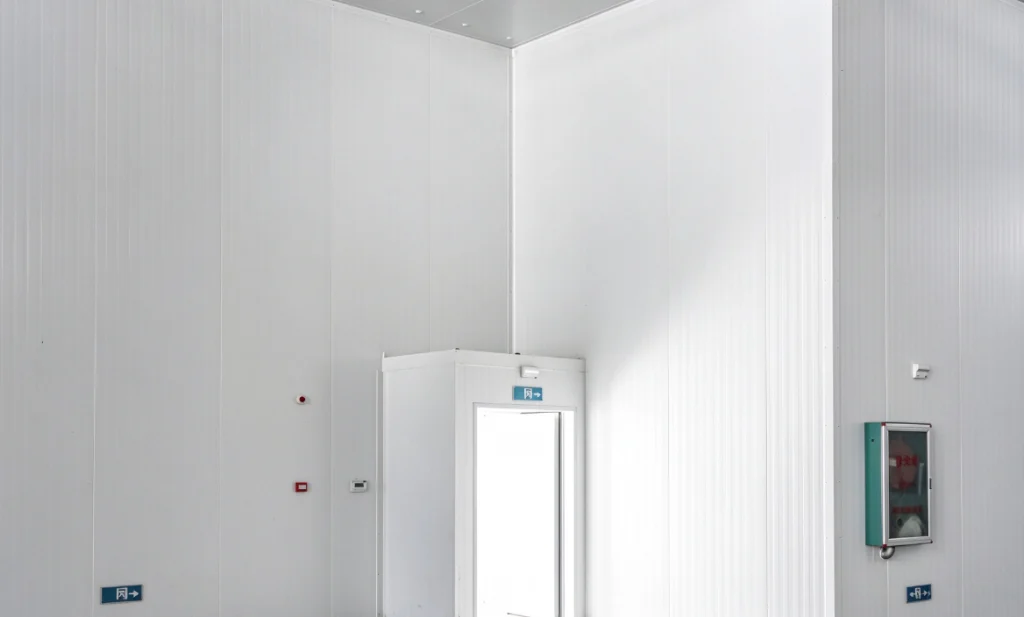
Panels decouple production from site. Once the panels arrive, the room goes up quickly with lifting equipment and a fitting crew, and rain matters far less. The trade-off is that the panel dimension fixes the room grid, so every door, opening and penetration has to be designed before the line runs. A late change means a new panel, not another pass of foam.
Inspection differs too. On site the inspection happens during application and cannot be repeated afterwards. In the factory it is a batch record, and a rejected panel is scrap rather than a repair.
Capital, throughput and the utilisation you can actually sell
A spray rig is the lower entry cost. One machine serves many projects within hose reach, so the investment is recovered project by project. The constraint is not the machine; it is the crew and the site. A rig earns while it sprays, and it sprays while the building is ready.
A panel line is the opposite trade. The capital sits in a belt, a cut-off, facings handling and the building to house them, and it earns while the line runs. Utilisation decides the cost per square metre, not the headline output.
The middle ground is a batch line, which trades continuous speed for flexibility. Haifeng’s batch-type panel line, for example, is specified for 20 to 300 mm thickness with a 3 to 10 minute cycle per panel and 8 to 15 MPa mixing pressure, which suits mixed sizes and short runs better than one standard product.
A quick illustration, using the upper end of that cycle and an assumed 70% utilisation: one mold position returns six panels an hour at continuous running and about four in practice. Additional mold positions multiply that before anyone touches the cycle time. On a spray job the same arithmetic runs through crew hours and passes per wall rather than panels per hour, which is why the two routes are rarely compared honestly on a single cost per square metre.
A decision table for your order book
| Route | Fits when | Do not choose it when |
|---|---|---|
| Spray rig, new build | Curved soffits, dense penetrations, irregular plant rooms, or a structure with no lifting access | The programme cannot tolerate weather exposure, or the site has no room for ventilation and overspray containment |
| Spray rig, operating facility | Small areas, repairs, tie-ins and plant insulation inside a running building | The client needs a demountable or relocatable room |
| Continuous panel line | One or two standard thicknesses, high annual area, repeatable room sizes, long runs | Order sizes are small, or thickness and facing change every few weeks |
| Batch panel line | Mixed sizes, special facings, prototypes and short runs | The contract needs continuous high-volume output at a fixed price |
| Hybrid: panels plus spray | Large rooms with difficult wall-to-roof details and complex penetrations | Nobody on the job is clearly responsible for the interface between the two |
The hybrid row is the one most often rejected for the wrong reason. Technically, panels for the envelope and spray for the junctions is a sound combination and often the cheapest way to close a difficult roof-to-wall detail. Commercially it fails when two subcontractors each assume the other owns the interface. If you take that route, name the owner of each joint in the contract rather than in a site meeting.
What to verify before you commit
For a spray route, the verification that matters happens on the actual substrate. A mock-up at production thickness, a pull-off adhesion test, a density coupon cut from the same pass, a thickness survey across the wall and a core temperature record give you something to compare against the specification. The pass schedule should be written down and signed, because the next crew will not reproduce it from memory.
For a panel route, ask for the batch record: dimensions, density, facing bond, and a joint mock-up assembled with the specified sealant. A trial corner built from production panels tells you more about fit and sealant behaviour than a flat sample ever will.
Checks you can run in a day
Cut a coupon from a sprayed test area and weigh it for density. Pull a bonded disc and record where it fails, in the foam or at the substrate. Measure thickness at ten points across a wall or a panel face. Assemble one joint with the specified sealant, then look at it under a light from the cold side.
What the paperwork has to show
The declared assembly value, the fire class of the tested configuration, the substrate or facing specification, and a named party responsible for the vapour barrier. If any of those is missing, the room is being bought on a foam data sheet rather than on a system.
Send the room schedule before you choose a route
Tell us the room sizes and insulation thicknesses, the annual area you expect, the substrate you will spray onto or the facing you want on the panel, the required fire class and U-value, and whether the rooms are fixed or relocatable. Include the drawing with joint and penetration details, because that is where the two routes usually separate. Haifeng Polyurethane Machinery supplies both spray machines and continuous and batch panel lines, so the comparison can be run against the same schedule instead of one side of it. Email Info@chinahaifeng.com or message WhatsApp 86 13566296633.
FAQ
Can sprayed foam and sandwich panels reach the same U-value?
Yes, at the same thickness and chemistry the difference in the foam itself is small. The assembly decides the rest. Joints, fixings and thickness tolerance all sit outside the foam’s declared value, so a room built from narrow panels may need more thickness than a sprayed room to reach the same target. Compare declared assembly values, not foam data sheets.
Which route is faster on a large cold-store project?
It depends on where the bottleneck sits. A spray rig is limited by site readiness, weather and the number of passes a wall needs. A panel line is limited by factory utilisation and by lifting on site. For a large repeatable room with good access, panels usually shorten the site programme. For an irregular retrofit, spray is often the only route that fits at all.
Does sprayed foam need a separate vapour barrier in a cold store?
The barrier belongs on the warm side. Closed-cell sprayed foam acts as an air barrier and slows vapour movement, but a vapour-tight membrane or coating on the warm face remains the normal cold-store detail, particularly where the foam goes on the cold face of a structure. The panel route carries the barrier in the facing, and that only holds if the joint sealant is continuous and compatible with the facing coating.
Can one factory run both a panel line and a spray rig?
Yes, and many do. The two operations share chemistry knowledge and quality systems but not labour or scheduling. The useful split is panels for the repeatable envelope and a rig for junctions, repairs and site work. Keep the foam systems separate unless the supplier confirms the same formulation suits both processes at their different densities and pass thicknesses.
References
[1] EN 14315-1:2013, “In-situ formed sprayed rigid polyurethane (PUR) and polyisocyanurate (PIR) foam products, Part 1: Specification for the rigid foam spray system before installation,” CEN, 2013.
[2] EN 14509:2013, “Self-supporting double skin metal faced insulating panels, factory made products: specifications,” CEN, 2013.
[3] EN 13501-1:2018, “Fire classification of construction products and building elements, Part 1: Classification using data from reaction to fire tests,” CEN, 2018.
If you’re interested, check out these related articles:
What Is Spray Polyurethane Foam Composition And Application
RRIM Vs RIM Which Process Suits Your Structural Part
How Polyurethane Rollers Are Made From Casting To Cure