Choosing Flame Retardants for Polyurethane: 5 Key Steps
Review a process-based approach to polyurethane flame-retardant selection, from the required fire test to chemistry, dispersion and production trials.


Review a process-based approach to polyurethane flame-retardant selection, from the required fire test to chemistry, dispersion and production trials.

Explore how polyurethane fillers change viscosity, settling, abrasion and mixing, and what those changes mean for pumps, recirculation and dosing equipment.

Review applications for polyester-based polyurethane, its service-condition trade-offs and the material-conditioning and processing requirements behind selection.

Compare polyether and polyester polyols through service conditions, hydrolysis behavior, mechanical properties and metering-line processing requirements.

Compare amine and diol chain extenders for polyurethane, including material-selection trade-offs and the temperature, ratio and equipment changes needed when switching.

Understand polyurethane exotherm peaks and review how formulation, part geometry, temperature and heat removal affect cure and finished-part quality.

Review polyol and isocyanate equivalent-weight calculations, connect them to isocyanate index, and identify common errors in polyurethane formulation math.

Explore polyurethane elastomer chemistry, material types, hardness and mechanical properties, with production considerations for selecting a processing route.

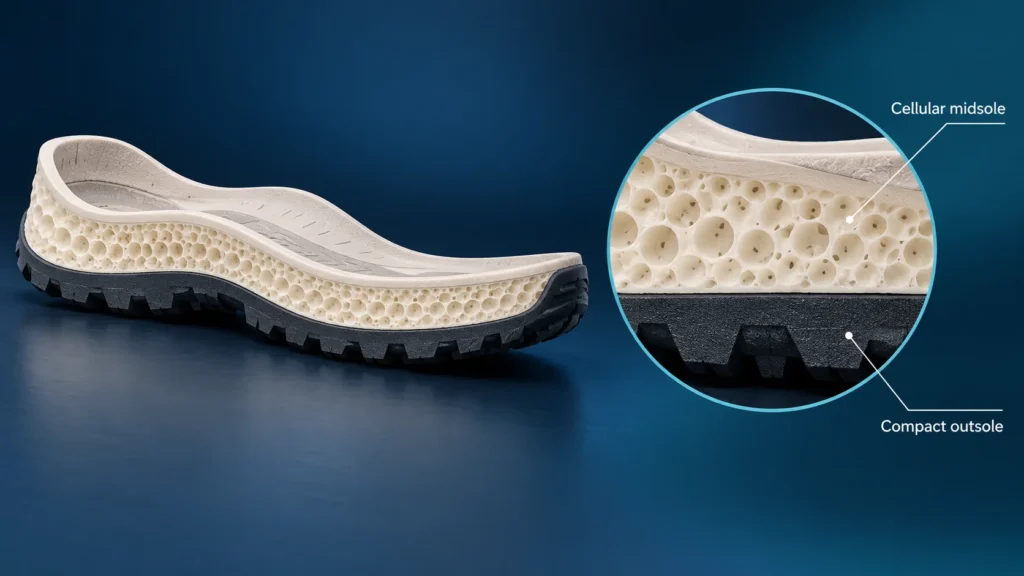
Explore dual-density polyurethane sole production, from the two-layer design and pouring sequence to the metering and reaction controls needed for consistent molding.

Compare dynamic and high-pressure impingement mixing for polyurethane, including shot size, viscosity, cleaning, maintenance and process-selection trade-offs.