

One of the most expensive decisions in a polyurethane pouring or foaming project comes before the machine is ordered: deciding how the polyol and isocyanate are actually mixed. I have walked into plants where a dynamic mixing head was chosen because the initial quote was easier to justify, and the real cost showed up later in stuck rotors, slow color changes, and scrap on short shots. The difference between dynamic and high-pressure mixing is not just two mounting patterns. It changes shot-weight control, filler handling, clean-up time, and how well the metering system holds ratio when flow rate moves.
The Mixing Principles Are Not Interchangeable
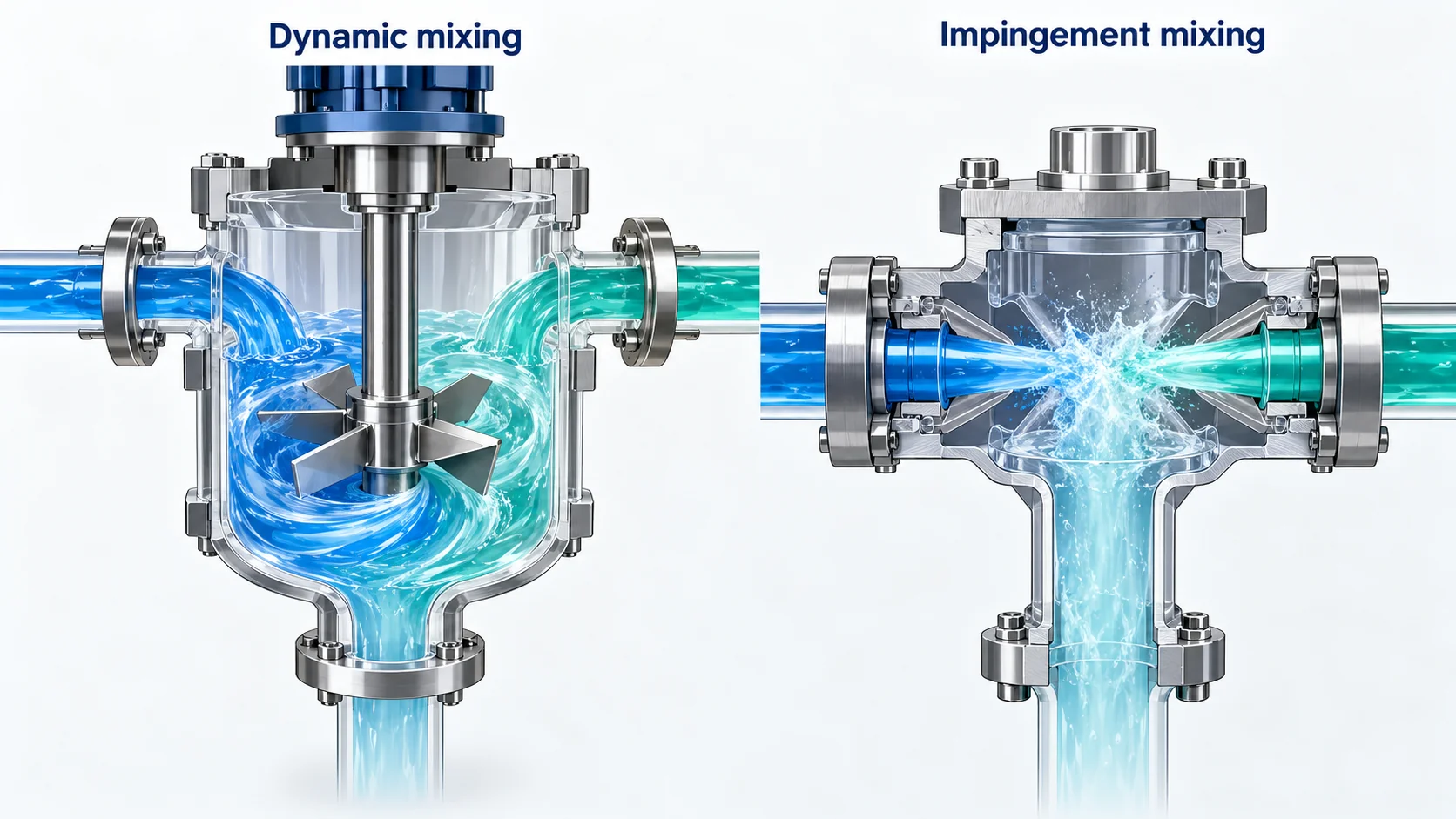
A dynamic mixing head uses a motor-driven rotor or stirrer inside the mixing chamber. The rotor supplies mechanical shear; mixing quality depends on shaft speed, rotor geometry, and the short residence time before the mixture exits. In our low-pressure casting equipment, mixing head speeds are typically in the range of 6,000 to 12,000 r/min depending on shot size and viscosity. Injection pressures are much lower — often less than 2.5 MPa in the pouring circuit — because the work of mixing is done by the rotor, not by pressure.
A high-pressure mixing head uses impingement. The A-side and B-side enter a small chamber through opposed nozzles at high velocity, and the collision turns pressure energy into turbulence. In the high-pressure machines we build, the mixing pressure target is commonly 150 to 200 bar. There is no mechanical rotor in the chamber; a plunger clears the mixed material at the end of every shot. That makes the mixed volume small, the residence time very short, and the cleaning sequence different from a dynamic head.
Machine safety is assessed against the requirements applicable to the equipment and destination market, including EN 1612 where applicable for reaction moulding machines and ISO 12100 for risk assessment [1][2]. A dynamic head has rotating parts and cleaning access to guard; a high-pressure head has pressure energy and injector access to control. This comparison is not a certificate of compliance.

Where Dynamic Mixing Heads Earn Their Keep
Dynamic mixing is at its best when the shot is small or medium, when the formulation carries fillers that need continuous shear, and when the plant can tolerate a slower clean-to-next-shot time. For elastomer casting, seal strips, rollers, and small molded parts, the rotor gives consistent dispersion without relying on violent stream collision. Haifeng low-pressure casting units also use this approach to keep the vacuum-degassed mixture path short and controlled from chamber to mold, which matters because a degassed material should not be re-gassed before it enters the cavity.
The cost to watch is changeover, not mixing quality. A dynamic head must be flushed and purged more thoroughly; any material left in the rotor chamber sets up into a hardened deposit and becomes tomorrow’s leak or jam. That is why we treat cleaning time as a cycle-time input, not an afterthought.
Shot weight is usually the first number to confirm here. If your molds require a few tens of grams or a few hundred grams, mechanical mixing can hold a precise shot. If the same line must also fill a large cavity, the residence time changes and the shot-to-shot consistency becomes harder to prove without testing.
Shot-weight control decides whether a dynamic mixing head can hold tolerance across all molds. How To Calculate Shot Weight In Polyurethane covers the calculation sequence production planners actually use.
Where High-Pressure Impingement Wins
High-pressure mixing becomes the stronger choice when the line runs high flow rates, fast cycles, or large molds. In automotive seating, rigid foam panels, insulation-filled panels, and RIM structural parts, the short injection window and rising cream time leave little room for a long mixing chamber. Impingement mixes quickly, clears quickly with a plunger, and returns to the next shot without the rotor-flush routine. That is why high-pressure heads are common in high-output foaming and in RIM or SRIM applications where reaction speed controls the cycle.
The trade-off is that high-pressure systems are more sensitive to nozzle condition and to any flow-rate mismatch between the two sides. Because mixing energy comes from the collision, a worn nozzle or a lagging pump can produce ratio streaks even when the metering readout looks normal. Filler-loaded systems can still run on high-pressure heads, but the filler particle size and hardness determine how aggressively the nozzles and plunger wear.
When reinforced formulations enter the picture, the head choice follows the process. RRIM Vs RIM Which Process Suits Your Structural Part covers where fiber loading changes machine selection.

Shot Size, Viscosity, and Cleaning Comparison
The table below is not a scoreboard. A dynamic head is not automatically worse, and high-pressure is not automatically better. The correct column is the one that survives your most difficult material and your fastest changeover demand.
| Criterion | Dynamic mixing head | High-pressure impingement head | What to verify |
|---|---|---|---|
| Typical metering pressure | Low-pressure circuit; often below 2.5 MPa | 150–200 bar mixing pressure | Pump capacity and hose rating |
| Mixing energy source | Motor-driven rotor, roughly 6,000–12,000 r/min | Opposed-stream collision | Maintenance and spare part inventory |
| Shot weight fit | Small to medium precise shots | Medium and large high-flow shots | Min/max flow, not nominal flow only |
| Filler response | Good shear dispersion; rotor seal wear | Short mixing path; nozzle/plunger wear | Real filler particle size and hardness |
| Color change | Flush plus purge; more steps | Plunger-cleared; often faster | Clean-to-next-shot time |
| Ratio control | ±0.3% dynamic metering possible | ±0.3% dynamic range typical | Accuracy at minimum and maximum flow |
| Residence time | Longer; needs timed dispense | Very short | Cream time and pot life |

Mid-line specification check. If your two most extreme production formulations differ by more than 30% in shot weight or system viscosity, do not select a mixing head from a generic table. Send the A-side viscosity, B-side viscosity, minimum and maximum shot weight, filler type and loading, and daily cycle count to Info@chinahaifeng.com or WhatsApp 86 13566296633. The recommendation should follow the hardest formulation you actually run, not the easiest one in the demonstration video.
Cleaning, Changeover, and Maintenance Reality
Production people rarely call to say a head mixes poorly. They call because a head becomes a maintenance burden. The cleaning sequence is where dynamic and high-pressure machines feel most different. A dynamic head has more wetted surfaces inside the rotor chamber, and the flush must reach those surfaces before the material reacts. A high-pressure head cleans the chamber with a mechanical plunger, but the nozzle tips and filters still need scheduled inspection, especially with filled or high-viscosity systems.
For guarding and maintenance access, machine-level risk assessment should follow ISO 12100 [2], and electrical equipment design should meet EN 60204-1 [4]. For low-pressure dispensing, nozzle geometry also affects how clean the cut-off is; Haifeng holds Chinese patent ZL 201611168678.6 [3] for a precision pouring nozzle used on compact rotary-disc lines. A good nozzle does not replace rotor care, but it reduces the dribble that becomes edge finish and scrap.
A Simple Selection Checklist
Before you choose, write down:
- Actual shot weight range from the smallest insert to the largest cavity, not just the daily average
- Viscosity of each side at processing temperature, including retarded and accelerated conditions
- Filler type, particle size, and loading by weight
- Cream time and pot life for the fastest formulation
- Required clean-to-next-shot time under two color-change schedules
- Metering accuracy at the minimum and maximum flow, not at a comfortable middle flow
- Available maintenance skill and spare parts stock
Run the final trial with production material. Lab surrogates are fine for first screening, but a mixing head does not decide in a lab; it decides on a line with real viscosity, real fillers, and a real shift-end cleaning buzzer.
Talk to a Haifeng Engineer
If you are comparing a dynamic mixing head and a high-pressure mixing head for the same line, send process data rather than a list of model numbers. Include two extreme formulations, target shot weight range, filler loading, daily cycle count, color-change frequency, and any certification requirements. A Haifeng engineer can then look at the mixing method from the meter’s point of view: where ratio error begins and where the next shot gets contaminated.
As the sole drafter of China’s PU pouring machine industry standard, Haifeng Polyurethane Machinery works across footwear, automotive, rail transit, and other sectors with EPC+M+O turnkey support. Contact Info@chinahaifeng.com or WhatsApp 86 13566296633.
Frequently Asked Questions
Is a dynamic mixing head the same as a low-pressure system?
Not exactly. Dynamic describes the use of a motor-driven rotor; low-pressure describes the injection or pouring pressure. Many dynamic mixing heads run on low-pressure machines, but the two terms describe different parts of the system.
Which mixing head is better for filled or abrasive polyurethane systems?
There is no universal answer. Dynamic heads supply mechanical shear that helps dispersion, but rotor seals and shafts wear. High-pressure heads have a short mixing path but nozzle and plunger wear. The filler particle size, hardness, and loading should be tested with production material.
Can one machine easily switch between dynamic and high-pressure mixing?
Usually not. The metering pumps, hydraulic circuit, head mounting, and control logic are designed around one mixing concept. A plant that wants both should plan separate lines or a clear conversion path with the machine builder.
How much does mixing head choice affect cycle time?
It affects cleaning time more than pure injection time. High-pressure heads often clear the chamber faster between shots, which matters on large high-flow parts. Dynamic heads can still be competitive on small precision shots where cycle time is dominated by mold handling, not mixing.
What metering accuracy should I expect from polyurethane machines?
On Haifeng low-pressure and high-pressure machines, the engineering target is ±0.3% across the full dynamic range, not only at a single calibration point. Verify the value at your minimum and maximum flow before ordering.
References
[2] ISO 12100:2010, Safety of machinery — General principles for design — Risk assessment and risk reduction. International Organization for Standardization.
[3] Patent ZL 201611168678.6, Precision pouring nozzle.
[4] EN 60204-1:2018, Safety of machinery — Electrical equipment of machines — Part 1: General requirements.
If you’re interested, check out these related articles:
Shore A Vs Shore D Hardness In Polyurethane
RRIM Vs RIM Which Process Suits Your Structural Part
What Is Spray Polyurethane Foam Composition And Application
SRIM Explained Structural Reaction Injection Molding Basics
The Role Of Rise Time In Polyurethane Foaming





