

Most dual-density sole failures do not start with a bad polyurethane system. They start with a line that treats two different reaction profiles as if they were one. A dense, abrasion-resistant outsole and a shock-absorbing microcellular midsole have different viscosities, rise rates, and demold windows. Running both through the same machine saves floor space, but it also means a small metering drift can shift the line between a clean two-layer part and a part that passes visual inspection yet fails after final assembly.
This article walks through the production logic: what dual-density means, how the pour sequence works, the controls that keep the two layers distinct, and the checks that catch delamination or hardness drift before the first article reaches the customer.
What “Dual-Density” Means in a Polyurethane Sole
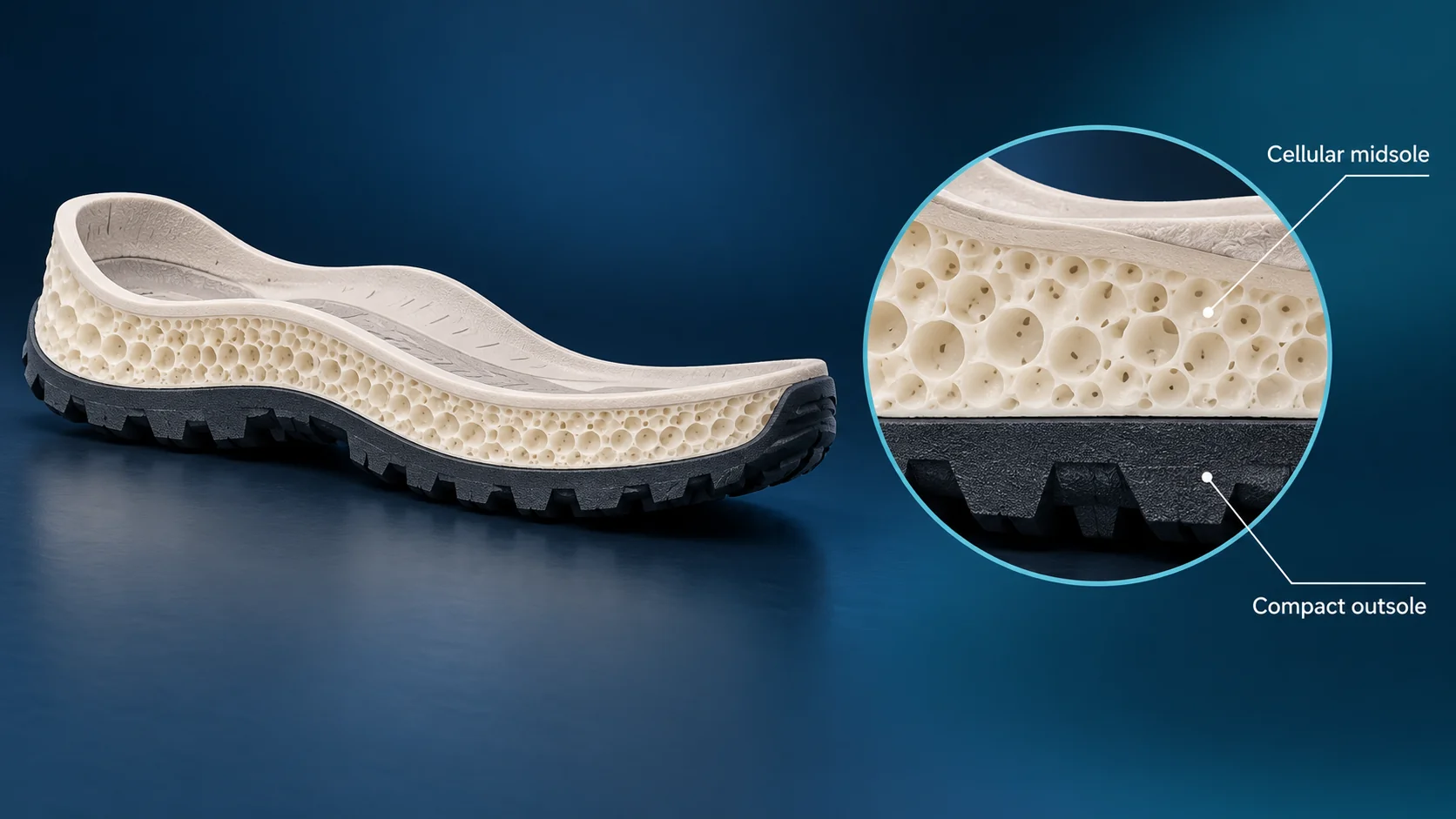
Dual-density is not two colors or two hardnesses applied as an afterthought. It is two polyurethane formulations poured in sequence into the same mold cycle. The outsole is normally a compact or low-foam elastomer with a higher Shore value, while the midsole is a microcellular foam with lower apparent density and greater energy absorption. The difference comes from chain extender selection, blowing agent concentration, and component ratio, not from a simple pigment change.
The functional split is measured with two separate methods. Hardness is determined by durometer testing according to ISO 868 [1], while apparent density is determined according to ISO 845 [2]. A useful specification therefore records both values for each layer: a harder, denser outsole and a softer, lower-density midsole. When only hardness is specified, density can drift and still produce a part that feels correct in the hand.
The functional split is a hardness and density decision, not just a mold-design decision. Shore A vs Shore D Hardness In Polyurethane covers when Shore A and Shore D values matter for layered polyurethane parts that work hard on the surface and absorb energy underneath.
The Two-Layer Design That Makes Dual Density Work
The outsole layer earns its place through cut resistance, slip resistance, and abrasion performance. In rubbery polyurethane, abrasion resistance is often evaluated using ISO 4649 [3], and the result depends on both formulation and cure. The midsole layer earns its place through cushioning and fatigue resistance. If the midsole is too dense, the shoe becomes stiff; if it is too soft, the part collapses under repeated load.
Because the two layers must bond during the pour, the interface design matters as much as the formulation. A wet-on-wet sequence gives a better bond than dry assembly, but it also requires the first layer to reach the right gel state before the second shot arrives. Too early, and the layers mix; too late, and they form a weak boundary.

How the Sole Is Poured, Step by Step
The pour sequence depends on whether the line is direct-on-upper or sole-only, but the core logic is the same.
- Mold preparation — The mold is preheated and a release agent is applied. Shanks, inserts, or pre-molded components are loaded if the design calls for them.
- First shot — The first formulation is metered into the cavity. Shot weight is calculated from cavity volume and target density, not from a fixed timer.
- Second shot and mold movement — A rotary or slide table moves the mold to the second head, or the same head switches to the second formulation after a purge cycle.
- Cure and demold — The part cures under heat, then releases cleanly enough to hold dimension without deformation.
A wrong shot weight changes density before any other process variable can compensate. If the first shot is light, the midsole may be too soft; if it is heavy, the outsole may become thicker and heavier than the specification.
A wrong shot weight changes density before any other process variable can compensate. How To Calculate Shot Weight In Polyurethane covers the cavity-volume-to-shot-mass calculation that keeps dual-density soles from ending up too heavy or too soft.

Process Controls That Decide Consistency
Component ratio and metering
The component ratio is not a coarse setting. A one-percentage-point drift changes more than shot mass; it changes stoichiometry, leaving unreacted isocyanate or polyol and shifting hardness, density, and cure together. Servo metering systems can hold within ±0.3% over their full dynamic range, but the actual performance also depends on pump selection, material temperature, and recirculation pressure.
Rise and gel balance
The midsole depends on a balance between the blowing reaction and the gelling reaction. If the formulation gels too quickly, it cannot fill the cavity. If it gels too slowly, the foam may rise and then collapse before the polymer network is strong enough to hold the cells. The correct balance changes with mold temperature, line speed, and the density of the layer.
Demold time and dimensional control
Demold too early and the part may distort after ejection. Demold too late and the line loses productivity for no property gain. The correct demold window is a function of peak exotherm, mold temperature, and the part’s thickest cross-section.
One commissioning case involving functional dual-density insoles shows what happens when these controls line up: moving to dual-density metering modules raised daily output from 3,000 to 12,000 pairs per line, reduced waste from 8% to 1.5%, and brought defects below 1%. The improvement came from metering repeatability and a stored-formula changeover, not from an increase in nominal machine speed.
If you are balancing two viscosities through the same manifold, record the midsole and outsole ratios, the worst-case shot variance, and the two material temperatures. If the numbers do not close, send the midsole and outsole specifications to Info@chinahaifeng.com or WhatsApp 86 13566296633 and ask for a balanced-head review before committing to a configuration.
Quality Checks Before the First Article
A production sample should not be judged by feel alone. The first article needs to answer four questions.
- Is the hardness split correct? Measure the outsole and midsole separately with the appropriate durometer method [1].
- Is the density split correct? Cut the part and measure a specimen from each layer [2].
- Does the outsole meet the required abrasion or safety criteria? For safety footwear, the applicable standard such as ISO 20345 [4] defines the minimum protective performance. Outsole abrasion is evaluated by methods such as ISO 4649 [3].
- Does the layered structure survive flexing and conditioning? ISO 20344 [5] provides test methods for footwear components and whole shoes, including procedures that expose poor interlayer bonding.
Dimensional checks catch what durometer cannot: a midsole that shrank after cure. If the first layer shrinks before the second shot, the mold cavity no longer matches the design and the next shot may overfill or leave voids.
Dimensional checks catch what durometer cannot: a midsole that shrank after cure. Causes Of Shrinkage In Polyurethane Foam How To Control It covers why microcellular soles lose dimension and the control points that keep the second shot from being thrown off.
Moving from Trial to Production Line
Before you shortlist a dual-density line, narrow three inputs.
- the Shore A split and density split for the two layers,
- expected daily pairs and cavity count,
- whether the line is direct-on-upper or sole-only.
Send those specifications to Info@chinahaifeng.com or WhatsApp 86 13566296633. A metering and mold-flow review is easier to correct during planning than after the first production batch.
Frequently Asked Questions
What is the difference between dual-density and two-part soles?
Dual-density refers to two polyurethane formulations poured in the same mold cycle. Two-part soles can also be made by bonding a separately molded outsole and midsole. The difference matters because wet-on-wet dual-density production does not rely on a later adhesive bond.
Which polyurethane is used for the outsole and midsole?
The outsole is usually a compact or low-foam elastomer with higher hardness and better abrasion resistance. The midsole is usually a microcellular foam with lower apparent density and greater cushioning. Both formulations can be adjusted with chain extenders, blowing agents, and polyol selection.
Can a single machine pour both densities?
Yes. The machine needs either two independent metering and mixing circuits or a validated purge and switch sequence between shots. The main risk is not the machine capability itself, but repeatability across the changeover and at the boundary between the two layers.
Why do dual-density soles delaminate?
Delamination usually comes from poor interface timing. If the first layer is too wet, the second shot can mix into it; if the first layer is too advanced, the second layer may not bond. Contaminated mold surfaces, incorrect mold temperature, and ratio drift can also contribute.
How is density controlled in the midsole?
Density is controlled by shot weight, blowing agent concentration, mold fill ratio, and material temperature. The practical control point is metering accuracy and shot-weight consistency, because the mold cavity volume is fixed once the tool is cut.
References
[1] ISO 868:2003, Plastics and ebonite — Determination of indentation hardness by means of a durometer (Shore hardness), International Organization for Standardization, Geneva, Switzerland, 2003.
[2] ISO 845:2006, Cellular plastics and rubbers — Determination of apparent density, International Organization for Standardization, Geneva, Switzerland, 2006.
[3] ISO 4649:2021, Rubber, vulcanized or thermoplastic — Determination of abrasion resistance using a rotating cylindrical drum device, International Organization for Standardization, Geneva, Switzerland, 2021.
[4] ISO 20345:2022, Personal protective equipment — Safety footwear, International Organization for Standardization, Geneva, Switzerland, 2022.
[5] ISO 20344:2021, Personal protective equipment — Test methods for footwear, International Organization for Standardization, Geneva, Switzerland, 2021.
If you’re interested, check out these related articles:
SRIM Explained Structural Reaction Injection Molding Basics
Measuring Polyurethane Foam Resilience A Practical Test Guide
The Role Of Rise Time In Polyurethane Foaming
What Is Spray Polyurethane Foam Composition And Application
Causes Of Shrinkage In Polyurethane Foam How To Control It





