

A polyurethane foam or elastomer part can pass dimensional checks, cure cleanly, and still fail at the burn test. Flame retardant selection is often treated as a formulation afterthought. In practice, it has to be settled early because the fire class determines the chemistry, and the chemistry changes the way the material moves through the metering pump, mixing head, and mold.
The correct approach is to work from the end-use standard backward. A flexible seating foam governed by a motor-vehicle interior test does not need the same system as a rigid insulation board tested for surface flame spread, and neither matches the demands of an electrical enclosure part seeking a vertical burning class or a higher oxygen index.

Start with the fire standard, not the flame retardant
Flame retardants do not make a polyurethane part non-combustible. They slow ignition, reduce flame spread, lower heat release, or suppress smoke depending on the chemistry and loading. The more useful question is: which performance parameter does the specification actually measure?
Common test routes include surface flame spread and smoke development under ASTM E84 [1], vertical or horizontal burning classification under UL 94 [2], the horizontal burn rate under FMVSS 302 [3], and the limiting oxygen index under ISO 4589-2 [4]. These tests are not interchangeable, and a formulation optimized for one may look mediocre in another.
Common fire tests for polyurethane parts
| Standard or test | What it measures | Typical application |
|---|---|---|
| UL 94 [2] | Vertical or horizontal burning class for plastic materials | Electrical enclosures, appliance housings, molded parts |
| FMVSS 302 [3] | Horizontal burn rate | Automotive interior materials |
| ASTM E84 [1] | Flame spread and smoke developed on exposed surfaces | Building materials, insulation boards |
| ISO 4589-2 [4] | Limiting oxygen index | Research, quality control, comparative ranking |
Start with the test named in the purchase specification or regional requirement. If two standards apply, design to the more severe limit after considering part geometry, density, and foam type.
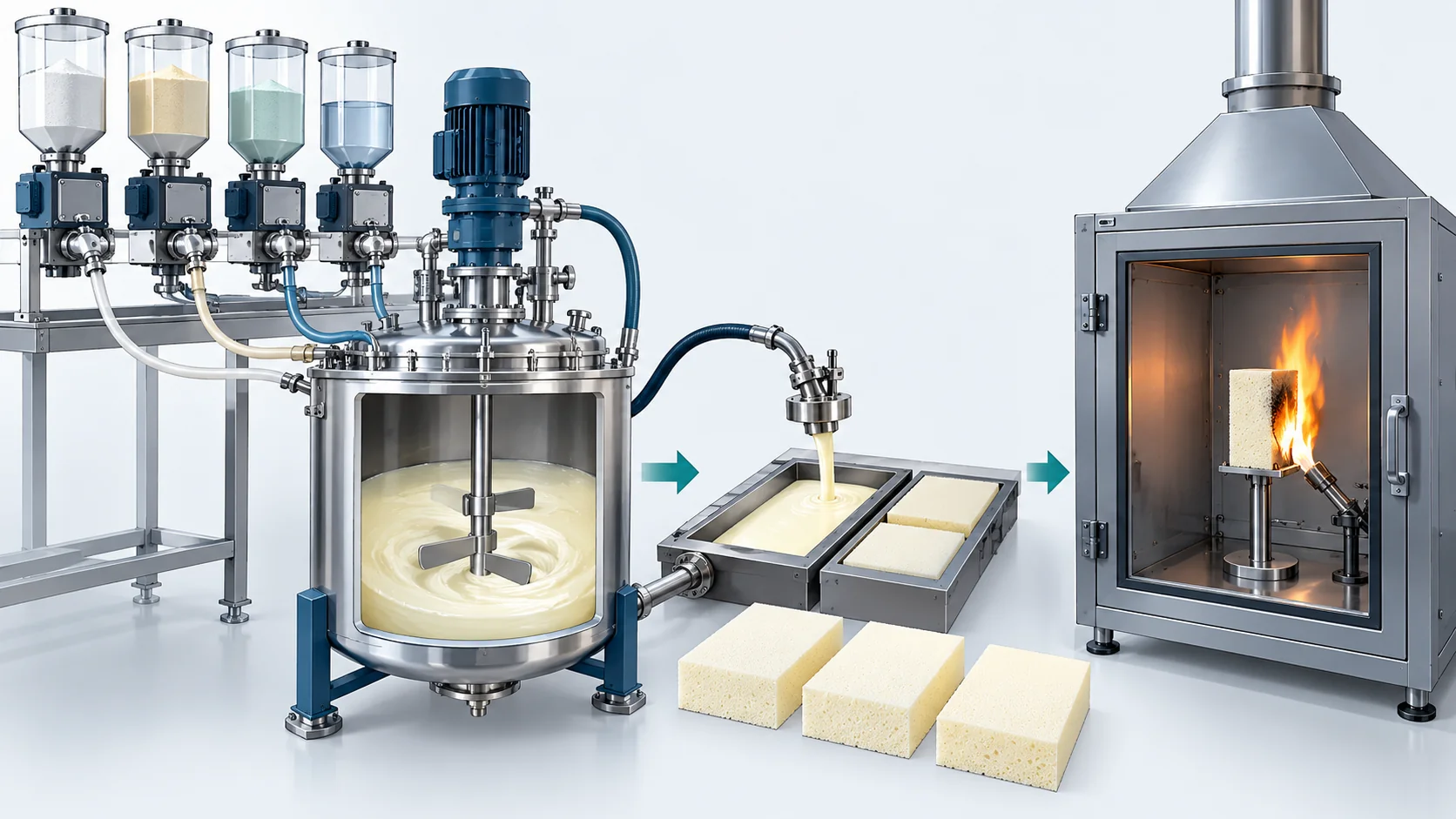
Choose the flame retardant chemistry that fits the polymer system
Outsiders often ask which flame retardant is best. The more useful question is whether the part needs an additive or a reactive system. Additive flame retardants are physically dispersed in the polyol or isocyanate side and do not form covalent bonds with the polyurethane network. They are easier to adjust in blending but can migrate, bloom, or affect surface feel over time. Reactive flame retardants contain functional groups that enter the polymer chain, so they stay in the matrix permanently and can be more resistant to extraction, but they are less flexible to change late in formulation.
Production systems usually draw from four families:
| Flame retardant class | Common examples | Primary mechanism | Advantages | Watchouts |
|---|---|---|---|---|
| Halogenated | Brominated or chlorinated organic compounds | Gas-phase radical scavenging, sometimes with a synergist | Established at relatively low loading in many polyurethane grades | Regulatory pressure, smoke and corrosion concerns |
| Phosphorus-based | Phosphate esters, ammonium polyphosphate | Char formation and condensed-phase action | Halogen-free options available | May plasticize, migrate, or reduce hardness |
| Mineral | Aluminum trihydrate, magnesium hydroxide | Endothermic water release | Low smoke, low cost for high loadings | High loading raises viscosity and density |
| Nitrogen-based | Melamine and derivatives | Fuel dilution, inert gas release | Low corrosivity | Narrower effective temperature window |
Regulatory and buyer pressure has moved many flexible foam and furniture processes away from certain chlorinated phosphate esters because of health, environmental, and end-of-life concerns [5].
The choice depends heavily on whether the part is flexible foam, rigid foam, integral skin, or elastomer. Rigid insulation can tolerate mineral loads that would tear a flexible seating foam apart. Semi-rigid parts sit between these extremes.
[Semi-rigid foams have a denser cell structure and a different cure profile than flexible slabstock, so flame-retardant loading must be rebalanced for the same fire class]. What Is Semi Rigid Polyurethane Foam covers [how density, cell structure, and processing conditions shape the final part properties].
Process fit: let the flame retardant selection drive the machine parameters
Flame retardants are not inert drops in an otherwise unchanged formula. Liquid phosphate esters can lower system viscosity but may shift gel time. Halogenated additives may need higher mixing energy to distribute cleanly. Fine mineral fillers settle and wear dynamic seals. The production line sees all of this as ratio drift, viscosity changes, and temperature shifts in the mix head.
Before scaling a candidate package to production, review the machine the same way you review the formulation:
- Storage and feeding: Solid or high-viscosity additives need recirculation and controlled agitation to prevent settling and caking in day tanks.
- Metering: Filled or high-viscosity streams usually require wear-resistant metering elements, and the system should be recalibrated against the actual density of the additive stream.
- Mixing: Solid particles and viscosity changes alter impingement or mechanical mixing behavior. Mix-head speed and pressure may need to be re-tuned so the additive is distributed before the first gel point.
- Temperature control: Some flame retardants are heat-sensitive or separate at low storage temperature. Keep separate tank setpoints and verify hose temperature along the path from tank to mix head.
When the additive shifts filled density or changes the component ratio, the shot weight changes with it. A pour that was correct for the unfilled part is no longer reliable when the flame retardant stream enters the calculation.
[When a flame retardant changes the filled density or the component ratio, the shot weight calculation must be re-run from the final part target, not copied from an unfilled formula]. How To Calculate Shot Weight In Polyurethane covers [how formulation density, cavity volume, and overflow allowances enter the pour calculation].
Confirm the line before you scale
If you are evaluating a new flame-retardant package at production throughput, contact the application team at Info@chinahaifeng.com or WhatsApp +86 13566296633 with the additive type, target loading, foam or elastomer grade, and fire standard. Confirm viscosity behavior, ratio stability, and mixing quality before committing the line to full production.
Balance fire performance with mechanical and long-term properties
Flame retardants trade one property for another; the goal is to limit the sacrifice. Mineral fillers usually make a part stiffer and heavier. Phosphate esters can soften an elastomer, shift compression set, or create fogging and surface contamination in interior applications. Halogenated systems can raise smoke density and create corrosion risks for tooling and downstream equipment. No single solution avoids all of these burdens.
The part geometry also controls how much the additive matters. A thick, dense elastomer responds differently than a thin open-cell foam, and hardness is often the first property to drift away from the specification.
[Flame retardant loading changes hardness and stress-strain behavior more than many data sheets suggest, and the direction depends on whether the additive acts as a plasticizer or a filler]. Shore A Vs Shore D Hardness In Polyurethane covers [how hardness measurement reflects crosslink density, filler response, and part geometry].
A five-step selection process you can use tomorrow
- Identify the fire standard and test method. Write down the exact standard, required class, part thickness, and test specimen geometry before evaluating any additive.
- Confirm the base polyurethane system. Flexible foam, rigid foam, integral skin, and elastomer respond differently to the same flame retardant.
- Screen candidates against regulatory and mechanical requirements. Remove options that conflict with buyer specifications, regional restrictions, or required physical properties.
- Run lab-scale process tests at the exact loading and viscosity. Measure gel time, cream time, density, hardness, and fire performance under controlled conditions.
- Validate on the production machine at target throughput. Record ratio stability, shot weight, temperature, cell structure, and fire test results on real production parts.
Do not skip step five. Lab behavior can shift when metering shear, mold temperature, and material recirculation become production variables.
Need help matching flame retardant chemistry to your polyurethane line?
If you are formulating a new flame-retardant polyurethane part or troubleshooting a fire-class failure, send the target standard, current foam or elastomer formulation, and process data to Info@chinahaifeng.com or WhatsApp +86 13566296633. Haifeng polyurethane engineers can help evaluate how the additive package affects metering accuracy, mixing quality, temperature control, and long-term equipment service.
Frequently Asked Questions
Are halogenated flame retardants still allowed in polyurethane?
They are still available in some regions and applications, but regional restrictions and buyer specifications are pushing many polyurethane processors toward halogen-free alternatives. Check the purchase specification and the target market before locking the formulation [5].
What is the difference between additive and reactive flame retardants?
An additive flame retardant is physically dispersed in the formulation and does not become part of the polymer network. A reactive flame retardant contains functional groups that bond within the polyurethane structure, usually giving better permanence and extraction resistance while changing network formation more directly.
How much flame retardant should I add to polyurethane?
There is no fixed universal percentage. The effective loading depends on the base formulation, foam density, part thickness, and target fire standard. Screen the additive at the supplier’s recommended working range, then adjust in small steps and retest against the actual end-use test method.
Does a flame retardant change the mixing ratio or shot weight?
Yes. Flame retardants can change density, viscosity, and component distribution, which in turn changes the shot weight and the effective mixing ratio. Recalibrate the metering system and recalculate the shot weight whenever the additive type or loading changes.
Can one flame retardant meet both UL 94 V-0 and ASTM E84?
Rarely. The tests measure different burning behaviors on different sample geometries, and the same part may behave differently in each test. Select based on the dominant application standard and validate each requirement separately [1], [2].
References
[1] ASTM E84, “Standard Test Method for Surface Burning Characteristics of Building Materials,” ASTM International. [Online]. Available: https://www.astm.org/e84-23.html
[2] UL LLC, “UL 94, Standard for Tests for Flammability of Plastic Materials for Parts in Devices and Appliances.” [Online]. Available: https://www.ul.com/resources/ul-94-standard-tests-flammability-plastic-materials
[3] National Highway Traffic Safety Administration, “FMVSS 302 Flammability of interior materials,” 49 CFR 571.302. [Online]. Available: https://www.ecfr.gov/current/title-49/subtitle-B/chapter-V/part-571/section-571.302
[4] ISO 4589-2:2017, “Plastics — Determination of burning behaviour by oxygen index — Part 2: Ambient-temperature test,” ISO. [Online]. Available: https://www.iso.org/standard/68267.html
[5] U.S. Environmental Protection Agency, “Flame Retardants Used in Flexible Polyurethane Foam: Alternatives Assessment Update.” [Online]. Available: https://www.epa.gov/saferchoice/flame-retardants-used-flexible-polyurethane-foam
If you’re interested, check out these related articles:
How To Calculate Shot Weight In Polyurethane
Shore A Vs Shore D Hardness In Polyurethane





