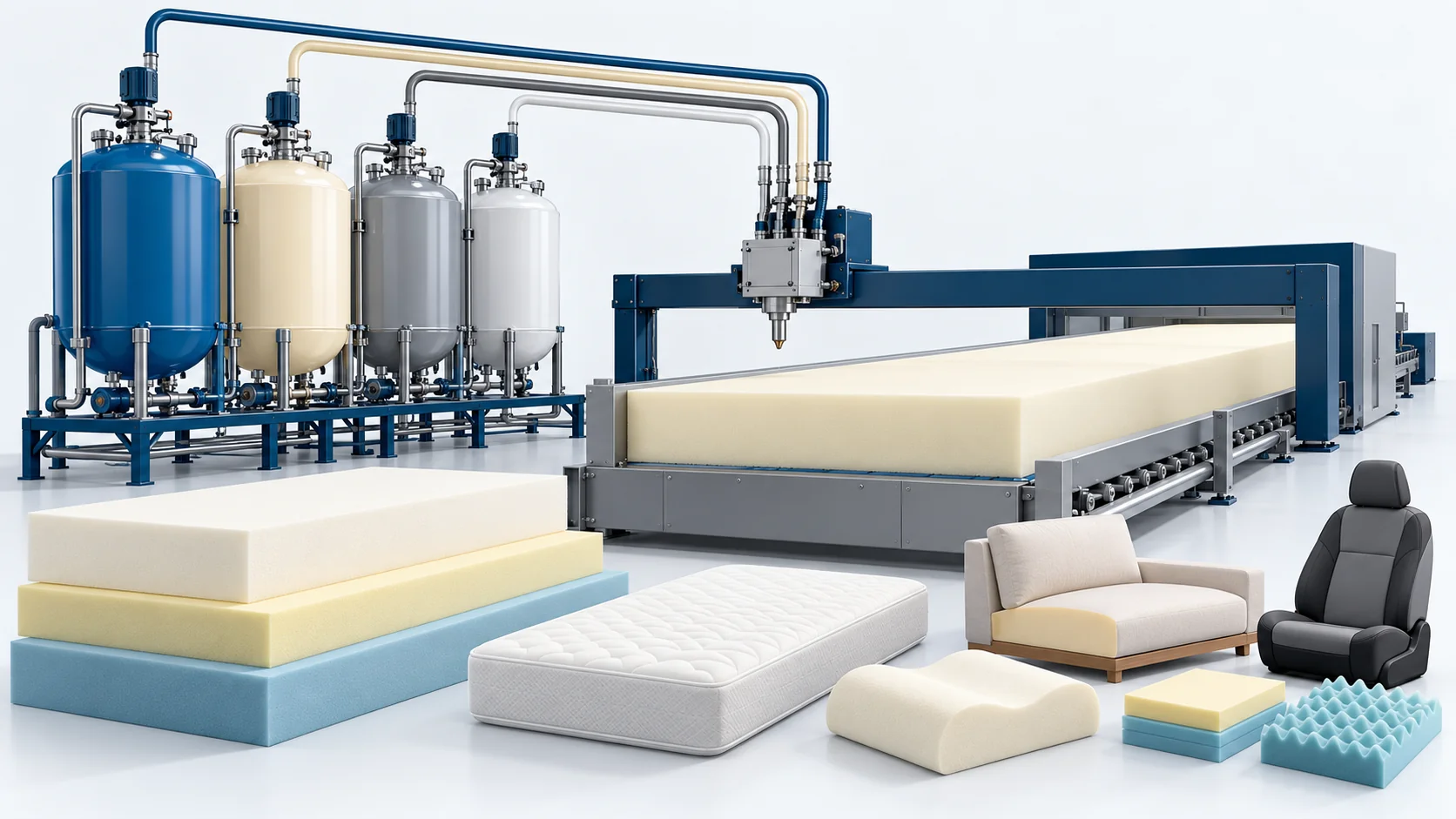
Flexible polyurethane foam production keeps returning to the same decision points: which isocyanate and polyol system will hold target density, hardness, and resilience across a full production day, and which line setup will repeat that result in every block or cavity. TDI remains the standard answer in a large share of cushioning, bedding, and seating operations. This article explains where TDI-based flexible foam fits, how the main grades behave, and which equipment and process variables matter most.
Why TDI Still Dominates Flexible Polyurethane Foam
TDI is supplied mainly as an 80:20 mixture of 2,4- and 2,6-toluene diisocyanate isomers [1]. That material is reactive but formulation-friendly: with polyether polyols, water as the chemical blowing agent, and an amine/tin catalyst package, it produces open-cell flexible foam with a useful balance of softness, support, and fatigue resistance. The aromatic ring in TDI contributes to high load-bearing potential and good elastic recovery compared with many aliphatic systems [2]. This is why slabstock cushioning, mattress cores, and molded seating remain TDI-centric.
TDI is not the only choice. MDI and TDI/MDI blends have gained share, especially in cold-cure molded foam. But TDI still works as the workhorse where a broad density range and incremental hardness control matter more than the lowest possible vapor pressure.
Slabstock and Block Foam: The Largest TDI Application
Conventional slabstock is the highest-volume TDI application. Low-density flexible foam for mattress cores, furniture cushions, carpet cushion, and packaging is made on continuous or discontinuous block lines, then cut and converted. Water concentration, tin catalyst level, and isocyanate index set the density and hardness profile; foam density is determined mainly by the water and auxiliary blowing agent balance rather than by TDI alone [2]. Because the chemistry is forgiving, producers can move from soft low-density grades to much firmer load-bearing products on the same TDI-based system, although process settings and raw material temperatures change.
Block height, exotherm control, and open-cell formation matter as much as formulation. If the reaction generates more heat than the cooling path removes, the core can scorch or develop density gradients. For large blocks, this is the key constraint on catalyst selection and TDI index.
Molded Flexible Foam for Seating and OEM Parts
TDI-based molded foam is standard in automotive seat cushions, headrests, armrests, office chairs, and industrial seating. Molded formulations are either hot-cure or cold-cure. Hot-cure conventional molded foam uses TDI and polyether polyols with forced oven post-curing; cold-cure high-resilience systems often use TDI or TDI/MDI blends and rely on more reactive polyols and internal exotherm to cure at lower mold temperature [1][2]. The choice affects cycle time, tooling cost, and surface quality.
For molded TDI foam, repeatable cavity weight is the foundation. The metering unit must deliver the same pre-mix mass shot after shot, and the calculated shot weight must account for mix ratio, free-rise density, mold volume, overpack, and vent loss. A few grams of variation may be invisible in the pour but enough to change density and hardness from cavity to cavity.
Getting shot weight right begins with real mix ratio and free-rise data, not a rough guess from cavity volume. <How To Calculate Shot Weight In Polyurethane> covers the calculation inputs and the material-side numbers to collect first.
Specialty TDI-Based Foam Grades
Viscoelastic foam, often called memory foam, and high-resilience foam are the two specialty grades that lean heavily on TDI chemistry. Viscoelastic foam uses controlled cell-opening and a lower glass-transition window to slow recovery after compression; high-resilience foam uses graft polyols and reactive catalysts to increase ball rebound and support [2]. TDI-based formulations can be tuned toward either behavior, but the measured properties are what matter most.
Standard properties such as density, IFD, tensile, tear, and compression set are measured under ASTM D3574, which gives producers a shared language for comparing recovery and fatigue behavior [3]. Resilience is one of the most misread numbers in flexible foam because it responds to formulation, sample conditioning, deflection depth, and cure state. Two foams with the same density can behave very differently in service.
Resilience testing is only meaningful when the method and sample history are consistent. <Measuring Polyurethane Foam Resilience A Practical Test Guide> covers the test mechanics and the material variables that shift the result.
How TDI Chemistry Affects Foam Quality and Defects
Most TDI-based flexible foam problems are not caused by TDI itself. They come from the balance among gelling and blowing reactions, cell opening, and cure. An excess of blowing reaction without enough gel strength can produce collapse; too much gel can trap closed cells and cause shrinkage after cooling [2]. Water content also acts as the main blowing source in many flexible formulations, so uncontrolled water can shift density and exotherm before any hardware adjustment is made.
Shrinkage in TDI-based molded foam usually appears after demold, when the polymer network is still cooling and the cells have not opened enough to equalize internal pressure. Early demold, low overpack, or an unbalanced catalyst package can all increase it.
Post-cure, water content, and open-cell formation interact in ways that are easy to miss on a busy line. <Causes Of Shrinkage In Polyurethane Foam How To Control It> covers the main shrinkage mechanisms and the process levers that keep molded dimensions stable.
Equipment Requirements for TDI-Based Foam Lines
TDI processing imposes several equipment requirements that are easy to underestimate. The isocyanate side must be kept dry and at controlled temperature to avoid crystallization and high vapor pressure; the polyol side must handle fillers and water blends; and the mixing head must generate enough shear for rapid nucleation. Low-pressure machines work well for slower continuous or small molded work, while high-pressure machines are generally selected for fast cycles and high output because they use controlled mixing pressure and a self-cleaning head [2].
In addition, TDI is a respiratory sensitizer. Worker exposure must be controlled through local exhaust ventilation, closed transfer, and the training requirements applicable to diisocyanates [4]. Ventilation and raw-material handling are as much a part of line design as metering accuracy.
Equipment selection depends on process numbers more than on machine brand or nominal output. If you are comparing line configurations, send the formulation viscosity, TDI index, target density, mold or block dimensions, cycle time, and expected shot weight to Info@chinahaifeng.com. A specific data set leads to a more useful recommendation than a general request for a flexible foam machine.
Production Support for TDI-Based Flexible Foam
TDI-based flexible foam is a mature chemistry, but a successful line still depends on matching formulation, mold, venting, and metering to the actual product range. Haifeng Polyurethane Machinery works on low-pressure and high-pressure foaming lines, elastomer casting, and turnkey production integration; the practical questions are the same ones we ask at project kickoff.
To get a configuration review, prepare these parameters:
- TDI index and target density or hardness
- Raw material viscosity and filler content
- Slabstock or molded product, including block dimensions or cavity layout
- Output in kg/min or shots per hour and cycle time
- Existing ventilation and handling restrictions
Email Info@chinahaifeng.com or WhatsApp 86 13566296633 with the complete set, and the engineering team will respond with a line configuration or a defined test program.
Frequently Asked Questions
Is TDI used only in flexible foam?
No. TDI can also be used in coatings, adhesives, sealants, elastomers, and some semi-flexible or semi-rigid foams, but flexible polyurethane slabstock and molded cushioning are its largest applications [1][2].
What is the difference between TDI 80/20 and pure 2,4-TDI?
TDI 80/20 contains roughly 80 percent 2,4-isomer and 20 percent 2,6-isomer and is the standard workhorse for flexible foam. Pure 2,4-TDI is used mainly in specific elastomer prepolymers and coatings where reaction control or linear chain extension is more important [1].
Can TDI-based flexible foam meet automotive low-emission requirements?
It can, provided the formulation and process are designed for it. Low-emission grades use reduced volatile catalysts, careful water balance, and post-curing to bring residual amines and emissions within the required limits. Ventilation and cure management matter as much as the isocyanate choice.
How do I choose between TDI-based and MDI-based flexible foam?
Choose by processing window and product requirements. TDI-based systems often offer broad hardness tuning and good elastic recovery with more forgiving slabstock chemistry; MDI-based systems are more common in some cold-cure molded applications where faster cure and lower vapor pressure are priorities [1][2]. No single chemistry fits every line best.
Why does TDI-based foam shrink after demold?
Shrinkage usually reflects incomplete cell opening, early demold, or an imbalance between gelling and blowing reactions while the foam is still cooling. Controlling index, catalyst balance, mold temperature, and post-cure timing is the main correction path [2].
References
[1] M. Ionescu, Chemistry and Technology of Polyols for Polyurethanes, 2nd ed. Shawbury, U.K.: Smithers Rapra, 2016.
[2] G. Oertel, Ed., Polyurethane Handbook, 2nd ed. Munich, Germany: Hanser Publishers, 1994.
[3] ASTM D3574-17, Standard Test Methods for Flexible Cellular Materials—Slab, Bonded, and Molded Urethane Foams, ASTM International, West Conshohocken, PA, USA, 2017.
[4] Commission Regulation (EU) 2020/1149, amending Annex XVII to Regulation (EC) No 1907/2006 as regards diisocyanates, Official Journal of the European Union, 2020.
If you’re interested, check out these related articles:
Shore A Vs Shore D Hardness In Polyurethane
How To Calculate Shot Weight In Polyurethane
The Role Of Rise Time In Polyurethane Foaming