
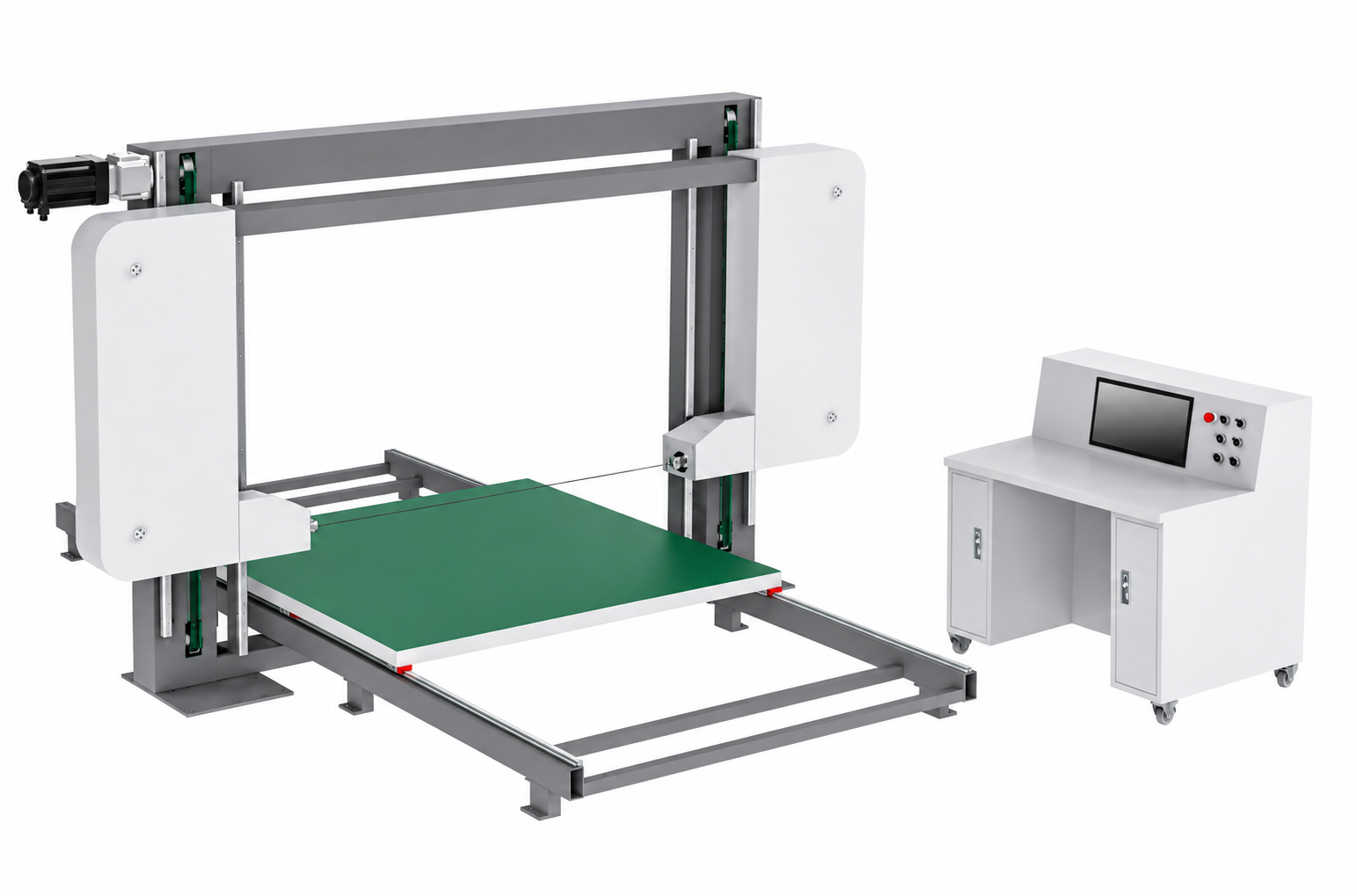
Foam Contour Cutting and Profiling Solution
Select contour cutting, convoluting, angle cutting or perforating equipment for shaped foam components used in furniture, mattresses and cushioning.
Foam Contour Cutting and Profiling Solution
Select contour cutting, convoluting, angle cutting or perforating equipment for shaped foam components used in furniture, mattresses and cushioning.
Application-led selection
Equipment listed below represents available process options. Confirm the selected route and equipment scope for each project.
Connection to foam production
Coordinate downstream processing with the selected Box Foaming or Continuous Slabstock Foaming process and the required conditioning space.
Haifeng coordinates equipment selection and process interfaces. Configuration, installation and service scope follow the agreed quotation.
From Input Material to Finished Product
Select and validate the process sequence for the actual material and finished product.
Define the component
Provide foam samples and drawings with finished dimensions and critical tolerances.
Select the conversion method
Match blade orientation, profiling rollers, angle fixtures or perforating tools to the component geometry. These are alternative process routes, not a mandatory combined line.
Prepare tooling and programs
Confirm fixtures, blade access, tooling and CNC software scope where applicable. Validate the process with representative material.
Selection and Acceptance Requirements
Use these inputs to define the configuration. Equipment-specific reference parameters appear on the corresponding product pages.
| Planning input | Engineering confirmation |
|---|---|
| Material and input geometry | Foam type, density, condition and maximum dimensions. |
| Finished product | Drawings, dimensions, tolerance and inspection method. |
| Production requirement | Batch mix, working hours, feeding and discharge arrangement; throughput to be confirmed. |
| Factory interfaces | Layout, electrical supply, guarding and process-specific utilities. |
| Acceptance | Representative material trials and agreed measurable criteria. |
Equipment Options for This Process
Select a compatible combination; not every listed machine is required for every project.
Foam Convoluting Machine | Profiled Foam Sheets
Feeds foam through profiled compression rollers and splits it into two patterned sheets for cushions, mattresses and acoustic lining applications.
Manual Foam Contour Cutter | Shaped Foam Components
Cuts foam into arcs, cylinders, pillow profiles and other shapes using interchangeable templates for furniture and upholstery components.
Four Wheel Foam Angle Cutter | Angled Foam Sheets
Performs vertical slicing and angled foam cuts with powered frame-angle adjustment and an automatic blade sharpening arrangement. EVA and polyethylene foam applications require material review.
Automatic Foam Profile Cutting Machine | Thick Profiled Foam
Uses profiled compression rollers to split foam into patterned sheets. The described configuration has automatic roller-depth adjustment, enlarged rollers and a powered-height roller feed table.
Automatic Foam Ball Shaping Machine | Foam and EVA Balls
Shapes cylindrical or square foam and EVA blanks into balls of the selected diameter. The described arrangement includes dust extraction.
Horizontal Blade CNC Foam Contour Cutter | Shaped Foam Components
Follows programmed contours using computer control, multi-axis motion control and servo drives. A circulating band blade cuts shaped foam components; an automatic pressure-roller arrangement is optional.
Vertical Blade CNC Foam Contour Cutter | Shaped Foam Components
Cuts programmed foam contours with computer control, multi-axis motion control, servo drives and a circulating vertical band blade. Blade selection is agreed for the material and cut geometry.
Automatic Foam Mattress Perforating Machine | Perforated Foam Mattresses
Perforates foam mattresses using servo-controlled feeding and an automatic punching arrangement. Waste removal is included in the described process.
Automatic Foam Angle Cutter | Furniture Foam Components
Cuts angles in upholstery and furniture foam. PLC digital input positions the machine to the selected cutting angle.
Dual Blade CNC Foam Contour Cutter | Foam Component Conversion
Cuts programmed foam contours with computer-controlled multi-axis motion, servo drives and circulating band blades. Front and rear lifting platforms support loading and unloading.
Define the Configuration Before Procurement
Use the actual material and production plan to establish scope.
Process selection
Choose the equipment route according to the required geometry and material behavior.
Interface planning
Coordinate access, utilities and handling with the factory layout.
Measured acceptance
Agree trials, inspection methods and acceptance criteria before ordering.
Frequently Asked Questions
Clarify scope and testing before final equipment selection.
Is every listed machine part of a single production line?
How is production capacity established?
How are product tolerances accepted?
How does this connect to the Sponge Turnkey Plant?
Discuss Your Foam Processing Project
Share foam samples, drawings, target production requirements and factory layout so Haifeng can define a suitable equipment scope.


