
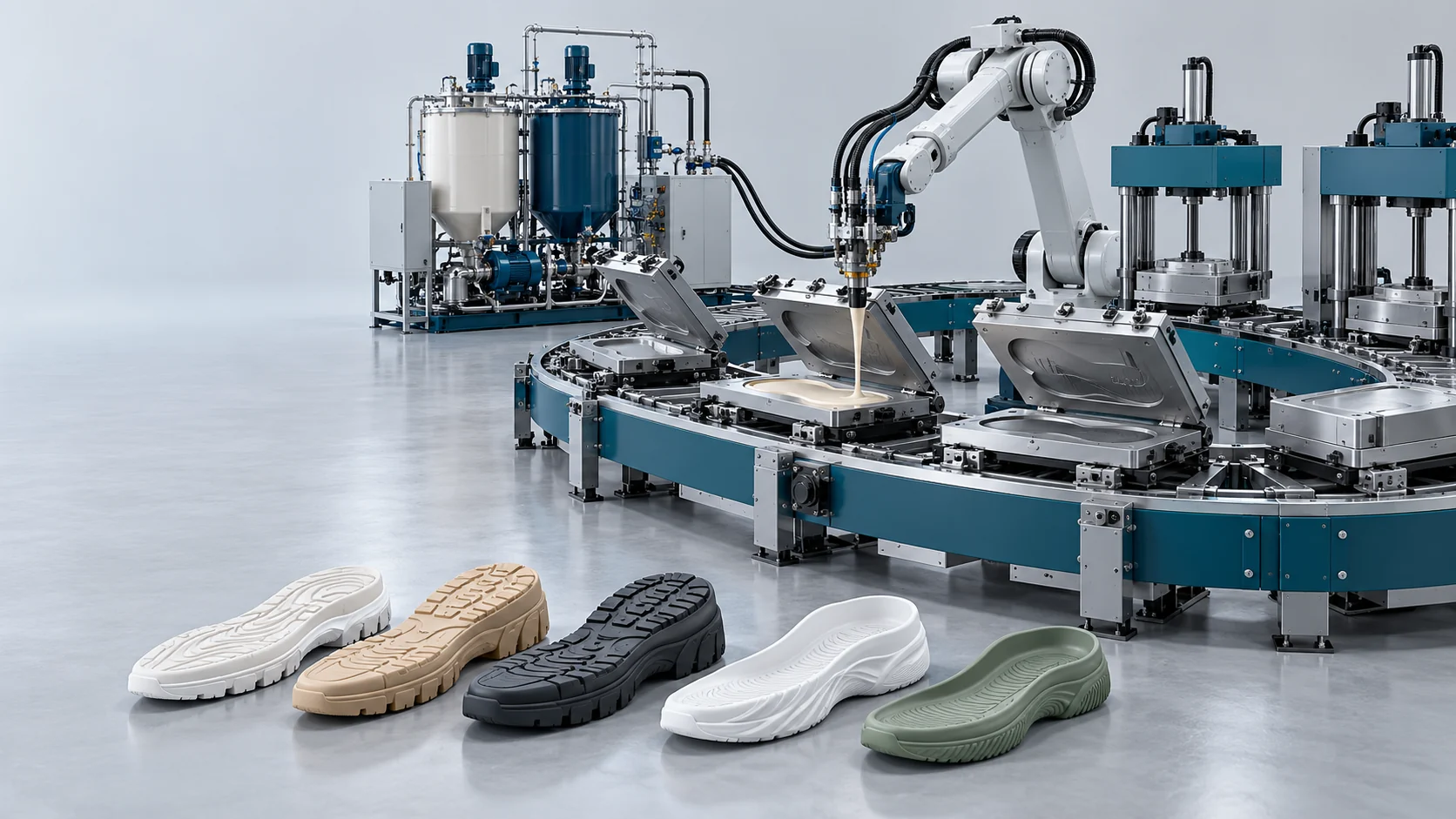
Automated PU Shoe Sole Production Solution
Plan an automated PU shoe sole line with low-pressure metering, robotic pouring and mold handling, configured for your sole designs and production goals.
Automated PU Shoe Sole Production Solution
Traditional shoe sole production relies on manual glue application, resulting in inadequate process control, poor abrasion resistance, slip resistance, and impact resistance. Batch sizes are also large. The solvent-based system generates high VOC emissions, limiting export. The production process is fragmented, leading to high labor costs and significant material waste. This solution centers around an HF-LPM low-pressure foaming machine, combined with a circular/banana-shaped continuous production line, automated mold opening, and a pouring robot. It supports the production of single-color, two-color, and gradient PU soles. It also addresses both the construction of new production lines and the upgrade of existing ones. Customizable, solvent-free PU formulations can be used to adjust hardness and tear strength, catering to both small batch, multi-style orders and large-scale, stable production. Different shoe types and material systems require specific configurations, and a single solution cannot cover all possible shoe sole scenarios.
Consistent product batch consistency
≤±0.3% precise measurement, with a compliance rate of over 95% for finished product performance, reducing variability within a batch; accuracy is subject to constraints imposed by raw materials and operating conditions.
Green, efficient, and cost-effective production.
Solvent-free formulation, with extremely low VOC emissions; raw material waste reduced to ≤5%, leading to a 50% increase in production capacity and facilitating export to the European and American markets.
The solution includes equipment, processes, and technical services, but the equipment cannot replace third-party material testing. The final determination of the product's performance, such as abrasion resistance, slip resistance, and tear strength, will be based on reports from a reputable third-party laboratory. Project acceptance will be based on the signed technical agreement.
Complete project implementation steps
We offer a comprehensive, end-to-end service, covering everything from initial needs assessment and formulation development, to equipment manufacturing, trial production optimization, and finally, full-scale production and delivery. This ensures a smooth and successful implementation of the PU shoe sole production line.
On-site condition assessment
The technical team conducts on-site assessments, combining customer order volume, shoe type, and factory layout to develop customized solutions.
Customized formula validation
The R&D center has completed the development of a solvent-free PU formulation and conducted laboratory-scale trials to verify the feasibility of the process.
Equipment manufacturing or upgrading existing production lines
We either manufacture a low-pressure foam machine (HF-LPM) or upgrade an existing production line with intelligent technology. Our engineers will handle the installation, wiring, and parameter adjustments on-site.
Technical specifications and performance analysis
The following represents a reference baseline. The final configuration will be determined in conjunction with the agreed-upon shoe type, materials, and production capacity, as outlined in the technical agreement between the parties.
| Parameter specifications | Automated solution for HF-LPM shoe soles |
|---|---|
| Applicable products | Single-tone/two-tone/gradient PU soles; leather shoes, casual shoes, athletic shoes, work boots. |
| Accuracy of the measuring system | ≤±0.3% (under the specified raw material and stable production conditions) |
| Range of sole hardness | Shore A: 55-85 (adjustable based on project specifications) |
| Sole tear resistance | ≥30 N/mm (determined by third-party testing based on the formulation) |
| Production line adaptation | Circular line / Continuous production line in the shape of a banana; supports casting and spraying modes. |
| Molding scheme | Optional dual-density material module; compatible with resin prototypes and standard metal molds. |
| Defect rate of finished products | ≤2% (Reference value; affected by mold, raw material, and testing conditions) |
| Waste rate of raw materials | ≤5% (compared to a standard operating condition) |
| Daily production capacity for a single production line | 7500 (This is a reference value and may vary depending on the shoe style and sole type) |
| Adaptability | Support the upgrade and modification of existing production lines with smart modules. |
| Compliance assistance | Assist with obtaining certifications such as CE and ISO9001. |
| Contents of delivery | Process design, machinery/retrofit modules, formulation process, on-site testing, and personnel training. |
| Warranty Information | Executed in accordance with the terms of the formal contract and the technical agreement. |
Equipment for Automated, comprehensive solution for PU sole manufacturing
Review the equipment associated with Automated, comprehensive solution for PU sole manufacturing. Confirm the core machines, auxiliary equipment, tooling and factory-service interfaces in the line proposal.
Low-Pressure PU Foaming Machine | Shoe Soles
Low-pressure PU foaming machine for shoe sole production, designed for low-viscosity materials to produce lightweight, durable, and dimensionally stable soles. Ideal for sports and safety footwear.
Low-Pressure PU Foaming Machine | Shoe Production
Low-pressure PU foaming machine for shoe production, designed for low-viscosity materials to produce lightweight, durable, and dimensionally stable soles. Ideal for sports and safety footwear.
Key advantages of the plan
Focusing on the key challenges in traditional shoe sole production, while also considering factors such as stability, environmental friendliness, production efficiency, and cost optimization.
Precise measurement ensures batch consistency.
The measurement accuracy is ≤±0.3%, significantly reducing variation in the performance of products within the same batch. The compliance rate for finished product performance can reach 95% or higher. The accuracy indicators are subject to the constraints of raw materials and operating conditions, and are governed by the technical specifications.
Customized formulations and mold adaptation.
Customizable, solvent-free PU formulations, allowing adjustment of hardness and tear strength. Compatible with low-cost resin for rapid prototyping and quick response to diverse, small-batch orders.
The new production line is compatible with existing production lines.
We can either build a completely new, automated production line, or install intelligent control modules to enable solvent-free processes and control project costs.
Smart quality control and export compliance support
Combining visual detection and automated sorting, this system assists with third-party verification and compliance with CE and ISO9001 standards, facilitating market expansion in Europe and the United States.
Project examples
The implementation project for automated PU sole production, covering both the construction of a new production line and the intelligent upgrade of existing lines.
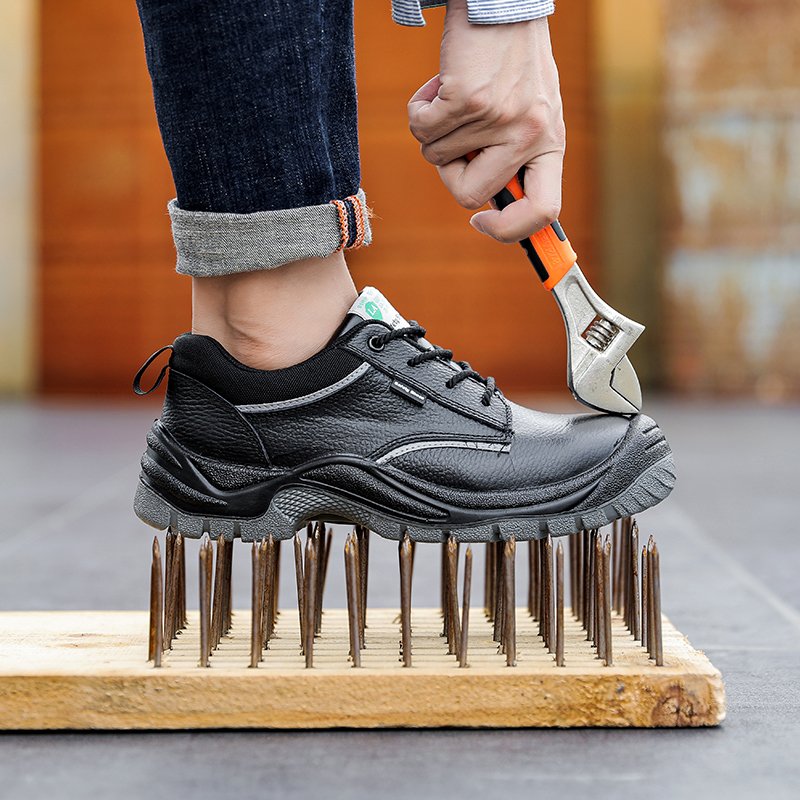
PU Safety Shoe Production Line Upgrade Project in Australia
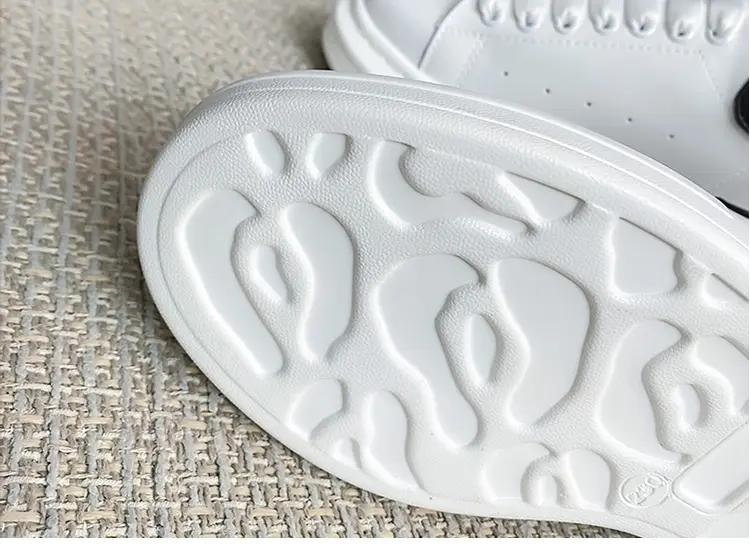
PU Shoe Sole Production Line Upgrade Project in Rwanda
Ready to Build Your Automated PU ShoeSole Production Line?
Request a customized technical proposal based on your sole type, target output, dualdensity requirements and existing workshop conditions. Our professional engineers will reply to you within 24 hours.


