
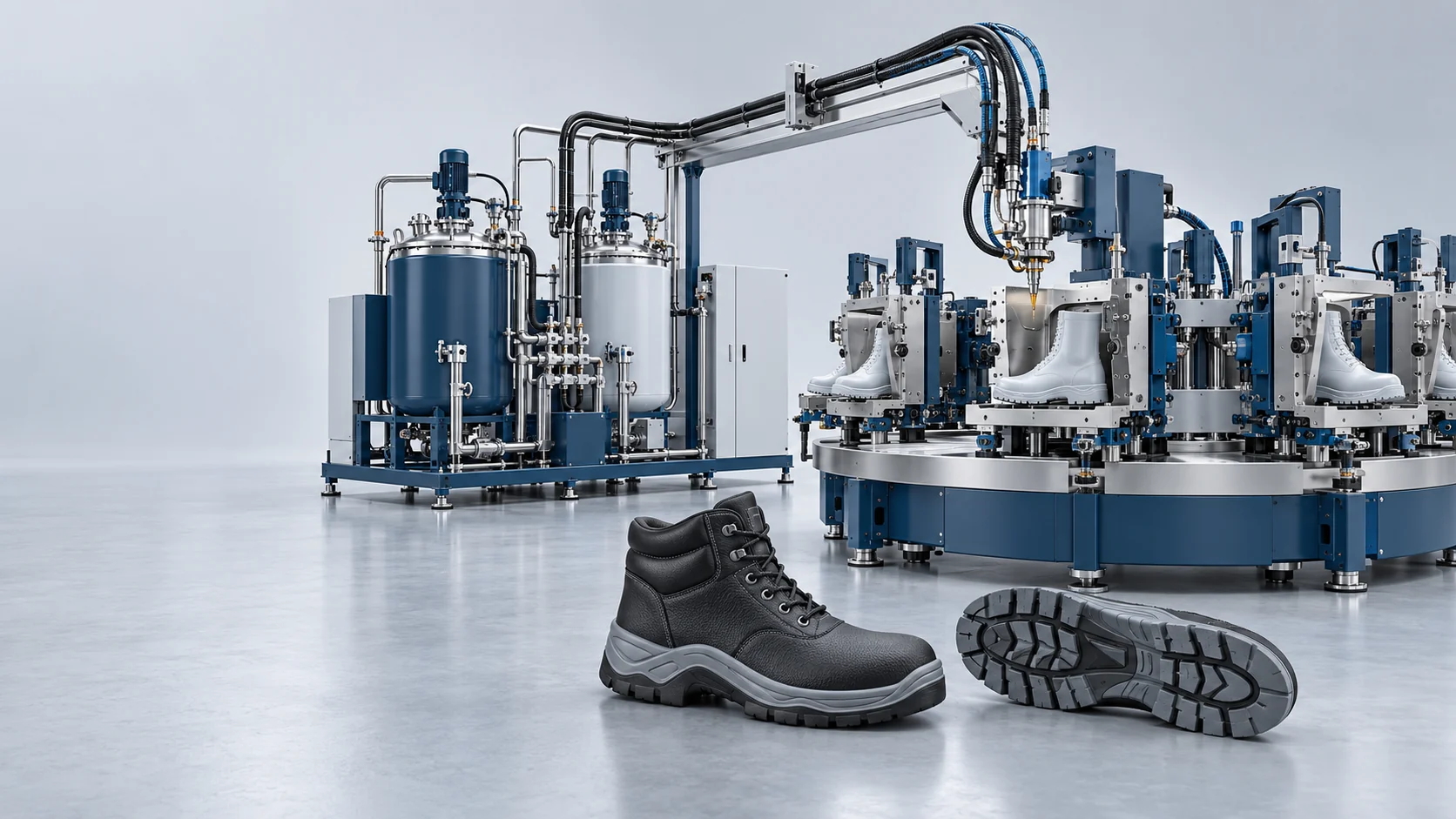
PU Safety Shoe Production Solution
Plan a new PU safety shoe production line or an upgrade around the target shoe construction, material system, sole layers and finished-product requirements. Select the molding route, metering equipment, tooling and handling before defining the commissioning and acceptance scope.
Plan the Safety Shoe Construction and Production Scope
Plan a new PU safety shoe production line or an upgrade around the target shoe construction, material system, sole layers and finished-product requirements. Select the molding route, metering equipment, tooling and handling before defining the commissioning and acceptance scope.
Shoe Construction Before Equipment
Define the upper, sole design, protective components and intended use. Independent sole molding and direct injection onto uppers require different tooling and handling, even when both use a PU material system.
Equipment Checks and Finished-Shoe Tests
Metering and process controls support repeatable processing. Finished-shoe performance depends on the material, construction and agreed tests; equipment supply alone does not certify the shoe.
The line proposal defines the selected materials, equipment, tooling, automation and acceptance responsibilities. Equipment ratings and reported project results apply to their stated configurations and conditions. Start the safety-shoe decision checklist with the upper and last, sole section and layer sequence, protective components and intended finished-shoe tests. Use that construction to choose independent sole molding or direct injection and to assign upper preparation, loading, demolding and finishing responsibilities.
PU Safety Footwear Production Workflow
Use the selected product, material and tooling to define the operating sequence. Commissioning, training and project milestones are specified separately in the delivery plan.
Prepare Materials and Shoe Components
Prepare the selected PU components and the uppers, inserts or protective parts required by the agreed shoe construction.
Prepare the Selected Tooling Route
Set up sole-component molds or the confirmed direct-injection mold and last arrangement. Define release, positioning and mold temperature for that route.
Meter and Mold the Sole Structure
Run the agreed material delivery and molding sequence for the selected sole layers. Coordinate each shot with the actual machine and tooling.
Line Configuration and Acceptance
Confirm product requirements, equipment scope, site conditions and acceptance criteria for your selected production route.
Product and Process
| Item | What to confirm |
|---|---|
| Product requirements | Intended use, upper construction, sole layers, protective components and required footwear tests. |
| Molding route | Select independent sole molding or direct injection onto uppers. Confirm molds, lasts and handling interfaces. |
| Metering configuration | Confirm material ratio, shot size and layer sequence. Metering equipment alone does not define a complete direct-injection line. |
Line and Site Planning
| Item | What to confirm |
|---|---|
| New line or upgrade | Identify reusable equipment and tooling, required modifications and new equipment included in supply. |
| Automation scope | Define material feeding, mold movement, component loading and finishing tasks. Staffing and output depend on the agreed configuration. |
| Site readiness | Confirm layout, maintenance access, utilities and installation responsibilities before scheduling commissioning. |
Acceptance and Testing
| Item | What to confirm |
|---|---|
| Equipment acceptance | Agree checks for metering, controls, interlocks and trial production using the selected materials and configuration. |
| Finished-shoe testing | Agree product tests, samples and third-party responsibilities separately. Equipment acceptance does not replace finished-shoe assessment. |
Equipment Roles and Supply Interfaces
| Equipment option | Role in the selected route | Details |
|---|---|---|
| Safety-Shoe PU Metering and Mixing Equipment | Metering and mixing option for the selected safety-shoe configuration; molding and upper handling are defined separately. | View Equipment: Safety-Shoe PU Metering and Mixing Equipment |
| PU Sole Metering and Mixing Equipment | Alternative for an applicable independent sole-molding route; an additional machine is not automatically required. | View Equipment: PU Sole Metering and Mixing Equipment |
Equipment for PU Safety Shoe Production
Review the safety-shoe metering configuration against the selected shoe construction. The independent-sole unit is an alternative route when soles are molded for later assembly. Tooling, upper handling and protective-component placement require their own defined interfaces.
Low-Pressure PU Foaming Machine | Safety Shoes
Low-pressure PU delivery for safety-shoe soles, with metering, mold handling and material circuits selected for the footwear construction.
Low-Pressure PU Foaming Machine | Shoe Soles
Low-pressure PU metering and mechanical mixing for sole molding, configured for formulation viscosity, shot demand and tooling.
Configuration and Engineering Considerations
Select the process and equipment around the actual product and agreed production scope.
Construction-Led Selection
Choose the production route from the upper, sole layers and protective components.
Assessed Upgrade Scope
Identify reusable equipment and the modules required for the existing line.
Defined Delivery Interfaces
Coordinate metering, tooling, controls, site services and operator tasks in the supply list.
Separate Product Qualification
Agree finished-shoe test requirements and responsibilities alongside equipment acceptance.
Related Project Record
The Australia safety-shoe upgrade is a related application reference. Check the construction, supplied automation and trial conditions against the proposed project; its equipment checks and reported results do not replace qualification of a new finished shoe.
Production Planning FAQ
Clarify the material route, tooling, equipment scope and validation requirements for your product.
Can an existing safety-shoe line be upgraded?
Does this solution always use direct injection onto uppers?
Does the line certify the finished safety shoe?
Are staffing, defect rate and project duration fixed?
What is needed to plan a new line or upgrade?
What must be decided before selecting the safety-shoe molding route?
Discuss Your Safety Shoe Line
Share the following for this application: Shoe and sole-section drawings, upper and last details, protective-component arrangement, material and layer requirements, target footwear tests, output plan, existing tooling and manual tasks. Our team will reply within one business day. Once requirements are clear, we provide a preliminary proposal within two business days.


