Most rigid foam failures that reach a production manager are reported as “bad foam,” but the root cause is usually something earlier: component temperature drift, ratio error, or a mixing head that is no longer doing its job. The chemistry matters, but in PMDI-based rigid polyurethane foam, the equipment and the process variables decide whether the chemistry performs.
PMDI is the workhorse isocyanate for rigid PUR and PIR foam because its mixed-functionality aromatic structure builds a highly crosslinked, closed-cell polymer network [1]. The result is a foam with low thermal conductivity, good compressive strength, and the dimensional stability required by insulation and structural applications.
What PMDI Brings to Rigid Polyurethane Foam
PMDI differs from TDI in two ways that matter for rigid foam. Its volatile monomeric isocyanate content is much lower, and its average functionality is higher, so it builds a tighter crosslink network without the same handling burden. In a standard PUR formulation, the PMDI index typically sits in the 105–130 range. In PIR foam, the index is intentionally raised to allow isocyanurate ring formation, which improves high-temperature stability and fire performance.
Because PMDI reacts with water, it also works as the A-side in water-blown systems. The reaction with water releases CO₂ while forming polyurea segments. This is a useful blowing mechanism, but water is not a neutral variable: excess water raises k-value, increases exotherm, and can make the foam more friable. A rigid-foam formula must balance PMDI index, water, physical blowing agent, catalyst, and surfactant together.

Core Applications for PMDI-Based Rigid Foam
Appliance and Cold-Chain Insulation
PMDI rigid foam is poured into refrigerator cabinets, freezers, and cold-chain panels because it fills irregular cavities, bonds to the liner, and delivers low k-value in a thin wall. The process depends on shot weight, injection pattern, and mold temperature more than the nominal formulation. A cavity that is cold or poorly vented will produce the same coarse cells and voids as an out-of-spec formula.
Building Envelope Panels and PIR Insulation Boards
Continuous and batch sandwich-panel lines use PMDI-based rigid PUR or PIR foam between steel or aluminum facings. EN 13165 [2] defines the product-family approach for factory-made rigid polyurethane foam insulation. PIR boards add isocyanurate chemistry and are often specified where higher fire performance is required [3]. The foam must balance density, closed-cell content, adhesion, and panel flatness across the full width of the line.
Spray-Applied Insulation and Air Sealing
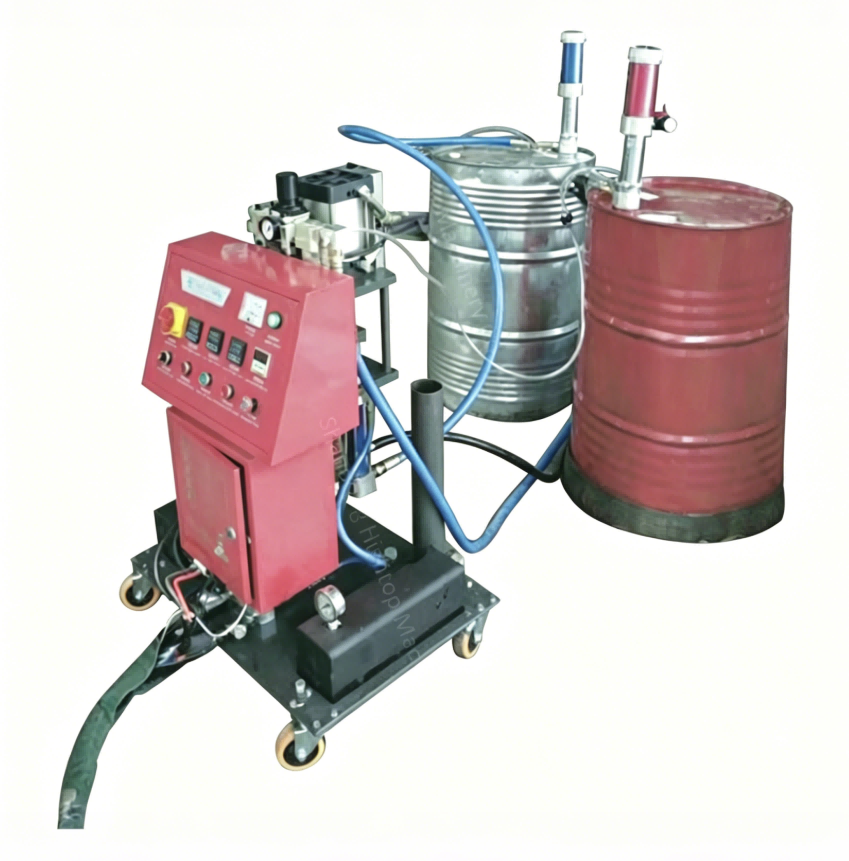
PMDI-based spray polyurethane foam is used for roofs, rim joists, cold-storage repair, and irregular building envelopes. The two components are heated and pressurized, then combined at the spray gun. Stable metering and good atomization are decisive: a wet spray produces irregular cells and poor adhesion [4].
PMDI rigid spray foam requires the right composition balance and application conditions, especially substrate temperature, pressure, and atomization quality. <What Is Spray Polyurethane Foam Composition And Application> covers composition and application requirements in detail.
Pipe and Duct Insulation
Preformed pipe sections, direct-buried pipe insulation, and duct panels use PMDI rigid foam for continuous insulation with low moisture uptake. Some processes are discontinuous mold filling; others are continuous annular pouring. Both require controlled rise and fill so the foam does not collapse before the polymer network can support itself.
If your application falls into one of these groups, the next practical step is to match the metering, mixing head, and controls to the target. Send the application type, required output, and blowing-agent constraint to Info@chinahaifeng.com or WhatsApp 86 13566296633 for a configuration review.
Formulation Variables That Control Foam Performance
The formulation is a coupled system, not a checklist. The main variables are:
- PMDI index. For standard rigid PUR foam, a low index leaves incomplete crosslinking and weak dimensional stability. Excessive index increases brittleness and exotherm.
- Blowing-agent balance. Physical blowing agents such as pentane, HFO, or HFC improve k-value but change flow and cell pressure. Water generates CO₂ through reaction and changes polyurea content.
- Polyol blend and catalysts. Polyol functionality, viscosity, and catalyst package set the gel-versus-blow balance. A skewed balance creates voids, coarse cells, or surface defects.
- Surfactant and cell-control additives. The surfactant stabilizes the expanding cells until enough polymer strength is achieved.
Two measured properties are useful when comparing formulas: apparent density by ASTM D1622 [5] and compressive strength by ASTM D1621 [6]. However, one number without the other is misleading. A higher density usually raises compressive strength, but it also increases cost and thermal bridging if overdone.

Equipment and Processing Parameters for PMDI Lines
PMDI rigid foam is sensitive to temperature and moisture, so the A-side system needs special attention. The PMDI tank should be blanketed with dry air or nitrogen, and the B-side tank must stay within the polyol supplier’s temperature window. Too-cold components raise viscosity and make ratio control harder. Too-warm PMDI shortens cream time and can promote side reactions.
The metering system is the core of the line. High-pressure machines use impingement mixing and fast, continuous pumping. Low-pressure machines use mechanical mixing and are often better for filled systems or lower outputs. Either way, ratio drift affects density, hardness, and surface quality. A deviation that is small in percentage terms can translate into multiple kilograms per cubic meter in the finished panel.
Rise time is one of the most practical process signals. If rise time drifts longer, the usual suspects are catalyst underdosing, low component temperature, or lost mixing energy. If it drifts shorter, it often points to heat, moisture, or excessive catalyst.
When rise time changes, the useful first step is to separate chemistry problems from temperature and ratio problems. <The Role Of Rise Time In Polyurethane Foaming> covers how rise time relates to formulation and equipment settings.
The mixing head also needs routine inspection. A worn impingement nozzle or an out-of-tolerance mixing chamber produces coarse cells, surface streaks, and density variation before any bulk test catches it.
Common Rigid Foam Defects and Their Causes
PMDI rigid foam defects are best read as signals rather than isolated problems.
- Voids at the far end of the mold usually indicate short shot or poor venting, not a bad batch.
- A dense skin with a low-density core points to excessive mold temperature or a gel reaction that is faster than the blowing reaction.
- Shrinkage or post-demold movement is commonly caused by low index, insufficient overpack, early demold, or an imbalance in gel and blow timing. In rigid PMDI systems, too low an index leaves under-cured polymer with weak network structure. Excessive index can increase brittle fracture and dimensional shift.
Rigid PMDI foam shrinkage usually comes from a combination of index, mold temperature, and demold timing rather than one chemical variable. <Causes Of Shrinkage In Polyurethane Foam How To Control It> covers cause identification and control.
- Friable or crumbly foam often indicates overindexing, poor mixing, or excess water.
- Coarse cells point to surfactant imbalance, insufficient nucleation, or degraded mixing energy.
Each defect is easier to correct if the line can capture time-stamped process data. Without trend data, maintenance starts from guesswork.
Selecting a PMDI Rigid Foam Line: A Practical Checklist
Before selecting equipment, define the requirement in process terms:
- Output and shot size. Specify kg/min and the largest single shot or panel thickness you intend to run.
- Blowing-agent system. Pentane, HFO, water, and mixed systems have different temperature and ventilation requirements.
- Mixing principle. Choose low-pressure mechanical mixing for filled systems or lower outputs, or high-pressure impingement for fast, continuous runs.
- Metering accuracy and traceability. Ask for the full-range metering deviation rather than the best-case laboratory number. Also confirm whether the line stores formulas and records process values.
- Moisture control. Confirm tank blanketing, recirculation, and the cleaning method for the iso side.
- Trial plan. Run the actual polyol/PMDI system on the machine at the intended output before accepting the line.
The right specification is not the machine with the most features. It is the machine that keeps the variables you cannot afford to lose within your control window.
Need support specifying a PMDI rigid foam line? Contact Haifeng Polyurethane Machinery at Info@chinahaifeng.com or WhatsApp 86 13566296633. We can begin with your target foam density, exotherm limit, and blowing-agent system, not a brochure.

Frequently Asked Questions
What is the difference between PMDI and TDI in rigid foam?
TDI is used mainly in flexible foam and has higher volatility and lower average functionality. PMDI has a higher average functionality and much lower volatile monomer content, so it is better suited to building the crosslinked closed-cell network that rigid foam requires.
Why is PMDI used in PIR insulation instead of standard PUR?
At higher catalyst and index conditions, PMDI forms isocyanurate rings rather than only urethane and urea links. That PIR network gives improved high-temperature stability and fire performance compared with a standard PUR structure.
How does water content affect PMDI rigid foam?
Water reacts with PMDI to produce CO₂, which contributes to blowing. At the same time, it increases exotherm and polyurea formation. Too much water can raise k-value, reduce dimensional stability, and make the foam friable. Too little water in a water-blown system reduces blowing before any physical blowing agent compensates.
What should be checked first when a PMDI rigid foam line starts producing inconsistent density?
Check component temperatures and tank blanketing, then verify metering ratio and pressure, then compare cream and rise time to the baseline. A density shift is usually a process drift signal before it is a formulation failure.
References
[1] M. Ionescu, Chemistry and Technology of Polyols for Polyurethanes, 2nd ed. Shawbury, UK: Smithers Rapra, 2019.
[2] Thermal insulation products for buildings — Factory made rigid polyurethane foam (PUR/PIR) products — Specification, EN 13165, CEN, 2016.
[3] Standard Specification for Unfaced Preformed Rigid Cellular Polyisocyanurate Thermal Insulation Board, ASTM C591, ASTM International.
[4] Standard Specification for Spray-Applied Rigid Cellular Polyurethane Thermal Insulation, ASTM C1029, ASTM International.
[5] Standard Test Method for Apparent Density of Rigid Cellular Plastics, ASTM D1622, ASTM International.
[6] Standard Test Method for Compressive Properties of Rigid Cellular Plastics, ASTM D1621, ASTM International.
If you’re interested, check out these related articles:
How Polyurethane Rollers Are Made From Casting To Cure
SRIM Explained Structural Reaction Injection Molding Basics