
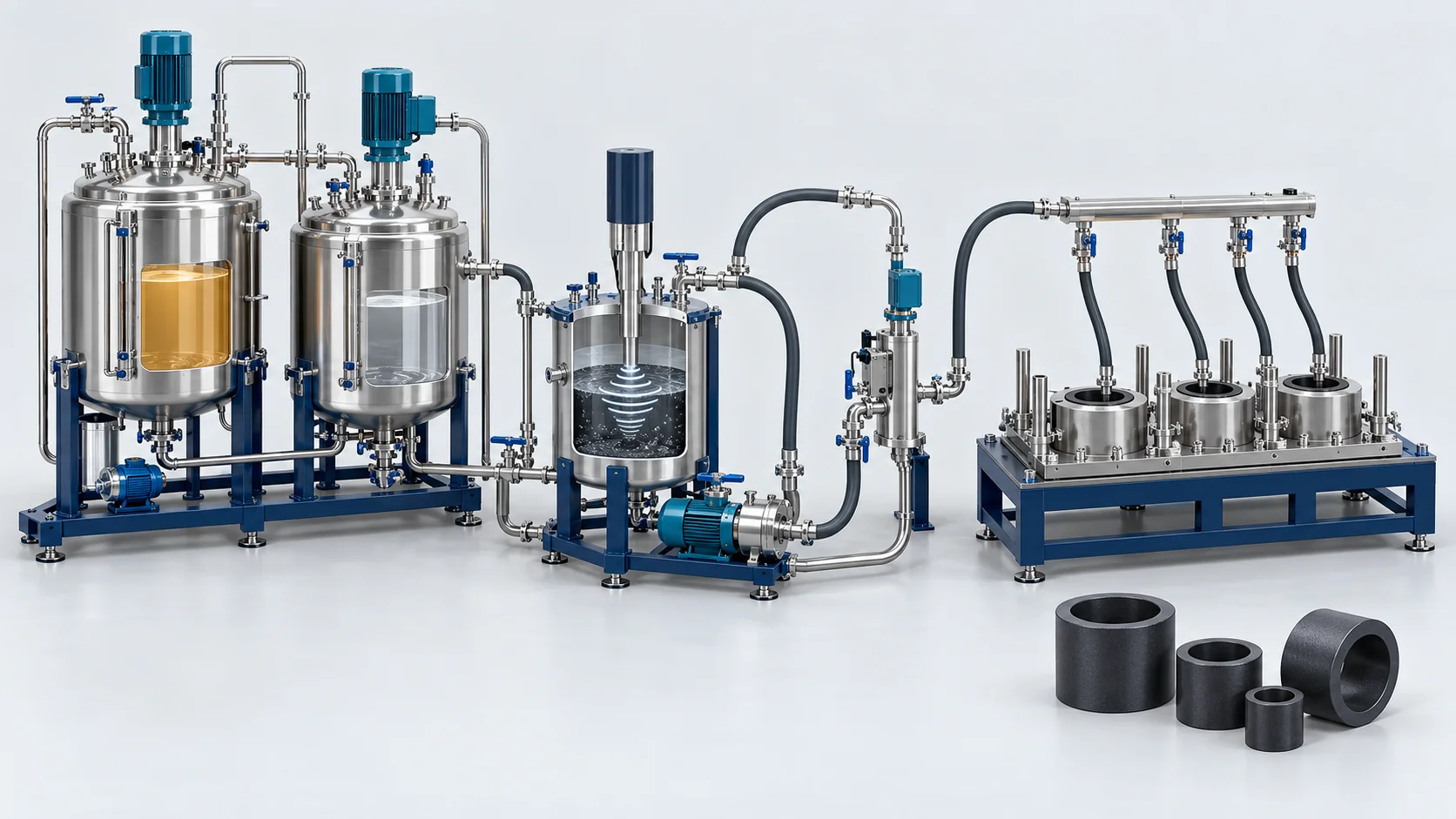
MoS2-Modified MC Nylon Casting Solution
Configure additive dispersion, circulation and reactive MC Nylon casting for the selected modified bushing material.
Wear and Lubrication Process Engineering for Heavy Machinery Bearings
Modified nylon bushing production requires additive wetting, dispersion, suspension control and a compatible reactive casting process. Ultrasonic frequency and pump construction describe equipment functions; they do not establish friction coefficient, wear life or maintenance-free service for a bushing.
Defined supply scope
Define additive preparation, thermal holding, recirculation, metering and tooling together. Powder size terminology must follow the actual distribution rather than treating micron-sized powder as submicron.
Inputs for process selection
Powder distribution/loading, monomer data, batch hold, bushing drawing, counterface, load/speed and exposure.
Equipment scope, retained factory interfaces and acceptance are agreed for the selected material and part. Define additive preparation, thermal holding, recirculation, metering and tooling together. Powder size terminology must follow the actual distribution rather than treating micron-sized powder as submicron.
MoS2-Modified MC Nylon Casting Workflow
Characterize the formulation → Disperse and circulate → Meter and cast → Condition and evaluate. Define preparation, filling, cure and output timing separately for the selected configuration.
Characterize the formulation
Confirm monomer system, MoS2 size/loading and any other additive.
Disperse and circulate
Develop the wetting, dispersion and hold procedure for the actual powder.
Meter and cast
Validate material delivery and reaction in the selected bushing tool.
Reference Solution Engineering Envelope
Existing configuration and test references. Equipment settings, material results and finished-assembly results are separate; apply each value only to its documented configuration and conditions.
| Parameter | Value / Unit | Applicable Configuration / Conditions |
|---|---|---|
| Continuous Casting Flow Rate | 3.0 to 25.0 kg/min | Zirconia ceramic-lined positive displacement pump skid |
| Dynamic Friction Coefficient | 0.08 to 0.12 (Dry unlubricated friction) | ASTM G99 pin-on-disk test under 35 MPa contact pressure |
| Ultrasonic Cavitation Frequency | 20 kHz (Continuous acoustic horn) | High-power ultrasonic generator inside molten vessel |
| Supported MoS₂ Powder Loading | 1.0% to 6.0% by weight | Sub-micron 1– 3 µm particle size de-agglomerated |
| Grease-Free Bushing Wear Life | Greater than or equal to 8,000 Hours | Verified radial wear under 0.1 mm in abrasive dust service |
| Annealing Oil Bath Temperature | Up to 150°C | Multi-zone thermal oil immersion tank relieving stress |
Core Equipment for This Solution
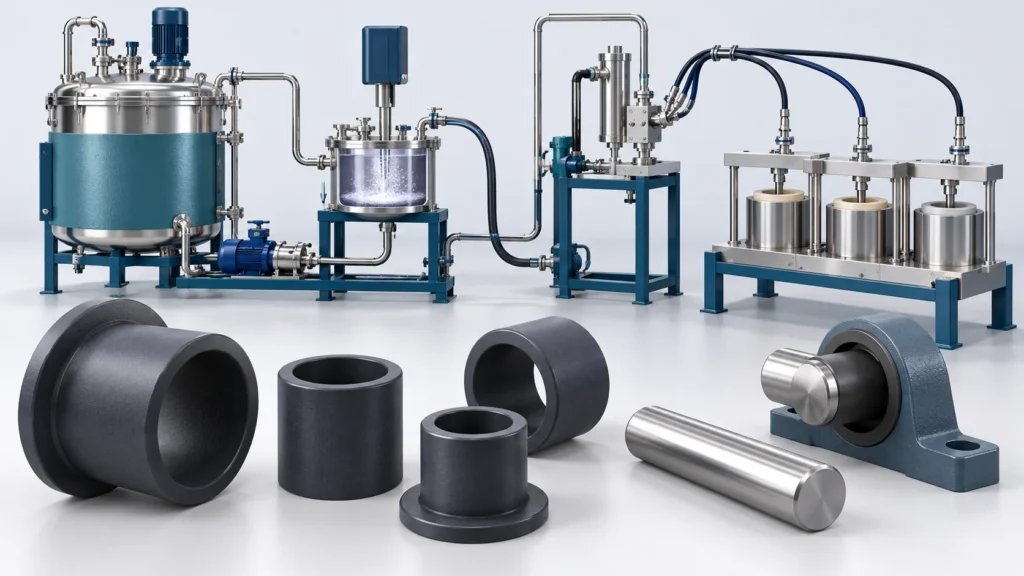
Equipment references are selected by their documented process. Main metering, auxiliary supply and alternative routes are not a single standard package.
Process controls and application checks
Evaluate these functions with the selected material, tooling and production brief. Finished-part results require their own acceptance evidence.
Additive-specific preparation
Select dispersion and circulation after material trials and endpoint evaluation.
Compatible material circuits
Review filled-material wear, seals, thermal control and cleaning.
Duty-specific tribology
Separate equipment functions from friction and endurance measurements.
Related Projects
These are related application references. Compare the actual material, process and delivered modules; reported project figures are not acceptance results for another line.
Production Planning FAQ
Selection, supply scope and validation for this production route.
Does the casting unit guarantee a friction coefficient or service life?
Does ultrasonic frequency establish stable suspension?
What information is needed for a preliminary configuration?
Discuss Your Production Goals
Share the following with your production brief: Powder distribution/loading, monomer data, batch hold, bushing drawing, counterface, load/speed and exposure. Our team will reply within one business day. Once requirements are clear, we provide a preliminary proposal within two business days.


