
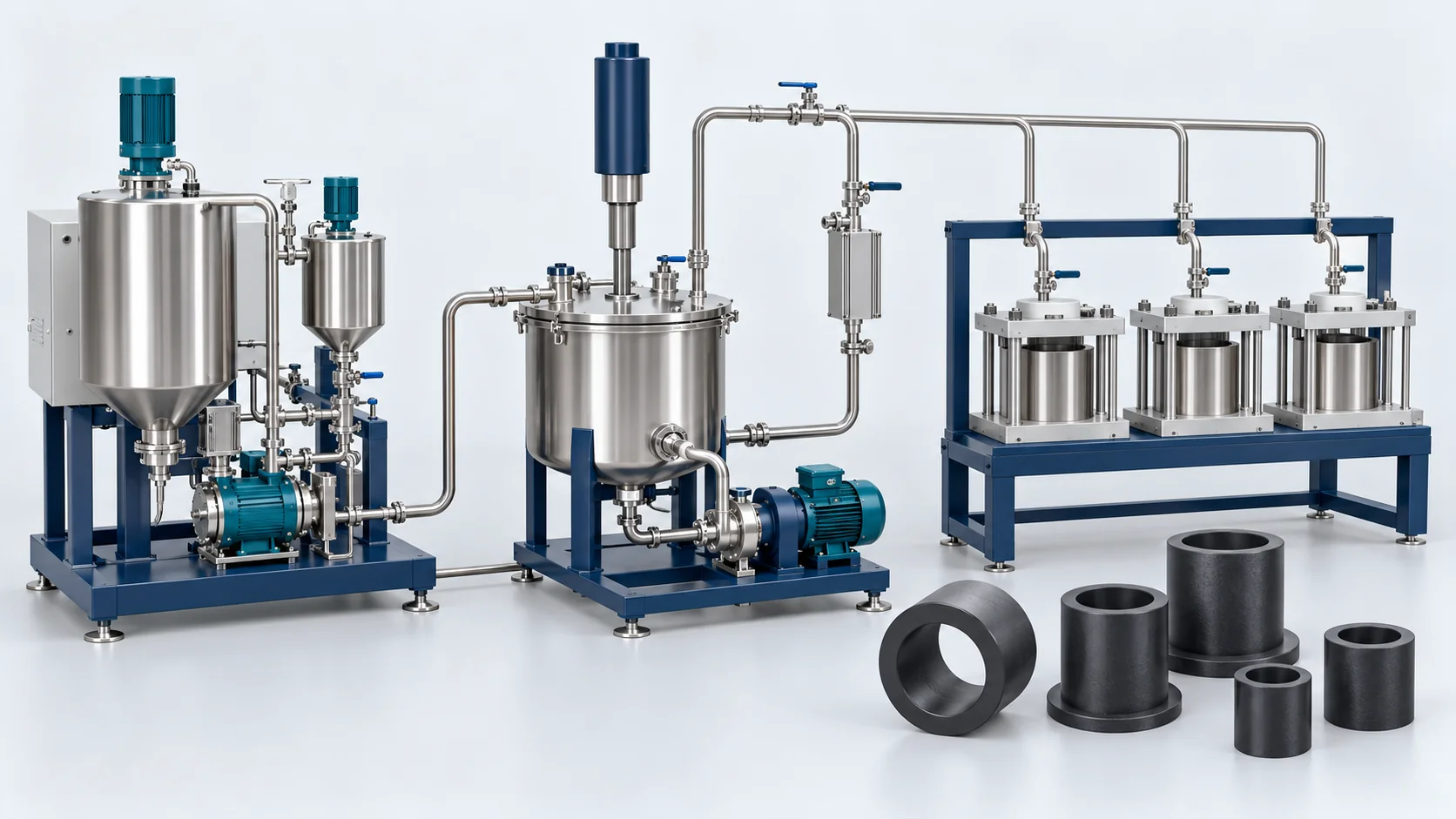
MC Nylon Casting Unit | Modified Bushings
Ultrasonic additive dispersion, suspension circulation and reactive casting for modified MC Nylon bushing formulations.
Ultrasonic Dispersion for Self-Lubricating MoS₂ & Oil-Filled MC Nylon
Ultrasonic additive dispersion, suspension circulation and reactive casting for modified MC Nylon bushing formulations.
Ultrasonic additive dispersion, suspension circulation and reactive casting for modified MC Nylon bushing formulations.
Heated monomer feed, configured ultrasonic preparation, additive circulation, metering/mixing and controls. Lubricant/additive chemistry, tooling and final wear qualification are separate.
Dry-friction coefficient, wear and grease-free life depend on specimen, load, speed and counterface. The reported 12-month/8,000-hour field run is not supported by the supplied implementation dates and March 2026 report without an earlier trial history. Powder suspension and additive compatibility require formulation trials.
Concept illustration: Generated concept illustration for process discussion; not a photograph of the specified machine, a customer facility or a delivered project.
Material Flow and Working Principle
Vacuum Dehydration & Ultrasonic MoS₂ Dispersion
Molten caprolactam at 135°C is blended with 3% to 5% micronized MoS₂ powder and synthetic oil inside a 200 L vessel under 0.01 kPa vacuum; 20 kHz ultrasonic transducers de-agglomerate particles.
High-Velocity Anti-Settling Fluid Recirculation
The filled monomer stream is continuously circulated through heated lines at high velocities (> 1.5 m/s) to prevent powder settling during waiting intervals, maintaining density within ±0.01 g/cm³.
High-Temperature Precision Metering
Ceramic-lined positive displacement pumps meter Stream A (monomer + MoS₂ + catalyst) and Stream B (monomer + activator) under Coriolis mass flow measurement within ±0.3%.
Dynamic Micro-Chamber Homogenization & Pouring
Materials blend in an oil-jacketed dynamic mixing head at 3,000 RPM, discharging into preheated bushing tooling (165°C) within 45 seconds without settling segregation.
In-Mold Anionic Polymerization & Annealing
The component polymerizes isothermally in 15 minutes, permanently trapping micro-oil droplets and MoS₂ platelets within the crystalline PA6 matrix before slow stress-relieving annealing.
Model and Technical Parameters
Supplied HF-MCN180-LUB configuration references, pending original calibration and acceptance documents. Material, finished-part and project outcomes are separate from equipment ratings. Dry-friction coefficient, wear and grease-free life depend on specimen, load, speed and counterface. The reported 12-month/8,000-hour field run is not supported by the supplied implementation dates and March 2026 report without an earlier trial history. Powder suspension and additive compatibility require formulation trials.
| Technical Parameter | HF-MCN180-LUB |
|---|---|
| Components | 2 Primary Streams (Stream A: Monomer + MoS₂/Oil + Cat, Stream B: Monomer + Act) |
| Output Range (g/s) | 3.0 to 25.0 kg/min (Continuous adjustable) |
| Mixing Ratio Range | 1:1 Fixed (Volumetric/weight balanced) |
| Ratio Accuracy | ±0.3% (Under continuous Coriolis mass flow tracking) |
| Power Supply | 380V, 3-Phase, 50Hz (Custom 440V/480V 60Hz optional) |
| Working Pressure | 0.3 to 0.6 MPa (Ceramic metering lines and head) |
| Tank Capacity (L) | Day tanks: 2 x 200 L (Stainless steel with ultrasonic horns) |
| Weight | 4,200 kg (Main casting unit and ultrasonic power skid) |
| Dimensions (L×W×H) | 3200 mm x 2200 mm x 2600 mm |
| Dynamic Friction Coefficient | 0.08 to 0.12 (Dry unlubricated friction); ASTM G99 pin-on-disk wear test; supplied reference pending original configuration or test records |
| Ultrasonic Transducer Power | 2.5 kW / 20 kHz (Continuous ultrasonic horn); Molten monomer preparation tank; supplied reference pending original configuration or test records |
| Grease-Free Bushing Wear | < 0.1 mm radial wear (After 8,000h run); Heavy rotary dumper field testing; supplied reference pending original configuration or test records |
| MoS₂ Powder Loading Capacity | 1.0% to 6.0% (By weight in monomer); De-agglomerated stable suspension; supplied reference pending original configuration or test records |
Key Equipment Features
Heated monomer feed, configured ultrasonic preparation, additive circulation, metering/mixing and controls. Lubricant/additive chemistry, tooling and final wear qualification are separate.
0.08 Ultra-Low Friction Coefficient
Supplied configuration reference: Synergistic MoS₂ and micro-oil encapsulation cuts dry friction to 0.08, one-third of standard cast nylon. Actual capability requires material and tooling validation.
20 kHz Ultrasonic Cavitation
Supplied configuration reference: In-situ ultrasonic transducers break sub-micron particle clumps, maintaining complete powder suspension at 135°C. Actual capability requires material and tooling validation.
8,000-Hour Grease-Free Endurance
Supplied configuration reference: Eliminates daily grease lubrication in harsh port dumper environments, with wear under 0.1 mm over 8,000 hours. Actual capability requires material and tooling validation.
Ceramic-Lined Anti-Abrasive Pumps
Supplied configuration reference: Zirconia ceramic sleeves and tungsten rotors resist aggressive wear from high-volume mineral powders. Actual capability requires material and tooling validation.


