
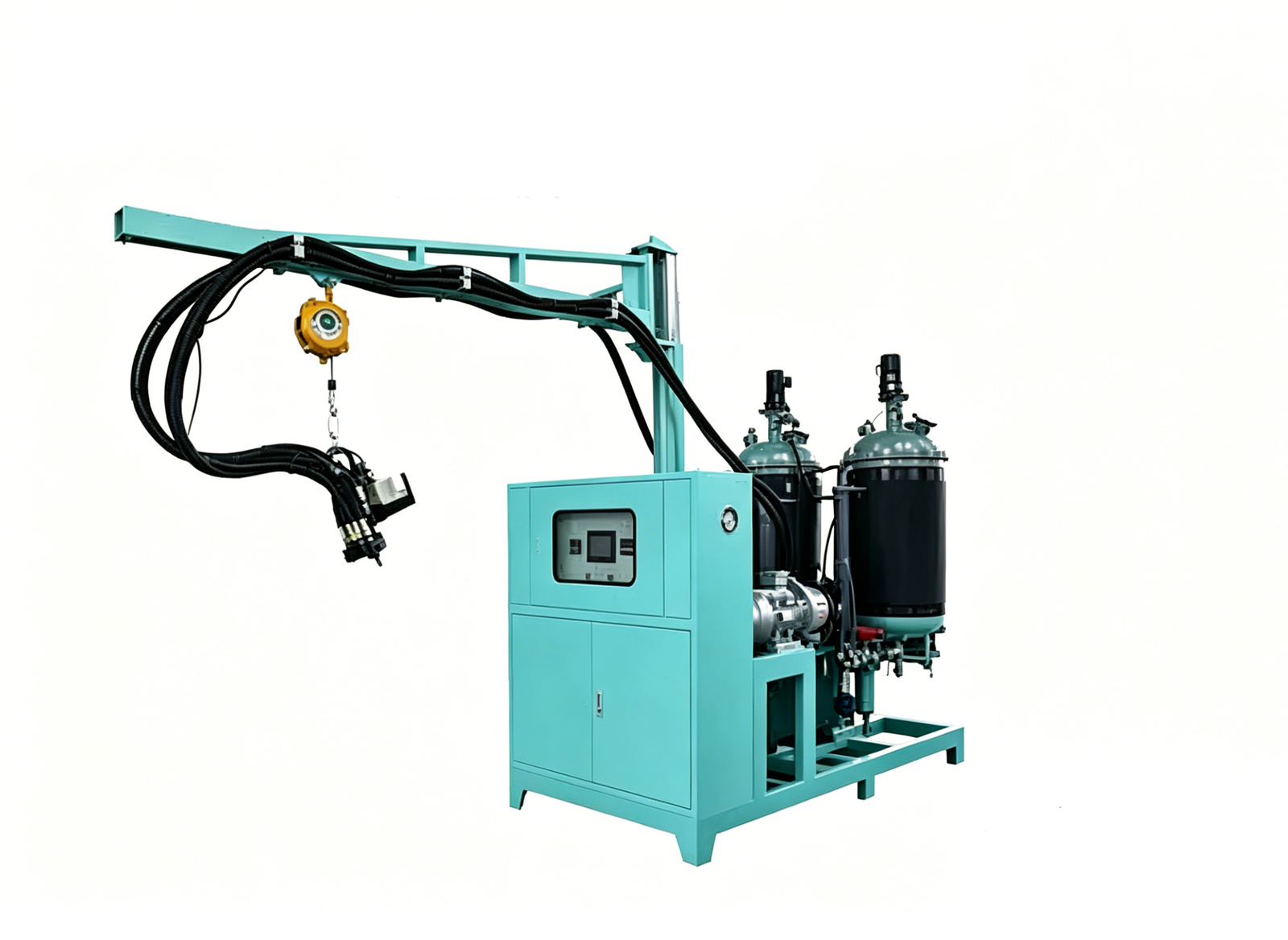
Large-Scale RV Roof Canopy PU-LFI Solution
Automated Long Fiber Injection (LFI) polyurethane production workcells for massive RV roofs, combining in-line roving chopping with seamless one-piece structural durability.
Automated PU-LFI Solutions for Seamless RV Roof Canopies
Recreational vehicle (RV) and specialty vehicle manufacturers have historically relied on manual fiberglass (FRP) lay-up or multi-piece sheet metal stampings for oversized roof panels. These methods involve high labor overhead, inconsistent resin content, heavy tare weight, and high water-leakage risks along mechanical seams. Under severe outdoor temperature swings, large composite panels with high thermal expansion frequently buckle and warp. Haifeng’s Long Fiber Injection (LFI) polyurethane solution utilizes robotic in-line fiber chopping and simultaneous high-pressure resin impregnation, delivering lightweight, stiff, and seamless monolithic roof shells that maintain dimensional stability in extreme weather.
Monolithic Seamless Shell Integrity
Eliminates mechanical fasteners and adhesive joints across expansive 3-meter spans, permanently eradicating water ingress risks while enhancing structural rollover rigidity.
Exceptional Dimensional Stability (CLTE)
Interlocking long glass fibers in a high-strength polyurethane matrix lock the coefficient of linear thermal expansion at approximately 25×10⁻⁶, eliminating roof sagging under intense desert sun exposure.
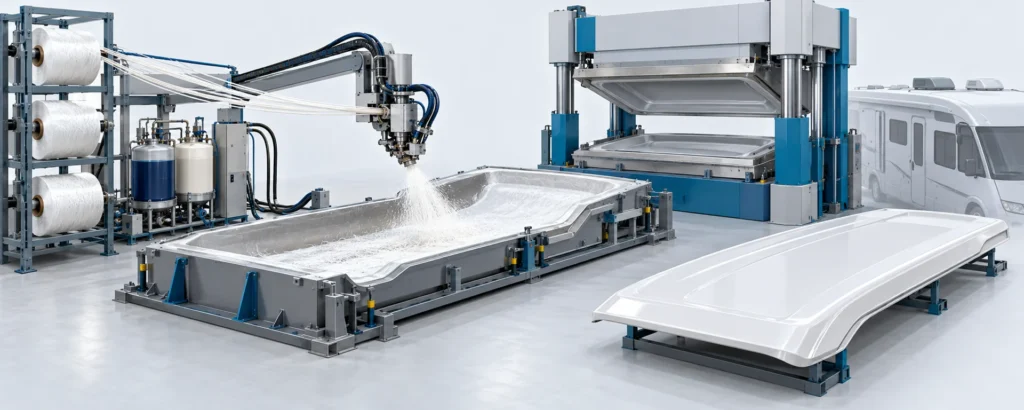
The LFI feed/deposition core is coordinated with tooling, press and handling equipment in the proposal.
Automated Polyurethane LFI Production Workflow
A fully orchestrated workflow integrating dynamic fiber chopping, robotic trajectory spraying, and low-pressure compression molding.
Fluid & Mold Thermal Balancing
Polyurethane precursors are conditioned in temperature-jacketed vessels. Multi-circuit TCU units stabilize fluid and mold core temperatures within ±1.0°C to optimize reaction kinetics.
Robotic In-Line Chopping & Dispensing
Continuous glass roving is drawn into the robot-mounted head, chopped to programmable lengths (12.5mm–100mm), and thoroughly wetted in-flight by high-pressure polyurethane jets directly into the open mold.
Low-Pressure Compression Molding
The large-platen press executes a controlled closing profile. Moderate cavity pressure causes the wetted fiber-resin mass to flow evenly without washing out reinforcement orientations.
Engineering Specifications & Production Capacity
Technical parameters for the Haifeng turnkey RV roof canopy LFI production system.
| Technical Parameter | Standard Specification / Value | Engineering Context & Verification |
|---|---|---|
| Target Application | Large RV Roof Canopies, Commercial Vehicle Panels | Oversized structural exterior body components |
| Material Matrix | Polyurethane Thermoset Resin + Chopped Glass Roving | High-stiffness isotropic composite system |
| Fiber Chopping Length | 12.5 mm – 100 mm (Programmable) | Continuous roving in-line cutter |
| Fiber Volume Fraction (FVF) | Up to 50% | High-density reinforcement capabilities |
| Metering Output Capacity | 30 – 80 kg/min (Customizable) | Servo axial piston pumps with Ratio Lock |
| Mold Temperature Window | 65°C – 85°C | Multi-zone dynamic water/oil TCU regulation |
| Demolding Cycle Time | 200 – 280 seconds (Standard 240 s) | Slashes manual lay-up times from 45+ minutes |
| Coefficient of Thermal Expansion | ~25×10⁻⁶ /K | Prevents buckling under outdoor thermal swings |
| Scope of Supply | Turnkey (LFI Dosing Skid, Robot, TCU + Optional Press/Tooling) | Complete workcell delivery or retrofit to existing press |
Key Engineering Advantages
Why leading RV and commercial vehicle builders transition to Haifeng automated LFI solutions.
40% Weight Reduction vs. SMC
Dramatically lighter than Sheet Molding Compound and 60% lighter than aluminum sheet, significantly lowering vehicle center of gravity and boosting fuel economy.
Seamless Weatherproof Construction
One-piece molding replaces multi-piece joints, completely eliminating water leakage paths and mechanical seam failures over vehicle operating life.
Superior Sun & Heat Resistance
Exceptional thermal stability with a low CLTE (~25×10⁻⁶) ensures roof surfaces remain dead-flat without distortion under intense desert solar radiation.
Substantial Labor & Cycle Savings
Compresses cycle times from 45+ minutes of manual fiberglass lamination down to 4 minutes of automated, repeatable robotic operation.
Related Project Records and Industry References
Review the evidence type on each record. Haifeng project figures describe their own configuration; public industry references identify third-party sources and are not Haifeng deliveries.
Frequently Asked Questions
Engineering and purchasing questions about this polyurethane production route.
How does LFI compare to traditional fiberglass hand lay-up for RV roofs?
Can Haifeng’s LFI system handle variable fiber lengths across different parts of the roof?
Can this LFI system integrate with our existing large-platen hydraulic press?
Does Haifeng provide complete turnkey lines including the press and molds?
What is the typical installation and commissioning timeline for an LFI line?
Is LFI identical to HP-RTM?
What information is needed to size the production line?
What is included in the equipment package?
Are cycle time and finished-product performance fixed?
Submit Your Production Goals
Share the finished product, material, target capacity, automation requirements and factory conditions to discuss a project-specific line configuration.
Related equipment for the process described on this page. Metering, handling, tooling and downstream scope are confirmed for the selected material and product; each equipment record defines its own configuration.


