
Large RV Roof Canopy Polyurethane LFI System Project in China
Haifeng delivered an automated LFI system for large RV roof canopies, cutting weight by 40% with seamless one-piece structural stability.
Project Overview
Illustration notice. Process illustrations are not verified photographs of this installation.
Project reference basis. Figures and configuration details are reported in the supplied project brief. They are reference values for the stated application, rather than verified acceptance results or a guarantee for another installation. Confirm the source records, material, tooling, operating schedule and test method when assessing a comparable project.
Haifeng successfully engineered and commissioned an automated Long Fiber Injection (LFI) polyurethane production workcell for a premier Chinese special vehicle and RV manufacturer, reducing large roof canopy weight by 40% while achieving a seamless, one-piece structural shell. The project covered the turnkey delivery of specialized high-pressure polyurethane dosing machines, multi-axis robotic glass fiber chopping and spray-dispensing heads, active temperature control skids, and digital interlocking interfacing with the client's large-platen compression molding press.
Prior to commissioning, the manufacturer struggled with multi-piece fiberglass (FRP) hand lay-up and stamped sheet metal panels. Legacy manual fabrication was labor-intensive and plagued by inconsistent resin ratios, heavy structural tare weights, and high leakage risks along mechanical joinery seams. Furthermore, large roof surfaces exposed to harsh outdoor temperature swings frequently warped due to elevated thermal expansion. The client required an automated composite manufacturing solution capable of chopping continuous glass roving in-line (from 12.5mm to 100mm), wetting fibers homogeneously with fast-reacting polyurethane resin, and holding a low coefficient of linear thermal expansion (CLTE around 25×10⁻⁶) to prevent sagging and dimensional distortion.
Operational since mid-2025 on a continuous two-shift production schedule across a 380 m² workcell, the installation provides reliable high-volume composite processing. By deploying Haifeng's closed-loop Ratio Lock metering and robotic continuous spray trajectory control, the client produces rigid, weather-resistant, and aerodynamically smooth RV roof canopies engineered for extreme outdoor durability.
Planning a related production line
Use this record as an application-specific reference. Reinforcement introduction, resin chemistry, tooling, consolidation and qualification differ between RIM, LFI, SMC and HP-RTM. A result from one process does not establish performance of another.
Production brief for technical discussion
Provide a finished-product drawing or sample, material data, target output, automation needs and factory conditions. Haifeng will review the process, equipment interfaces and acceptance plan for your own production goals.
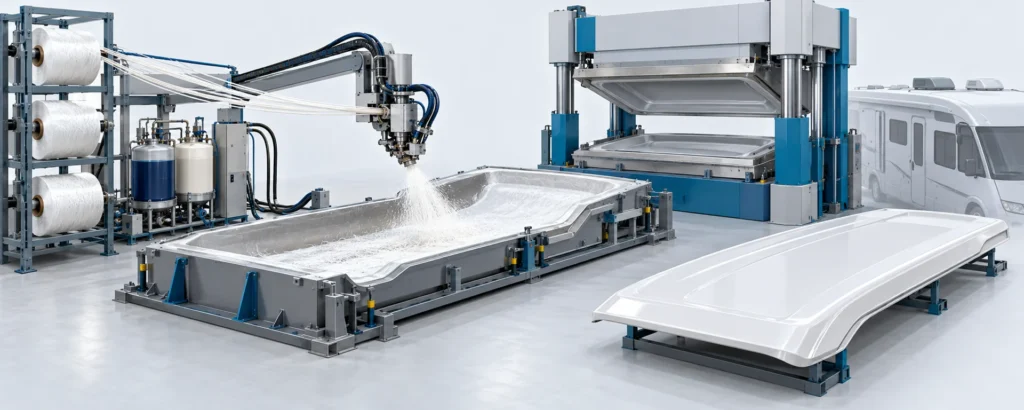
Concept illustration: The process image is a concept illustration used to explain the equipment arrangement; it does not document the delivered site.
Solutions Delivery
Haifeng deployed an industrial Long Fiber Injection (LFI) platform engineered for large-format composite exterior panels, eliminating assembly seams and accelerating cycle times down to 240 seconds across the complete molding sequence:
1. Closed-Loop High-Pressure Metering: Isocyanate and formulated polyol precursors are metered with ±0.5% stoichiometric precision via servo-driven displacement pumps, ensuring uniform wetting across high fiber volume fractions (up to 50% FVF).
2. Integrated Robotic Chopping & Spray Head: Mounted on a 6-axis industrial robot, the specialized LFI head continuously pulls glass roving, chops fibers to programmable lengths (12.5mm–100mm), and mixes them in-flight with the polyurethane resin stream directly into the open heated mold.
3. Dynamic Multi-Circuit Thermal Conditioning: Dedicated dynamic temperature control units regulate raw chemical tanks and mold halves within ±1.0°C, ensuring optimal resin viscosity and uniform cure kinetics across expansive three-meter surfaces.
4. Large-Platen Press Interface Synchronization: The master PLC system coordinates robotic spray cycles with the hydraulic press, executing controlled low-pressure compression ramps that preserve isotropic fiber distribution without wash-out.
Implementation & Training:
– Installation & Commissioning Timeline: 18 days from mechanical positioning and robot rail alignment to final mold trial shots.
– Operator Training: 4 days covering glass roving threading, cutter blade calibration, robotic spray trajectory programming, and mixing head preventive maintenance.
– Key Commissioning Milestones: Dry-run robotic path verification, fiber chopping length consistency checks, mold thermal mapping, and first-article large roof canopy dimensional CMM sign-off.
| Equipment | Model | Qty | Function |
|---|---|---|---|
| Precision High-Pressure PU Metering Machine | HF-LFI-HP60 | 1 Unit | High-output stoichiometric metering and continuous closed-loop pressure regulation |
| 6-Axis Robotic Fiber Chopping & Spray Station | HF-ROBOT-LFI | 1 Set | Continuous roving chopping, resin-fiber in-flight mixing & trajectory dispensing |
| Dual-Circuit Dynamic Mold Temperature Controller | HF-TCU-48 | 2 Units | Precision dynamic fluid and mold thermal balancing for large composite tooling |
| Integrated Industrial PLC Control Cabinet | HF-PLC-COMPACT | 1 Set | Master process logic, robot trajectory synchronization & press safety interlocks |
Project Results
Submit Your Production Goals
Share your product, material, target capacity, automation requirements and factory conditions to discuss a production line matched to your requirements.


