
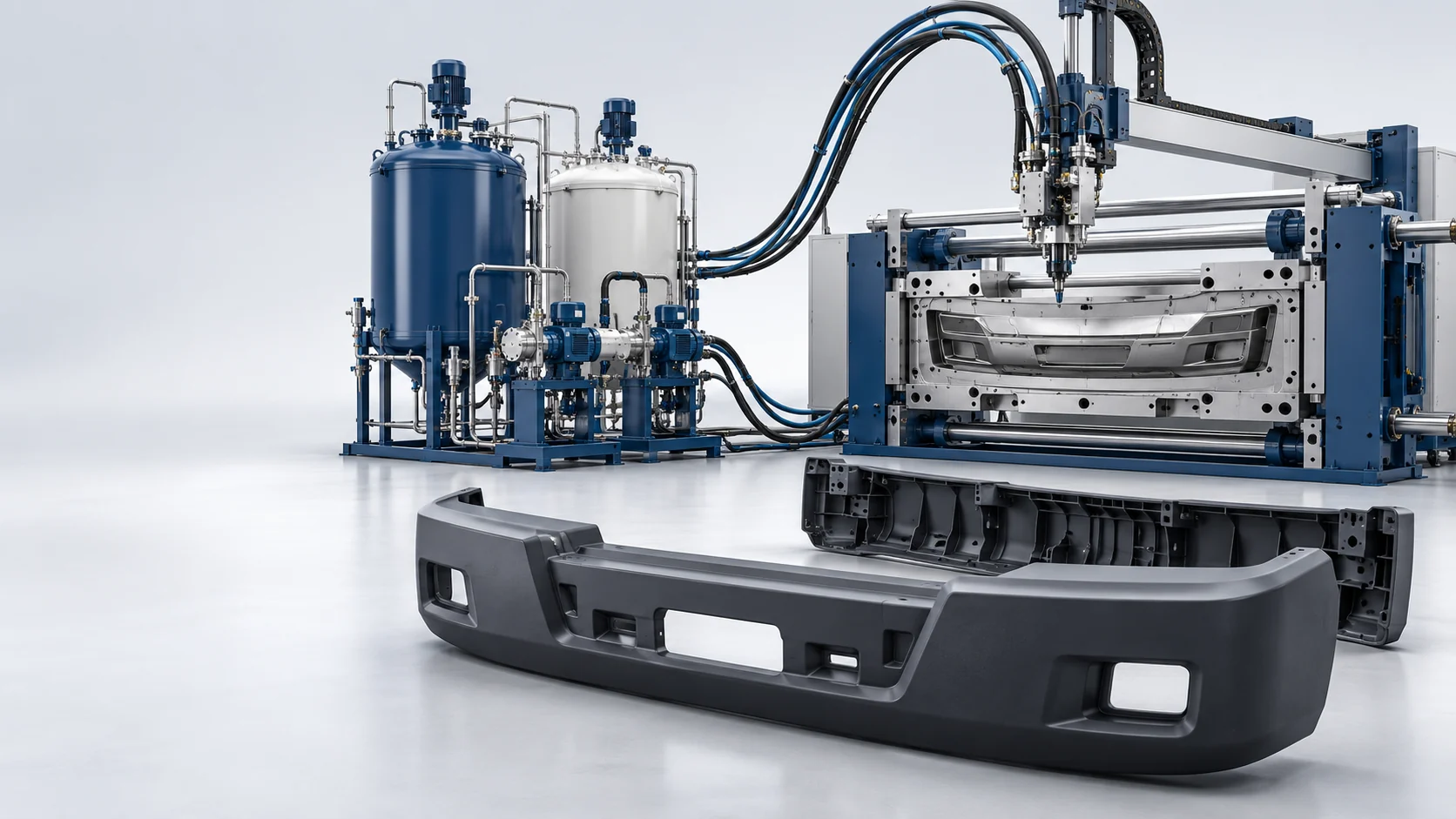
Heavy-Duty Truck Bumper RIM Molding Solution
High-output reaction injection molding systems engineered for heavy commercial vehicle bumpers, delivering 45% weight savings and extreme cold-impact durability.
Rugged RIM Solutions for Heavy-Duty Commercial Truck Bumpers
Commercial heavy-duty trucks operate in severe mining, long-haul freight, and off-road environments that demand structural crash resilience. Conventional stamped steel bumpers add substantial tare weight that diminishes payload efficiency and increases fuel consumption, while standard injection-molded plastics (such as modified PP) frequently crack catastrophically under flying gravel impact during sub-zero winter conditions (-40°C). Haifeng’s high-capacity Reaction Injection Molding (PU-RIM) solution enables the cost-effective molding of massive, thick-walled (4mm–8mm) elastomeric polyurethane bumpers that achieve high energy absorption, superior stone-impact recovery, and 45% weight reduction compared to steel.
Extreme Cold Impact Durability (-40°C)
Thermoset elastomeric polyurethane matrix retains high elongation and impact toughness down to -40°C, completely eliminating cold brittle cracking under heavy gravel impacts.
50% Tooling Capex Reduction
Low-pressure cavity filling allows the use of cost-effective steel or composite tooling, slashing capital expenditure by half compared to massive metal stamping dies.
Metering/mixing and the specified tool/handling interfaces are coordinated for the approved RIM part.
Heavy Commercial Vehicle Bumper RIM Workflow
A synchronized four-stage workflow delivering large-volume, void-free elastomeric bumpers with high impact toughness.
High-Volume Chemical Preconditioning
Polyol and isocyanate raw materials in bulk tanks are circulated through high-capacity dynamic heat exchangers, stabilizing reaction temperatures within ±0.8°C to prevent flow hesitation.
High-Velocity Impingement Injection
Heavy-duty servo axial piston pumps deliver large-volume chemical streams into an L-shaped impingement mixing head, executing rapid, laminar mold filling across long runner networks.
Low-Pressure Reaction & Microcellular Packing
The reacting liquid fills large cavity cross-sections (4mm–8mm) under low internal pressure. Fast-curing kinetics crosslink the elastomeric network without creating internal stress lines.
Engineering Specifications & Technical Parameters
Operational parameters for the Haifeng heavy-duty truck bumper RIM production system.
| Technical Parameter | Standard Specification / Value | Engineering Context & Verification |
|---|---|---|
| Target Application | Heavy-Duty Commercial Truck Front Bumpers | Exterior crash impact protection & fascia |
| Material Matrix | High-Toughness Elastomeric Polyurethane Matrix | Resilient elastomeric thermoset PU system |
| Metering Output Capacity | 30 – 80 kg/min (Customizable) | Heavy-duty axial piston pumps with Ratio Lock |
| Stoichiometric Ratio Accuracy | ±0.5% | Continuous digital flowmeter feedback |
| Low-Temperature Impact Rating | 100% Pass at -40°C Drop-Weight Test | Prevents cold-climate stone impact cracking |
| Mold Temperature Window | 60°C – 80°C | Multi-zone dynamic oil/water TCU regulation |
| Demolding Cycle Time | 180 – 240 seconds (Standard 200 s) | Optimized for large commercial vehicle assembly |
| Component Weight Reduction | 45% vs. Stamped Steel Assemblies | Substantial reduction in commercial fleet tare weight |
| Scope of Supply | Turnkey (RIM Dosing Skid, TCU, Master PLC + Optional Press/Tooling) | Full equipment integration or retrofit to existing press |
Heavy-Duty Machinery for Commercial Vehicles
Metering/mixing and the specified tool/handling interfaces are coordinated for the approved RIM part.
RIM Composite PU Foaming Machine | Auto Parts
RIM composite PU foaming machine for automotive parts, processing glass fiber/filler-reinforced systems. Delivers lightweight high-strength components for interior, exterior, and structural applications.
General RIM PU Molding Machine | Composite Parts
General-purpose RIM PU molding machine for glass fiber/filler-reinforced composites, producing lightweight high-strength parts. Widely used in automotive, construction, and heavy industrial applications.
Key Engineering Advantages
Why leading commercial vehicle manufacturers choose Haifeng heavy-duty bumper RIM solutions.
45% Weight Reduction vs. Steel
Significant reduction in front-end axle weight improves fleet payload capacity, reduces tire wear, and cuts long-haul fuel consumption.
100% Pass at -40°C Cold Impact
Thermoset elastomeric matrix absorbs heavy stone impacts in sub-zero winter freight corridors without brittle fractures or stress cracking.
50% Tooling Capex Savings
Low-pressure cavity filling allows cost-effective tooling, cutting capital expenditure by half compared to heavy stamping dies.
Corrosion & Chemical Resistance
Fully impervious to road salts, battery acids, diesel fuels, and high-pressure pressure washing, ensuring long-term aesthetic and structural durability.
Related Project Records and Industry References
Review the evidence type on each record. Haifeng project figures describe their own configuration; public industry references identify third-party sources and are not Haifeng deliveries.
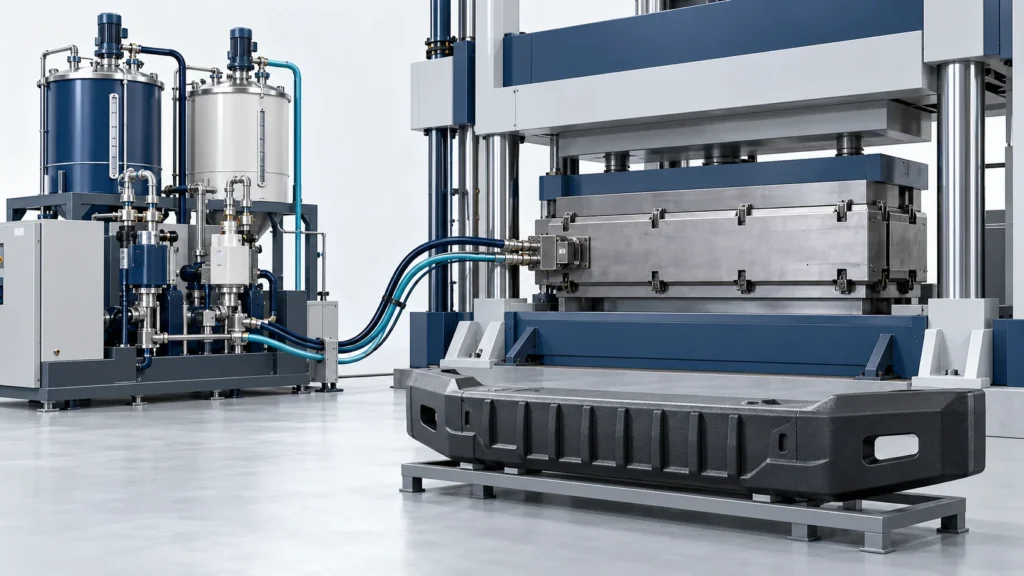
Heavy-Duty Truck Bumper RIM Dosing System Project in China
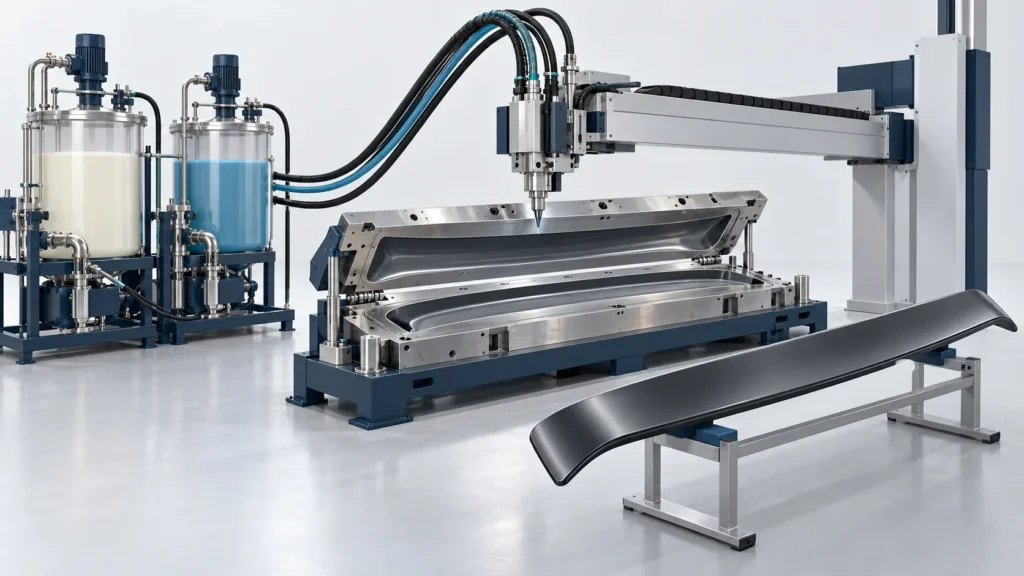
Automotive Sedan Spoiler RIM Dosing System Project in China
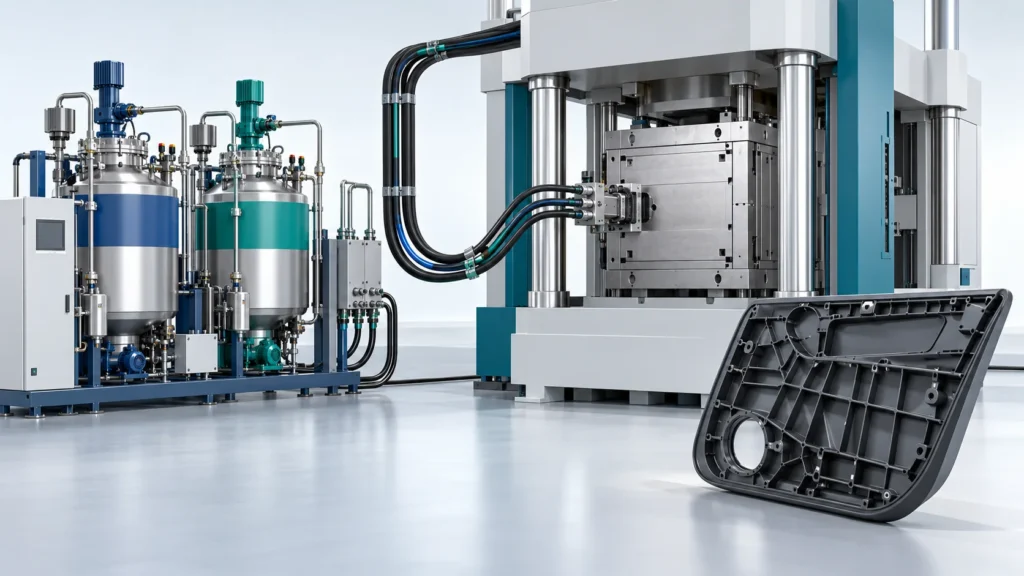
Automotive Door Panel RIM Dosing System Project in China
Frequently Asked Questions
Engineering and purchasing questions about this polyurethane production route.
How does elastomeric RIM compare to stamped steel for heavy truck bumpers?
Can this bumper withstand extreme cold winter conditions without cracking?
Can this high-capacity RIM machine integrate with our existing large hydraulic press?
Does Haifeng provide complete turnkey lines including presses and molds?
What is the typical installation and commissioning timeline on-site?
Does RIM require a dry-fiber preform?
What information is needed to size the production line?
What is included in the equipment package?
Are cycle time and finished-product performance fixed?
Submit Your Production Goals
Share the finished product, material, target capacity, automation requirements and factory conditions to discuss a project-specific line configuration.


