
Automotive Door Panel RIM Dosing System Project in China
Haifeng delivered a high-pressure RIM dosing system for automotive door panels, cutting substrate weight by 30% with zero surface sink marks.
Project Overview
Illustration notice. Process illustrations are not verified photographs of this installation.
Project reference basis. Figures and configuration details are reported in the supplied project brief. They are reference values for the stated application, rather than verified acceptance results or a guarantee for another installation. Confirm the source records, material, tooling, operating schedule and test method when assessing a comparable project.
Haifeng successfully delivered and commissioned an automated Reaction Injection Molding (RIM) dosing system for a Tier-1 automotive interior manufacturer in China, slashing door panel substrate weight by 30% while achieving zero surface sink marks across complex structural rib networks. The project covered the delivery of high-precision dual-component polyurethane metering equipment with an integrated PLC architecture, dynamic temperature conditioning loops, and digital safety interlocking interfacing with the customer's existing carrier mold press.
Prior to commissioning, the tier-1 supplier experienced structural warping and aesthetic defects when producing door trim substrates using conventional thermoplastic injection molding. Complex functional geometries—including integral speaker mounts, armrest load-bearing ribs, and fastener bosses where wall thicknesses transition between 2.5mm and 5.0mm—frequently developed visible sink marks that telegraphed through leather coverings. The customer required a low-cavity-pressure processing solution utilizing structural microcellular polyurethane to relieve internal residual stresses, maintain strict ±0.5mm dimensional tolerances, and comply with rigorous automotive cabin air quality standards.
Operational since December 2024 on a continuous two-shift production schedule across a 240 m² footprint, the workcell delivers consistent component repeatability. By deploying Haifeng's closed-loop Ratio Lock flow algorithms and high-velocity impingement injection heads, the client reliably manufactures lightweight, acoustically dampening door panel carriers tailored for high-volume automotive production.
Planning a related production line
Use this record as an application-specific reference. Reinforcement introduction, resin chemistry, tooling, consolidation and qualification differ between RIM, LFI, SMC and HP-RTM. A result from one process does not establish performance of another.
Production brief for technical discussion
Provide a finished-product drawing or sample, material data, target output, automation needs and factory conditions. Haifeng will review the process, equipment interfaces and acceptance plan for your own production goals.
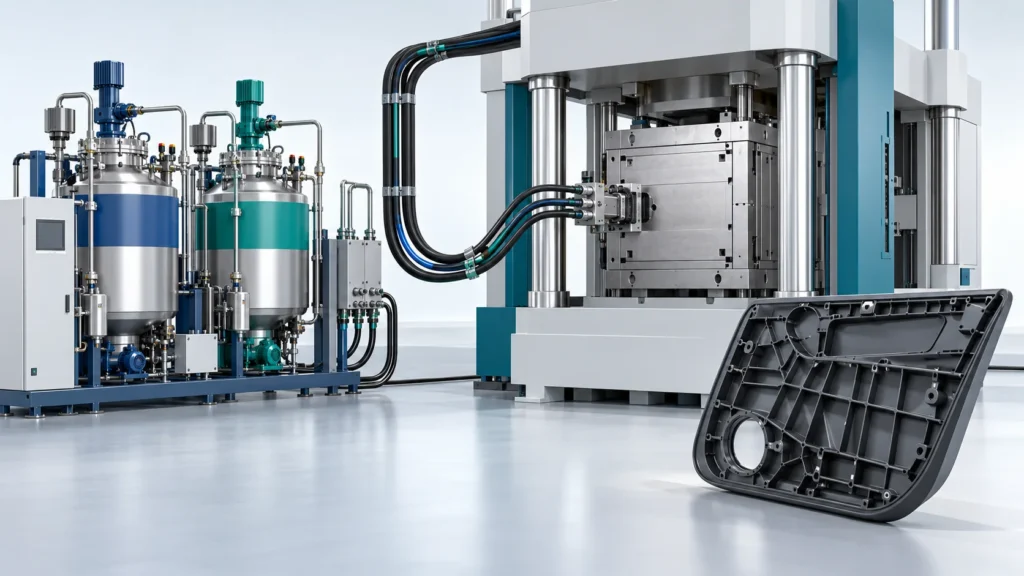
Concept illustration: The process image is a concept illustration used to explain the equipment arrangement; it does not document the delivered site.
Solutions Delivery
Haifeng deployed a high-precision polyurethane RIM dosing system tailored for rapid-curing microcellular formulations, eliminating sink marks and achieving a fast 120-second demolding cadence:
1. Closed-Loop Stoichiometric Ratio Lock: Isocyanate and formulated polyol streams are metered via servo-driven displacement pumps under continuous digital feedback, maintaining ±0.5% stoichiometric accuracy to secure uniform microcellular cell expansion.
2. Onboard Integrated Automation Architecture: The master PLC system and touch HMI are integrated directly onto the dosing chassis, synchronizing injection trigger curves, hydraulic interlocks, and safety protocols with the client’s existing clamping press.
3. Dual-Circuit Dynamic Thermal Stability: An external dynamic temperature conditioning skid maintains raw precursor and mold thermal equilibrium within ±0.5°C, ensuring uniform flow velocities across wide-span, thin-wall door geometries without cold spots.
4. Solvent-Free Self-Cleaning Impingement Mixing: An L-shaped impingement mixing head executes instantaneous mechanical clean cut-offs without chemical solvents, preventing air entrapment and eliminating nozzle clogging.
Implementation & Training:
– Installation & Commissioning Timeline: 12 days from mechanical positioning and fluid piping to hydraulic press interlocking and trial shots.
– Operator Training: 3 days covering stoichiometric calibration, recipe management, self-cleaning head maintenance, and preventive seal checks.
– Key Commissioning Milestones: Dry-run pressure checks, resin flow front rheology validation, mold thermal mapping, and first-article door panel dimensional sign-off.
| Equipment | Model | Qty | Function |
|---|---|---|---|
| Precision High-Pressure RIM Dosing Machine | HF-RIM-HP40 | 1 Unit | Stoichiometric ratio metering, high-velocity impingement mixing & shot weight control |
| Dual-Circuit Dynamic Mold Temperature Controller | HF-TCU-36 | 2 Units | Precision dynamic fluid and mold thermal balancing for door panel tooling |
| Integrated Industrial PLC Cabinet | HF-PLC-COMPACT | 1 Set | Built-in master process logic, servo pressure regulation & press digital interlocking |
| High-Pressure Impingement Mixing Head | HF-MIX-L16 | 1 Unit | High-velocity impingement mixing with hydraulic clean-off for door panels |
Project Results
Submit Your Production Goals
Share your product, material, target capacity, automation requirements and factory conditions to discuss a production line matched to your requirements.


