
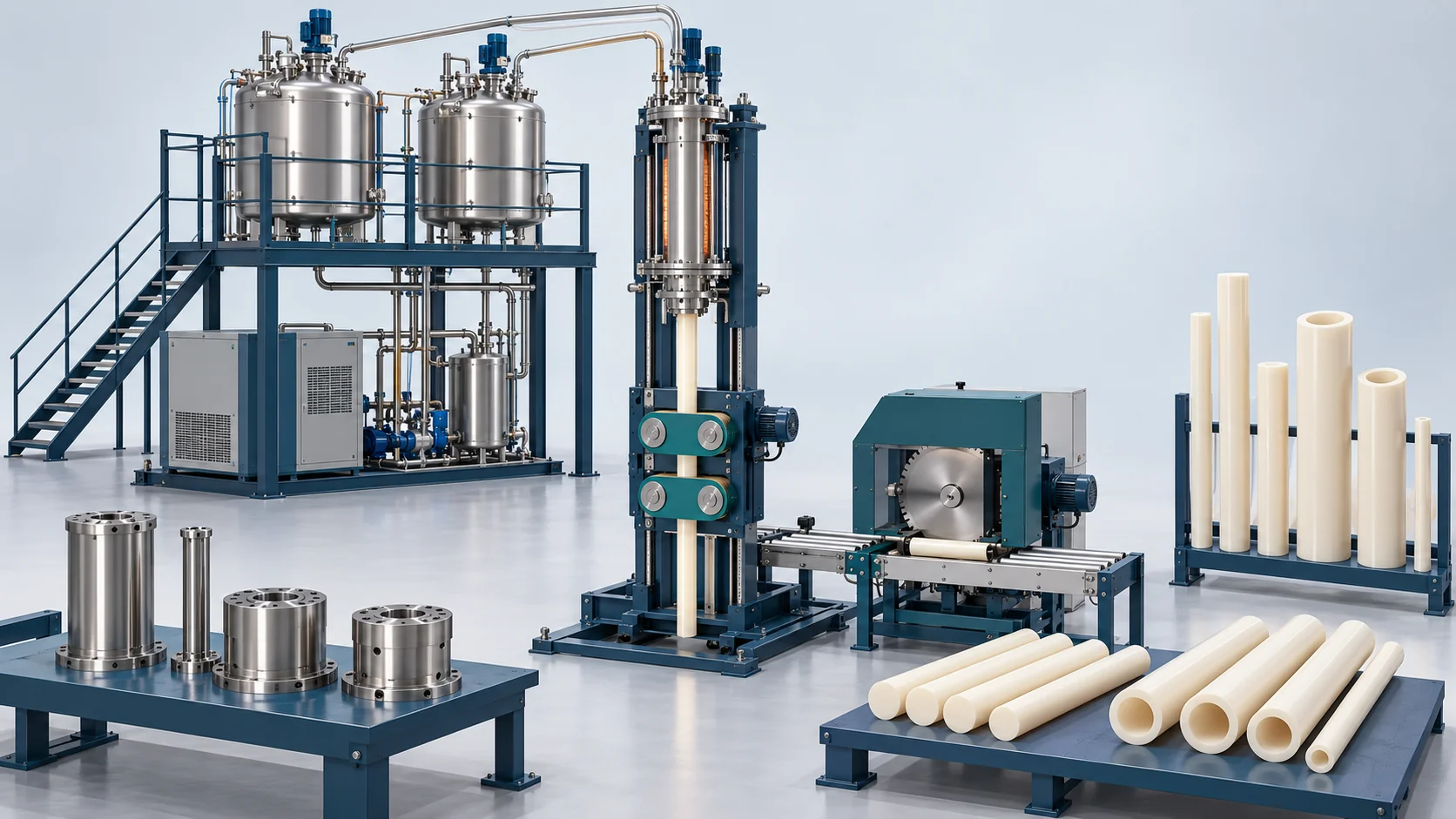
Continuous MC Nylon Rod Casting Solution
Continuous monomer feeding and vertical reactive casting with controlled haul-off and cutting for MC Nylon stock.
Unbroken Vertical Pultrusion for Large-Diameter Structural & Insulating Stock
Continuous monomer feeding and vertical reactive casting with controlled haul-off and cutting for MC Nylon stock.
Equipment and process scope
Conditioned monomer circuits, heated reactive die, puller, cutting and controls. Hollow/solid tooling, annealing and final stock testing are separately defined.
Validation and production planning
The supplied annual 1,520 t/year figure is extrapolated from a 30-day run, not an observed annual total. Throughput, rod diameter, line speed and utilization must be reconciled. Dielectric strength is a conditioned-material result; viscosity-derived molecular weight is not automatically weight-average Mw. Ratio basis requires density and temperature.
Conditioned monomer circuits, heated reactive die, puller, cutting and controls. Hollow/solid tooling, annealing and final stock testing are separately defined. The supplied annual 1,520 t/year figure is extrapolated from a 30-day run, not an observed annual total. Throughput, rod diameter, line speed and utilization must be reconciled. Dielectric strength is a conditioned-material result; viscosity-derived molecular weight is not automatically weight-average Mw. Ratio basis requires density and temperature.Generated concept illustration for process discussion; not a photograph of the specified machine, a customer facility or a delivered project.
Turnkey Vertical Continuous Rod Casting Workflow
Configuration sequence from the supplied brief. Material, tool, pressure/temperature basis and complete line balance require verification. The supplied annual 1,520 t/year figure is extrapolated from a 30-day run, not an observed annual total. Throughput, rod diameter, line speed and utilization must be reconciled. Dielectric strength is a conditioned-material result; viscosity-derived molecular weight is not automatically weight-average Mw. Ratio basis requires density and temperature.
Continuous Vacuum Monomer Dehydration
Supplied process reference: Caprolactam is melted at 135°C in twin 300 L stainless tanks under 0.01 kPa vacuum, stripping moisture below 20 ppm before adding catalyst.
Top-Fed Nitrogen-Blanketed Dispensing
Supplied process reference: Servo gear pumps meter Streams A and B (1:1 ratio) at 12 kg/min into the top reservoir of the vertical die under positive dry nitrogen.
Vertical Multi-Zone Sleeve Crystallization
Supplied process reference: The monomer descends through a 168°C thermal oil sleeve; anionic polymerization and crystallization occur simultaneously without shear.
Reference Solution Engineering Envelope
Supplied configuration and validation references; material/component results are separate from equipment ratings.
| Parameter | Value / Unit | Applicable Configuration / Conditions |
|---|---|---|
| Continuous Finished Diameter Range | Ø 50 mm to Ø 200 mm (Solid rod stock) | Precision chrome-plated continuous crystallization dies; supplied configuration or material target, pending the applicable original records |
| Hollow Tube Diameter Capability | Ø 100 mm to Ø 300 mm outer diameter | Internal water-cooled sizing mandrels for heavy-wall tubes; supplied configuration or material target, pending the applicable original records |
| Dielectric Breakdown Strength | Greater than or equal to 30.0 kV/mm | GB/T 1408.1 testing on cured railway insulation stock; supplied configuration or material target, pending the applicable original records |
| Polymer Molecular Weight (Mw) | 70,000 to 100,000 | Viscometric measurement on in-die polymerized PA6; supplied configuration or material target, pending the applicable original records |
| Continuous Downward Pull Speed | 50 to 300 mm/min | Multi-track servo caterpillar haul-off with speed encoder; supplied configuration or material target, pending the applicable original records |
| Annual Line Production Capacity | Up to 1,500 Metric Tons/year | Uninterrupted 24/7 continuous vertical casting operation; supplied configuration or material target, pending the applicable original records |
Core Equipment for This Solution
Conditioned monomer circuits, heated reactive die, puller, cutting and controls. Hollow/solid tooling, annealing and final stock testing are separately defined.
Core Advantages of Haifeng Continuous Rod Systems
Configured equipment functions and interfaces for the selected material and tooling.
Unbroken Length Scalability
Supplied configuration function: Vertical continuous drawing produces 6-meter rods without metal joints, eliminating flashover points. Project-dependent performance requires validation.
≥ 30 kV/mm Electrical Safety
Supplied configuration function: Deep-vacuum dehydration and top-fed filling eliminate voids, ensuring compliance with high-voltage railway codes. Project-dependent performance requires validation.
1,500 t/y Mass Output
Supplied configuration function: Continuous pultrusion elevates throughput 4x over batch casting, reducing per-kilogram operating expenses. Project-dependent performance requires validation.
100,000 High Molecular Weight
Supplied configuration function: Living anionic polymerization in-die builds long polymer chains without mechanical shear degradation. Project-dependent performance requires validation.
Related Project Draft
An anonymous project brief from the supplied document. Original attribution, dates, acceptance and outcome records require verification before public use.
Frequently Asked Questions
How does continuous vertical casting achieve molecular weights up to 100,000?
What prevents large Φ200 mm solid rods from sticking inside the steel die?
Why is dielectric strength exceeding 30 kV/mm reported in these rods?
How does the flying saw cut moving rods without stopping the haul-off?
Discuss Your Production Goals
Share your product or drawing, material system, target output, automation needs and factory utilities so the equipment and interfaces can be configured.


