
Railway Insulating Nylon Rod Line Project in China
Review draft: Railway Insulating Nylon Rod Line Project. Configuration and reported outcomes require original project records.
Project Overview
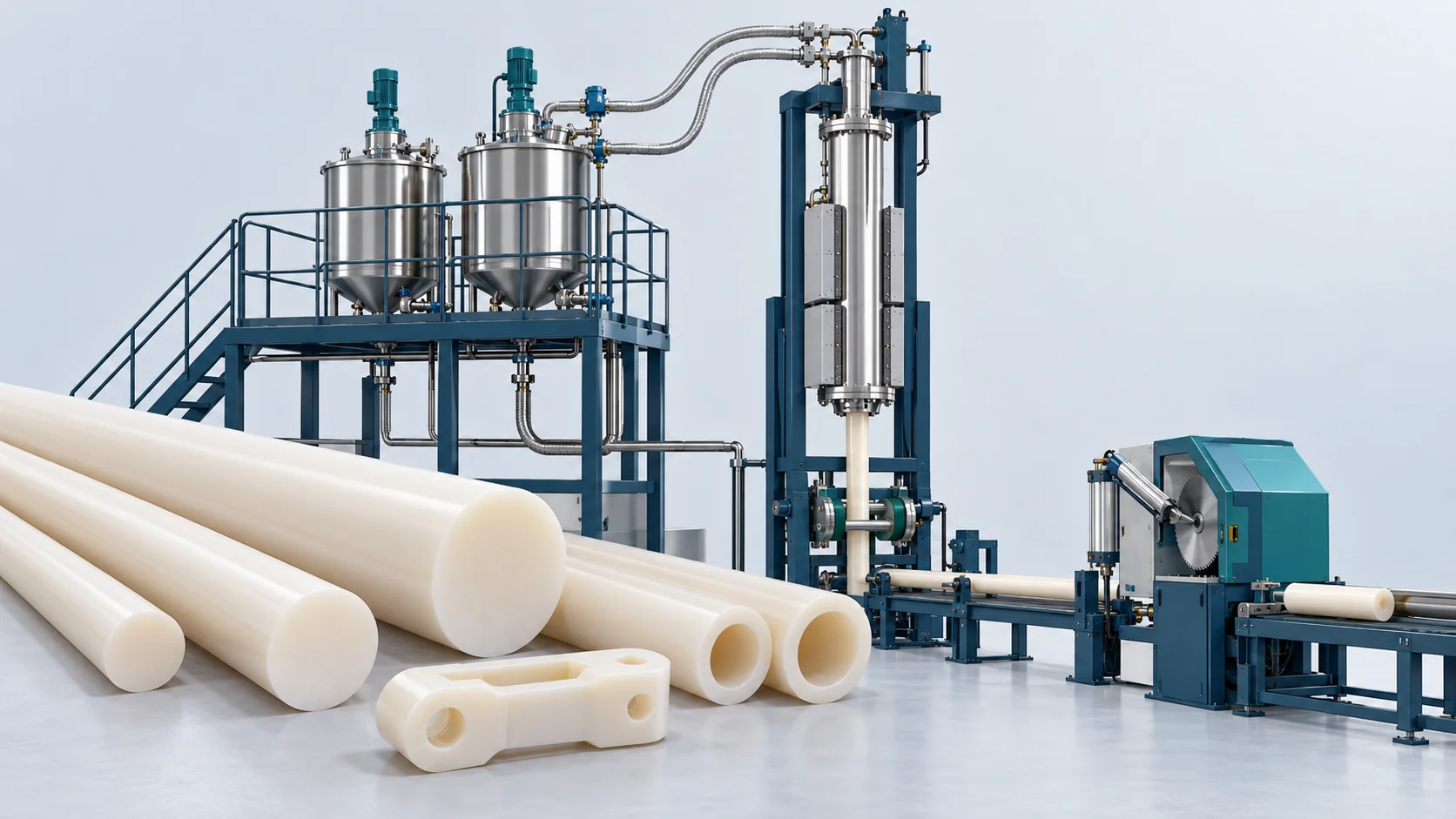
Illustration notice. Process illustrations are not verified photographs of this installation.
Project reference basis. Figures and configuration details are reported in the supplied project brief. They are reference values for the stated application, rather than verified acceptance results or a guarantee for another installation. Confirm the source records, material, tooling, operating schedule and test method when assessing a comparable project.
A leading national railway electrical traction and insulation technology giant in Hunan deployed Haifeng’s vertical continuous MC nylon rod pultrusion-casting line. The project was commissioned to establish an automated production facility for high-voltage catenary insulator support rods and switch operating linkages used in 350 km/h high-speed rail electrification networks.
Prior to this installation, the supplier manufactured insulating rods using batch casting tubes limited to 1.2 meters in length. Joining shorter segments required metal coupling sleeves that added weight and created dangerous surface flashover points under 27.5 kV catenary voltages. Batch rods also suffered from internal shrinkage voids and moisture contamination, dropping electrical breakdown values to 20–22 kV/mm and failing strict China Railway Corporation quality audits.
Haifeng engineered an integrated vertical continuous crystallization line centered on the HF-MCR200-CV system. Featuring top-fed liquid monomer injection, an enclosed multi-zone crystallization sleeve, and continuous servo caterpillar drawing, the facility continuously produced unbroken Ø 100 mm and Ø 120 mm rods. The line delivered an annual capacity of 1,500 tons with dielectric breakdown strengths reaching 32.5 kV/mm and zero internal void defects.
Review point: The supplied annual 1,520 t/year figure is extrapolated from a 30-day run, not an observed annual total. Throughput, rod diameter, line speed and utilization must be reconciled. Dielectric strength is a conditioned-material result; viscosity-derived molecular weight is not automatically weight-average Mw. Ratio basis requires density and temperature.
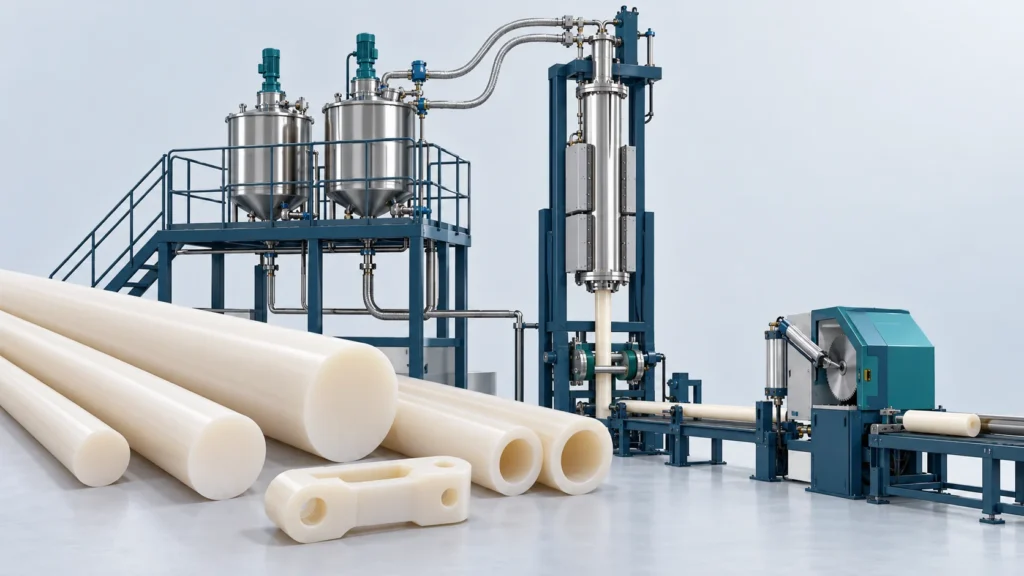
Concept illustration: Generated concept illustration for process discussion; not a photograph of the specified machine, a customer facility or a delivered project.
Solutions Delivery
Configuration reported in the supplied brief.
Haifeng engineered an automated vertical continuous manufacturing tower spanning 7.2 meters in height. Solid caprolactam flakes are melted at 135°C in twin 300 L stainless vessels under continuous 0.01 kPa vacuum, driving moisture content below 18 ppm to eliminate catalytic deactivation.
Monomer Streams A and B are metered via servo-driven gear pumps into a dynamic mixing head that dispenses into the top reservoir of a vertical, mirror-polished crystallization sleeve at 12 kg/min under continuous dry nitrogen blankets. As the formulation travels downward, multi-zone thermal oil jackets (168°C) trigger simultaneous anionic polymerization and crystallization.
The crosslinked solid profile forms a self-lubricating outer boundary as it contracts slightly. A heavy-duty multi-track servo caterpillar puller located beneath the floor grips the cured Ø 100 mm rod, exerting 50 kN of force to pull it downward at a stable 120 mm/min. An automated tracking flying saw clamps the moving rod and cuts it cleanly into 3-meter sections without halting the puller, ensuring high molecular weights of 85,000 and defect-free dielectric density.
The supplied annual 1,520 t/year figure is extrapolated from a 30-day run, not an observed annual total. Throughput, rod diameter, line speed and utilization must be reconciled. Dielectric strength is a conditioned-material result; viscosity-derived molecular weight is not automatically weight-average Mw. Ratio basis requires density and temperature.
| Equipment | Model | Qty | Function |
|---|---|---|---|
| Vertical Continuous MC Nylon Rod Unit | HF-MCR200-CV | 1 complete line | Top-feed continuous monomer dispensing, in-die crystallization, and pulling. |
| Multi-Zone Heated Crystallization Die | HF-VCD-120 | 2 sets | Ø 100 mm and Ø 120 mm precision chrome-plated crystallization sleeves. |
| 100 kN Multi-Track Servo Haul-Off | HF-MSH-100 | 1 unit | Closed-loop servo caterpillar puller maintaining non-slip downward traction. |
| Tracking Circular Flying Cutoff Saw | HF-TFS-03 | 1 unit | High-speed circular saw cutting moving rods to length without stopping lines. |
Reported Results — Original Records Required
Scale Your High-Voltage Insulating Nylon Rod Production
Connect with Haifeng continuous casting specialists to deploy vertical continuous crystallization lines engineered for electrical rail insulators.


