
MC Nylon Casting Line | Rods and Tubes
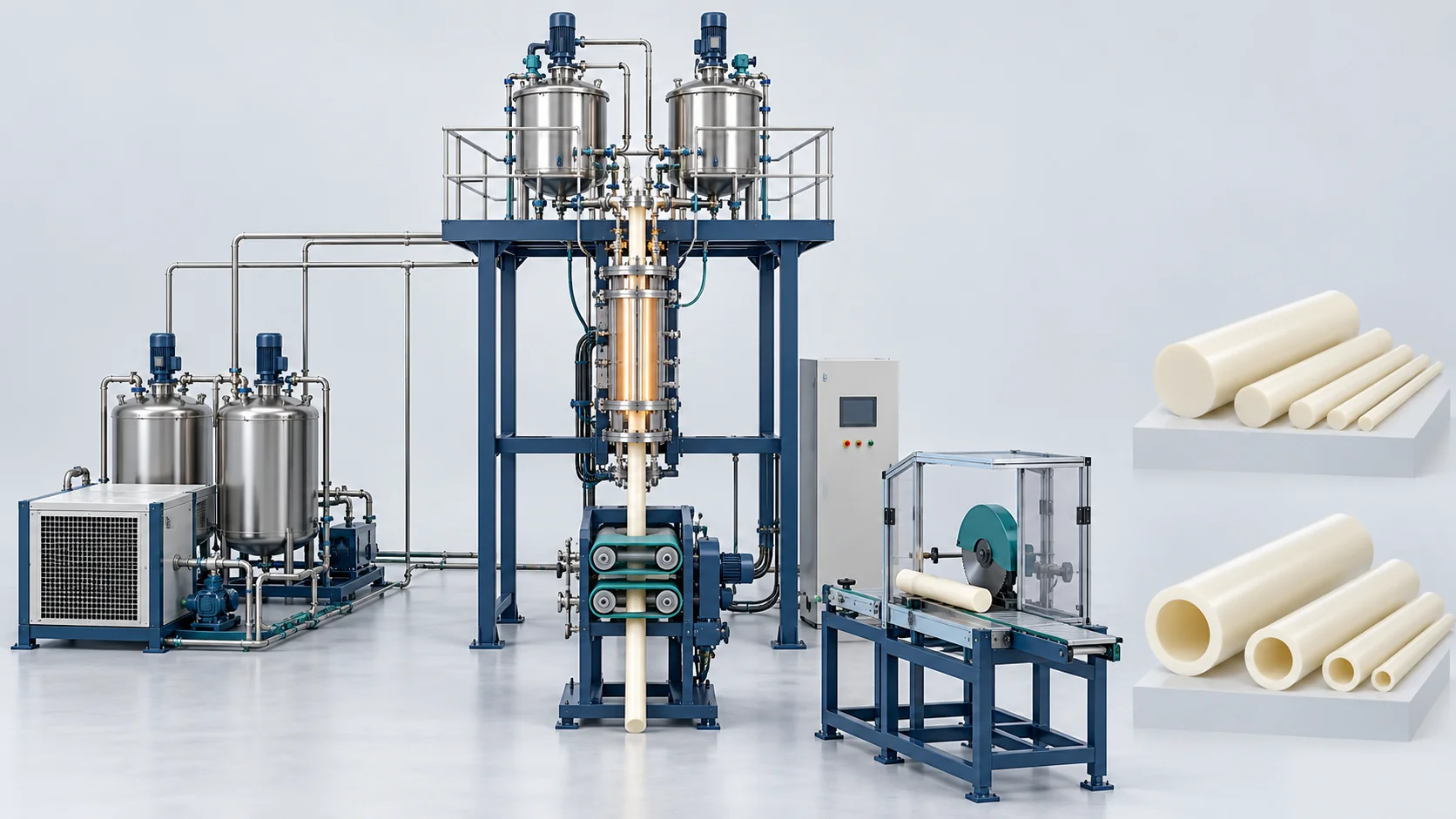
Continuous monomer feeding and vertical reactive casting with controlled haul-off and cutting for MC Nylon stock.
Continuous Vertical Polymerization for Large MC Nylon Rods & Tubes
Continuous monomer feeding and vertical reactive casting with controlled haul-off and cutting for MC Nylon stock.
Continuous monomer feeding and vertical reactive casting with controlled haul-off and cutting for MC Nylon stock.
Conditioned monomer circuits, heated reactive die, puller, cutting and controls. Hollow/solid tooling, annealing and final stock testing are separately defined.
The supplied annual 1,520 t/year figure is extrapolated from a 30-day run, not an observed annual total. Throughput, rod diameter, line speed and utilization must be reconciled. Dielectric strength is a conditioned-material result; viscosity-derived molecular weight is not automatically weight-average Mw. Ratio basis requires density and temperature.
Concept illustration: Generated concept illustration for process discussion; not a photograph of the specified machine, a customer facility or a delivered project.
Material Flow and Working Principle
Continuous Monomer Melting & High-Vacuum Degassing
Solid caprolactam flakes are melted at 135°C in twin 300 L stainless vessels under continuous 0.01 kPa vacuum, stripping moisture below 20 ppm before adding catalyst and activator.
Top-Fed Constant-Level Metering & Dispensing
Servo-driven positive displacement gear pumps meter Streams A and B (1:1 ratio) through a dynamic low-pressure mixing head, feeding the top reservoir of the vertical die under nitrogen.
Multi-Zone Vertical Sleeve In-Die Crystallization
The liquid moves downward through a multi-zone thermal oil sleeve (160°C to 175°C); anionic polymerization and crystallization occur simultaneously, forming a solid self-lubricating matrix.
Servo Caterpillar Continuous Downward Haul-Off
Opposed multi-track servo caterpillar pullers grip the solid profile, exerting up to 100 kN of tractive force to pull the rod downward at a stable 150 mm/min without slip.
Synchronized Tracking Flying Saw Cutoff
An automated circular flying saw clamps the moving rod and cuts it to custom lengths (up to 6 meters) without slowing pull speeds, discharging finished rods to sorting racks.
Model and Technical Parameters
Supplied HF-MCR200-CV configuration references, pending original calibration and acceptance documents. Material, finished-part and project outcomes are separate from equipment ratings. The supplied annual 1,520 t/year figure is extrapolated from a 30-day run, not an observed annual total. Throughput, rod diameter, line speed and utilization must be reconciled. Dielectric strength is a conditioned-material result; viscosity-derived molecular weight is not automatically weight-average Mw. Ratio basis requires density and temperature.
| Technical Parameter | HF-MCR200-CV |
|---|---|
| Components | 2 Streams (Stream A: Monomer + Catalyst, Stream B: Monomer + Activator) |
| Output Range (g/s) | 2.0 to 18.0 kg/min (Continuous steady-state flow) |
| Mixing Ratio Range | 1:1 Fixed (Volumetric/weight balanced) |
| Ratio Accuracy | ±0.2% (Coriolis mass flow continuous tracking) |
| Power Supply | 380V, 3-Phase, 50Hz (Custom 440V/480V 60Hz optional) |
| Working Pressure | 0.3 to 0.5 MPa (Top-feed low-pressure delivery line) |
| Tank Capacity (L) | Day tanks: 2 x 300 L (Stainless steel with thermal jackets) |
| Weight | 9,800 kg (Tower frame, die set, puller, and flying saw) |
| Dimensions (L×W×H) | 3500 mm x 2400 mm x 7200 mm (Vertical machine height) |
| Continuous Rod Diameter Range | Ø 50 mm to Ø 200 mm (Solid cylindrical stock); Interchangeable continuous dies; supplied reference pending original configuration or test records |
| Downward Tractive Haul Force | Up to 100 kN (Multi-track caterpillar drive); Variable speed 50–300 mm/min; supplied reference pending original configuration or test records |
| Dielectric Breakdown Strength | ≥ 30 kV/mm (50 Hz electrical breakdown test); GB/T 1408.1 / IEC 60243; supplied reference pending original configuration or test records |
| Polymer Molecular Weight | 70,000 to 100,000 (Mw via viscometry); Anionic in-die polymerization; supplied reference pending original configuration or test records |
Key Equipment Features
Conditioned monomer circuits, heated reactive die, puller, cutting and controls. Hollow/solid tooling, annealing and final stock testing are separately defined.
Continuous Vertical Pultrusion
Supplied configuration reference: Continuous downward drawing eliminates batch length limits, boosting single-line annual capacity to 1,500 tons. Actual capability requires material and tooling validation.
≥ 30 kV/mm Dielectric Strength
Supplied configuration reference: Deep-vacuum processing down to 0.01 kPa strips moisture, preventing electrical micro-void flashover. Actual capability requires material and tooling validation.
100 kN Downward Servo Pull
Supplied configuration reference: Heavy-duty multi-track caterpillar pullers deliver pulse-free haul-off speeds from 50 to 300 mm/min. Actual capability requires material and tooling validation.
70,000–100,000 High Molecular Weight
Supplied configuration reference: Continuous in-die anionic polymerization yields ultra-high molecular weights unmatched by extrusion. Actual capability requires material and tooling validation.


