
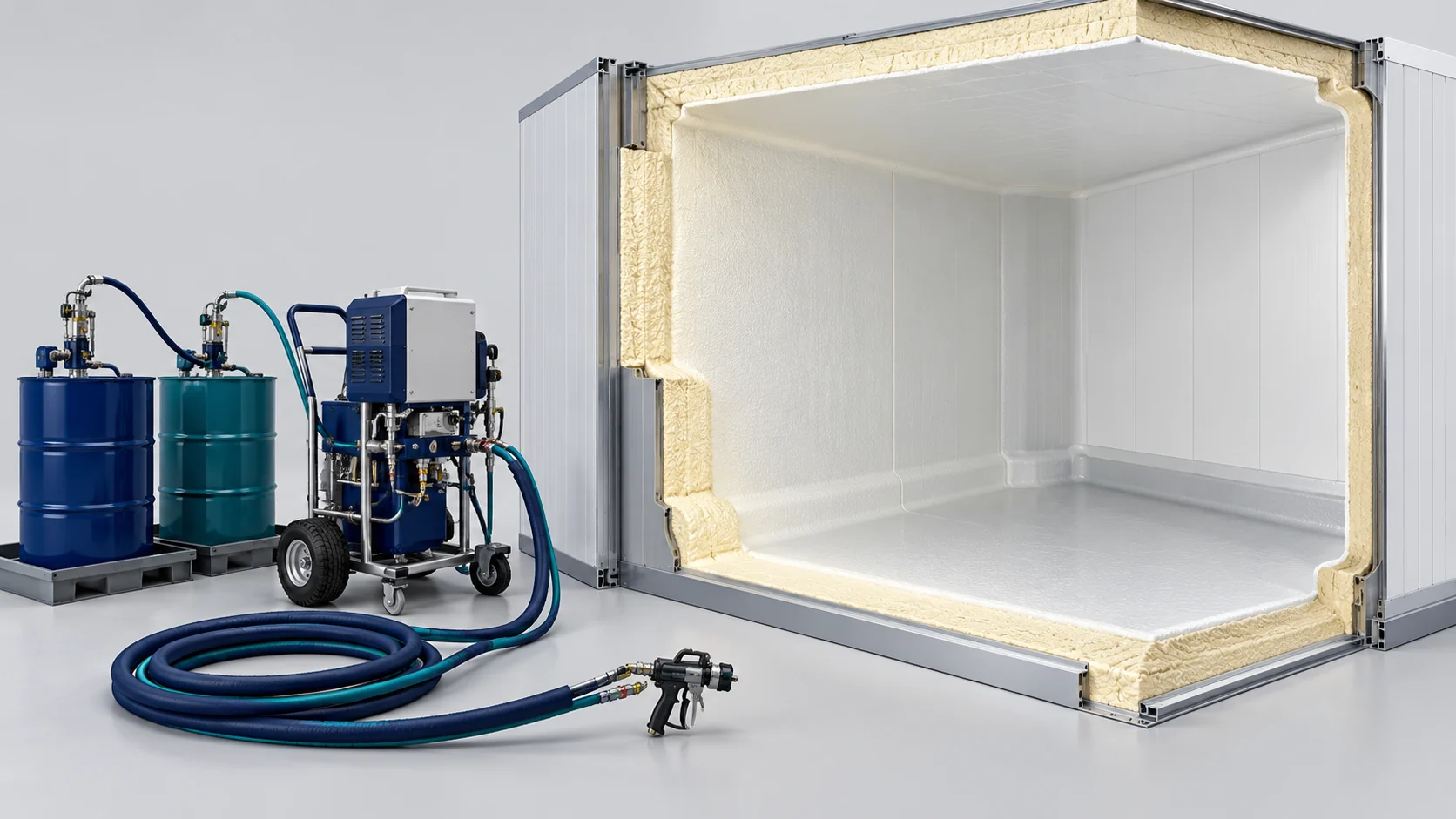
Solución de aislamiento de espuma de PU para cámaras frigoríficas
Planifique el aislamiento de PU in situ para cámaras frigoríficas y congeladores en función del estado del sustrato, la vía de aplicación, el espesor del aislamiento y el diseño completo del recinto.
Seamless In-Situ Polyurethane Solutions for Cold Storage & Freezers
In-situ PU insulation can suit complex surfaces and selected refurbishment projects. Thickness, vapor control, joints, protective finishes and floor-load requirements are designed and verified for the complete cold-room envelope.
Envelope and Vapor-Control Design
Review joints, penetrations, substrate moisture, vapor-control layers and protective finishes together. Closed-cell content alone does not establish airtightness or frost-free operation.
Floor and Surface Requirements
Floor loads are assessed for the full construction, including insulation, slab, supports and service loads. Facing and coating compatibility are selected for the cleaning and operating conditions. Match the blended-polyol and isocyanate grades to the intended service, processing viscosity and spray or fill route. Distinguish free-rise material data from the density and condition of the installed insulation; material fire classifications and enclosure qualification are reviewed separately.
Comparar rutas de producción relacionadas
Specify the insulated surface and refurbishment duty: walls, overhead surfaces, cavities and loaded floors have different constraints. Coordinate vapor control, joints and protective finishes with the complete cold-room envelope instead of relying on a foam property alone.
Production Workflow for Cold Storage PU Foam Insulation Machine System
The sequence is configured for the selected application and material. Temperatures, pressures, reaction timing and pass thickness are reference conditions reviewed through project trials.
Substrate Drying & Primer Activation
Concrete or masonry walls are dried and swept; specialized moisture-barrier primers are rolled onto surfaces to promote high chemical bonding strength.
High-Pressure Precursor Thermal Regulation
Condition polyol A and isocyanate B in separate circuits. Check material viscosity and temperature, component delivery and ratio, hose conditioning and gun settings before representative spray trials. Low ambient temperature does not by itself establish an acceptable substrate or application condition.
Multi-Pass In-Situ Cold Room Spraying
Apply successive passes within the material supplier’s thickness and cooling requirements. Inspect thickness and coverage against the cold-room envelope design.
Especificaciones técnicas
Supplied application and equipment references for configuration review. Material properties, operating conditions and acceptance tests are agreed for the selected project.
| Parámetro técnico | Supplied Reference / Configuration | Contexto de ingeniería y verificación |
|---|---|---|
| Aplicación objetivo | Cold Rooms, Deep Freezers, Blast Freezers, Cold Logistics | Extreme cold temperature containment (-40°C) |
| Matriz del material | Rigid Closed-Cell Polyurethane Foam (SPF) | High-index formulation for refrigeration |
| Densidad de la espuma del núcleo | 40 – 48 kg/m³ | Optimized for thermal efficiency and compression |
| Conductividad térmica (λ) | 0.019–0.021 (supplied reference) W/(m·K) | Thermal test method, mean temperature, conditioning and aging to be agreed |
| Closed-Cell Content | ≥96% | Supplied cell-content reference; vapor-control design and material testing required |
| Resistencia a la compresión | >250 kPa (Floor grade >350 kPa) | Material reference; complete floor construction and service loads require design review |
| Proportioner Fluid Output | 8 – 16 kg/min | Continuous hydraulic displacement output |
Reference Haifeng Insulation Equipment
Spraying, high-pressure injection and low-pressure foaming are separate configured routes. Select the actual material delivery and any protective coating stage.
Máquina de proyección de PU | Aislamiento de cámaras frigoríficas
Acondicionamiento y pulverización de PU para aislamiento de almacenamiento en frío, con revisión de la formulación, el sustrato, el suministro por manguera y las condiciones del sitio.
Máquina de espumado de PU de alta presión | Cámaras frigoríficas
Máquina de espumado de PU de alta presión para cámaras frigoríficas. Revise las funciones del equipo, los requisitos de materiales y las opciones de configuración para su proceso de producción.
Máquina de espumado de PU de baja presión | Cámaras frigoríficas
Suministro de PU a baja presión para componentes de almacenamiento en frío, con dosificación y mezcla configuradas para la formulación y el utillaje.
Ventajas técnicas clave
Application-specific process controls, tooling and equipment integration.
Geometry-Specific Application
Review in-situ application for corners, irregular surfaces and selected refurbishment work.
Vapor-Control Coordination
Include joints, penetrations and specified vapor-control measures in the envelope design.
Material and Floor Review
Verify thermal properties and floor construction against the intended service.
Application and Inspection Planning
Agree equipment, substrate preparation and finished-envelope checks for the project.
Proyectos relacionados
The related in-situ cold-room projects support their stated envelope areas and materials, not all floor-loading or vapor-control designs.
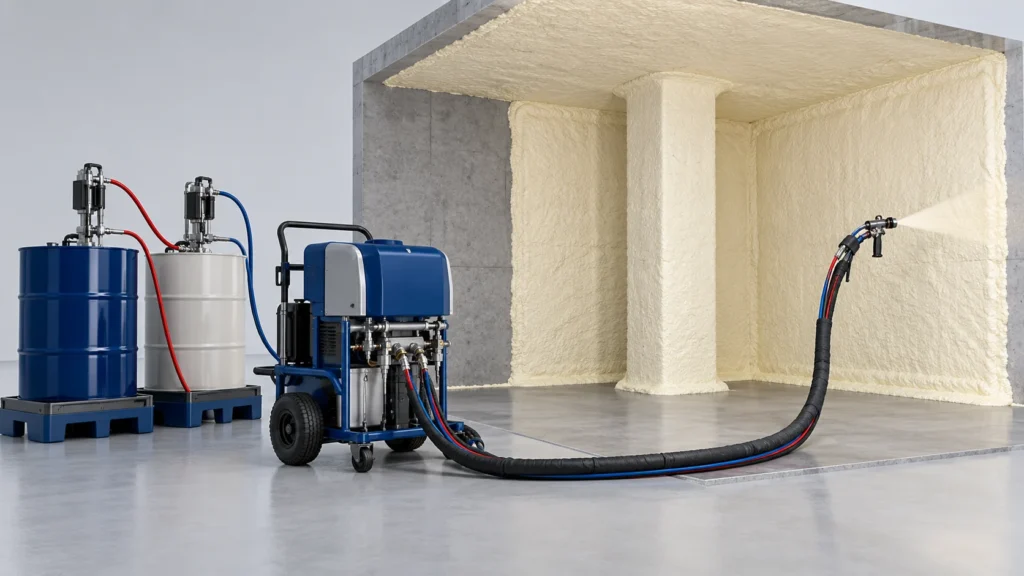
Proyecto de línea de PU in situ para cámara frigorífica comercial en Marruecos
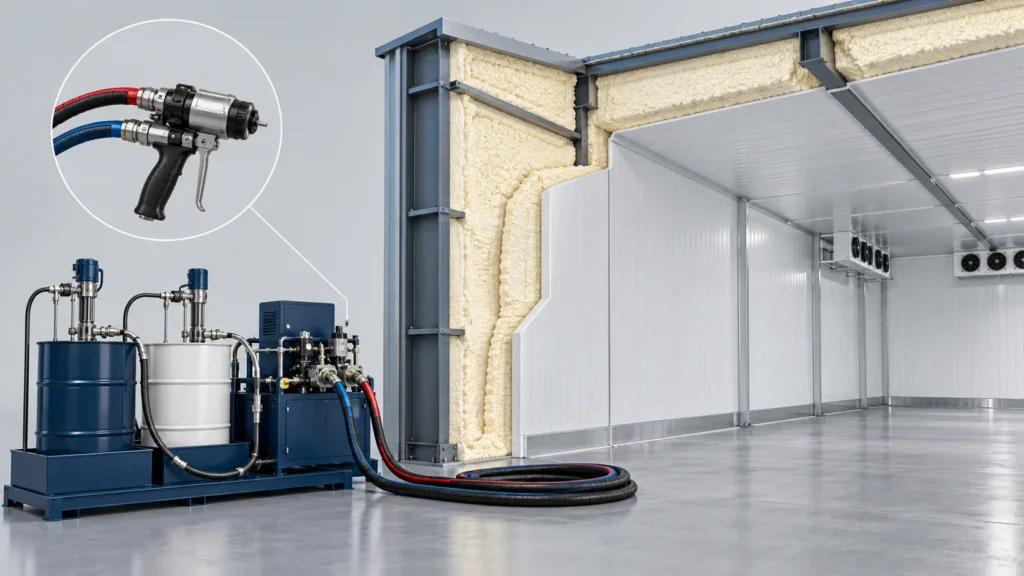
Proyecto de aislamiento de PU para almacén de congelación profunda en Kazajistán
Preguntas frecuentes
Compare rutas de producción, requisitos de materiales, configuraciones de equipos y datos de entrada del proyecto.
Should I choose in-situ foam or factory-made panels?
Can the insulation support a cold-store floor?
How is airtightness assessed?
How are protective finishes selected?
Which equipment route is needed?
How is commissioning scheduled?
Is the free-rise density in a material datasheet the installed cold-room insulation density?
Does a foam fire classification qualify the complete cold-room enclosure?
¿Qué datos se necesitan para esta configuración?
How should cold-store floor insulation be selected?
Envíe sus objetivos de producción
Share the following for this application: Envelope and floor drawings, service conditions, existing vapor barrier, floor loads, surface state, formulation and protective system. Our team will reply within one business day. Once requirements are clear, we provide a preliminary proposal within two business days.


