Why the Isocyanate Backbone Decides Light Stability and Service Life
A clear polyurethane part that yellows within six months of outdoor exposure is a common, expensive failure in coatings, optical components, synthetic leather, and light-stable elastomers. The cause is usually not the polyol, the mold, or the metering equipment. It is the isocyanate backbone. Aromatic isocyanates such as MDI and TDI form conjugated, UV-sensitive structures as they degrade; sunlight converts them into colored quinoid by-products, which is why conventional aromatic polyurethanes turn amber and lose mechanical integrity over time [1], [2].
Isophorone diisocyanate (IPDI) is a widely used cycloaliphatic diisocyanate that solves this problem. IPDI-based polyurethane systems retain clarity and mechanical properties far longer under UV and weathering, but they also impose different processing demands on the equipment: lower reactivity, higher prepolymer viscosity, tighter temperature control, and more careful ratio management. The useful question for production managers is not whether IPDI works, but whether the existing line can hold the processing window the system requires.
What Makes IPDI Chemically Different
IPDI is a cycloaliphatic diisocyanate built around a substituted cyclohexane ring. Two structural attributes define its behavior.
First, the saturated ring has no aromatic conjugation, so the cured network does not form the colored degradation species typical of MDI and TDI [1], [2]. That structural difference is the basis of IPDI’s light stability.
Second, IPDI carries two isocyanate groups of unequal reactivity: one NCO attached to a primary aliphatic carbon and one attached to a secondary carbon on the cyclohexane ring, with steric hindrance further reducing the latter’s reaction rate [3]. In practice, IPDI-based systems cure more slowly than MDI equivalents and typically require a catalyst — commonly organotin, bismuth, or zinc compounds in waterborne and solventborne formulations [4]. The reactivity mismatch also produces a more controlled prepolymer build, which is valuable when targeting narrow molecular-weight distributions for high-clarity films and cast parts.
Molecular weight is about 222 g/mol, and theoretical NCO content is approximately 37.8%, slightly lower on commercial products that contain isomers or minor impurities [3], [4]. Neat IPDI is a low-viscosity liquid at room temperature, typically in the 10–15 mPa·s range; the high viscosities encountered in production usually come from IPDI prepolymers, not the monomer [3].
Core Characteristics of IPDI-Based Polyurethane Systems
Light and weathering resistance is the defining benefit. Aromatic polyurethane yellows on prolonged UV exposure; IPDI-based systems are routinely specified where color retention, gloss retention, and long outdoor service life are requirements [2]. Accelerated weathering per ISO 4892-3 is the common qualification route for these claims [5].
Mechanical properties can be tuned across a wide hardness range. Depending on polyol backbone, chain extender, and isocyanate index, IPDI systems span from very soft cast elastomers in the Shore A 40s to hard, glass-like coatings above Shore D 70. Light stability is achieved without necessarily sacrificing hardness, tear strength, or abrasion resistance, provided the formulation is balanced [1], [2].
Chemical and hydrolysis resistance depends mainly on the soft segment. IPDI combined with polycarbonate diols or certain polyester polyols gives strong resistance to sweat, solvents, and hydrolysis; with polyether polyols, flexibility and low-temperature performance improve but hydrolytic stability drops [2]. This is a formulation trade-off, not an IPDI guarantee — the processing line still has to mix at the right ratio to preserve it.
Hardness selection shapes both the molded part and the casting line. Shore A Vs Shore D Hardness In Polyurethane covers how the two scales map to real part performance and process control.
For readers weighing an aromatic-to-IPDI conversion, the processing audit in the next sections is the same filter our engineers use in their own line assessments.
IPDI Versus Aromatic Isocyanates at a Glance
The table below summarizes widely published, verified differences. Values are typical ranges, not universal guarantees [1]–[4].
| Property | IPDI | MDI | TDI |
|---|---|---|---|
| Isocyanate class | Cycloaliphatic | Aromatic | Aromatic |
| UV light stability | Excellent | Poor (yellows) | Poor (yellows) |
| Reactivity, relative | Low–moderate | High | High |
| Typical NCO content, monomer | ~37.8% | ~33.6% (pure 4,4′-MDI) | ~48.3% (TDI 80/20) |
| Monomer viscosity at 25 °C | ~10–15 mPa·s | Solid at room temperature | ~3 mPa·s |
| Catalyst requirement | Usually required | Often optional | Often optional |
| Color and clarity retention | Excellent | Limited | Limited |
What IPDI Systems Demand from Processing Equipment
IPDI’s chemistry flows directly into equipment decisions. Four factors matter most on a production line.
Viscosity control is the first. IPDI prepolymers used in cast elastomers and coatings can reach several thousand to tens of thousands of mPa·s at processing temperature, far higher than many TDI/MDI prepolymers. Day tanks, metering pumps, and mixing heads must be heated and sized for that viscosity, and the lines must be insulated to keep material flowing [2].
Temperature precision is the second. Because IPDI reactivity is low, reaction rate is strongly temperature-driven. A tank or hose temperature drift of a few degrees changes gel time and can shift final hardness and conversion. Closed-loop temperature control with tight setpoint tolerance is more valuable here than on many aromatic lines [3].
Ratio and metering accuracy is the third. The NCO:OH index has an outsized effect on final mechanical properties in slow-curing systems. A deviation of even one index point can measurably move hardness and crosslink density. High-precision dynamic metering with full-range accuracy of ±0.3% or better is the practical floor for repeatable IPDI casting.
Moisture discipline is the fourth. Isocyanates react readily with water, and slow IPDI systems give moisture more time to act, creating CO₂ bubbles, surface defects, and reduced properties in films and castings [1]. Dried raw materials, nitrogen blanketing on tanks, and short open-path handling are standard countermeasures.
The practical message is that an IPDI line is less forgiving of loose temperature and metering control than a high-reactivity aromatic foaming line. Dynamic accuracy and thermal stability usually matter more than nominal throughput.
Metering accuracy affects shot consistency in cast and thin-film applications alike. How To Calculate Shot Weight In Polyurethane covers the calculation and why component ratio control determines part repeatability.
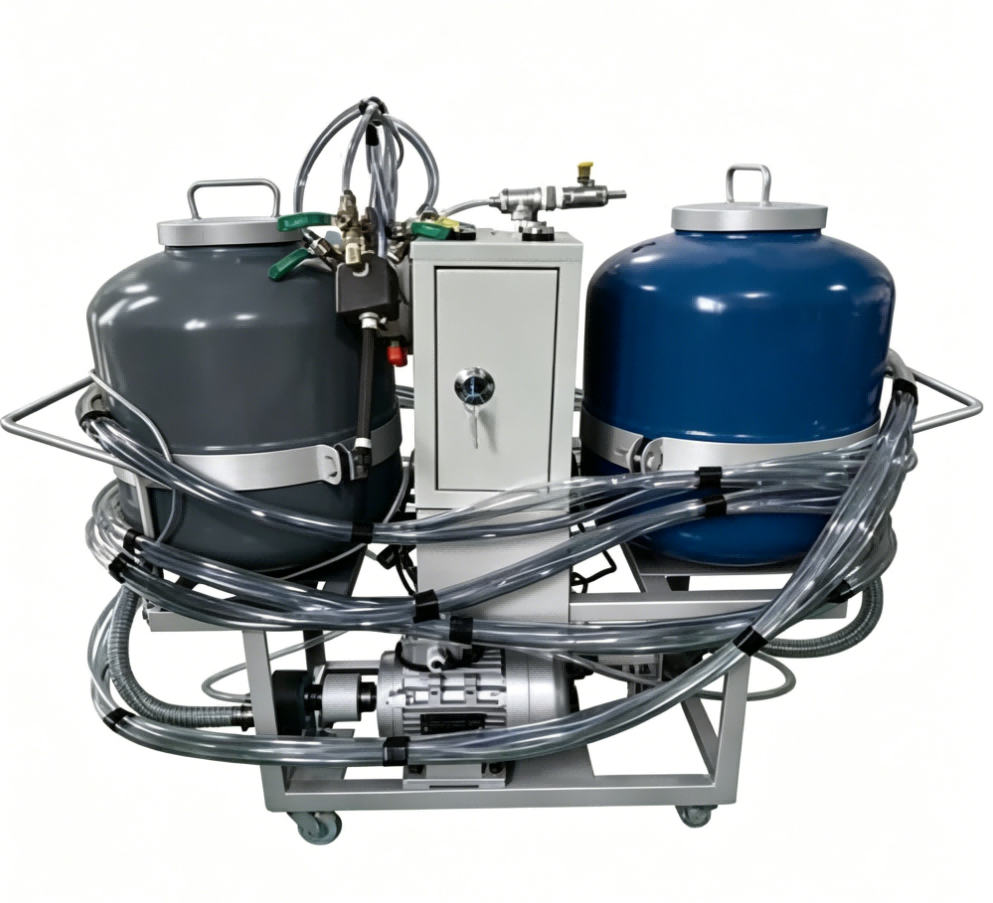
If your current machine was sized for a fast aromatic system, it is worth checking temperature uniformity and full-range metering accuracy before committing to an IPDI product. Reach us at Info@chinahaifeng.com or WhatsApp 86 13566296633 and we will help you run that check against your target formulation.
Where IPDI Systems Deliver the Best Value
IPDI’s light stability and hardness range create a clear application niche: parts that must stay clear or light-colored while facing sunlight, abrasion, and chemicals.
Waterborne PU dispersions for synthetic leather are a major use. In high-end synthetic leather, an IPDI-based polyurethane topcoat delivers the color fastness and solvent resistance that European brand audits demand, without the yellowing that aromatic systems show after exposure [4]. On one synthetic leather expansion for a Turkish manufacturer supplying European light-luxury brands, Haifeng delivered three XJJF-series pouring lines with precise metering and constant-temperature closed-loop control. The result was stable density, consistent peel strength and hand-feel, full EU REACH/RoHS compliance, and a 100% inspection pass rate through European brand factory audits.
Other established IPDI applications include:
- Transparent cast elastomers and optical-grade parts where clarity must survive years of light exposure.
- Automotive OEM and refinish clear coats, where gloss retention and weatherability are specification barriers.
- Light-stable rollers and seals for printing, converting, and outdoor equipment, combining IPDI’s non-yellowing behavior with abrasion-resistant polyol backbones.
- Medical, consumer, and apparel coatings where skin-contact stability and color neutrality are required.
Rollers are a clear example of how the aliphatic backbone changes product economics. How Polyurethane Rollers Are Made From Casting To Cure covers the casting steps and where material choice affects cure, clarity, and service life.
A Decision Checklist Before You Commit to an IPDI Line
Before committing to an IPDI-based system, verify five things. These checks come from field experience with slow-reacting, high-viscosity, moisture-sensitive systems.
- Confirm the light-stability requirement is load-bearing. If the part is indoor, hidden, or painted, an aromatic system may cost less with equal mechanical performance.
- Match the polyol and chain extender to the service environment: polycarbonate diol for hydrolysis and chemical resistance; polyether for low-temperature flexibility.
- Specify full-range dynamic metering accuracy at ±0.3% or tighter, and confirm the machine holds that accuracy across the entire shot-weight range, not just at maximum flow.
- Verify heated tank, hose, and mixing-head controls with setpoint tolerance that matches the prepolymer viscosity curve. Ask for temperature uniformity data, not just a setpoint number.
- Plan moisture controls — dried raw materials, nitrogen blanketing, purge routines — before startup, not after the first batch of bubbles appears.
If the product is new and the formulation is still moving, a line with multi-formula storage and one-touch recipe switching reduces the cost of iteration.
Bring Your IPDI Processing Questions to a Metering Specialist
IPDI-based systems do not typically fail because of the chemistry alone; they fail when the line cannot hold viscosity, temperature, and ratio inside the system’s narrow processing window. If you are evaluating IPDI prepolymers for a light-stable casting, coating, or synthetic leather project and want to check the equipment requirements against a real line calculation, contact Haifeng Polyurethane Machinery. Share your target output, shot weight or coating width, material viscosity, and cure schedule, and we will specify the metering, heating, and cleaning configuration that matches the process.
Email: Info@chinahaifeng.com
WhatsApp: 86 13566296633
Frequently Asked Questions
Why is IPDI more expensive than MDI or TDI, and is it worth it?
The cycloaliphatic structure costs more to manufacture, and lower reactivity often adds cycle time. It is worth it when the part must retain clarity, color, or outdoor service life. For hidden structural parts, aromatic systems usually deliver equivalent mechanics at lower cost.
Does IPDI yellow at all?
Under normal UV exposure, cured IPDI-based systems resist yellowing far longer than aromatic polyurethanes. Prolonged high-dose UV, aggressive amines, or an improper catalyst package can still cause discoloration, so “non-yellowing” is relative, not absolute.
Can I run IPDI and MDI systems on the same polyurethane machine?
Often yes, if the machine has independent temperature control, multi-formula storage, and a cleaning system designed for isocyanate flushing. The main constraint is residual contamination: small MDI carryover can compromise the light stability of an IPDI run. Thorough purging and, where possible, dedicated tank sets are the safer route.
What hardness range is realistic with IPDI-based cast elastomers?
From roughly Shore A 40 to Shore D 70-plus, depending on polyol, chain extender, and isocyanate index. The hardness target should be fixed before equipment sizing because it drives viscosity and shot parameters.
How does the low reactivity change pot life and demold time?
Pot life extends, which is useful for large or complex molds, but demold and full-property cure take longer without heat or catalyst. Most production IPDI systems are accelerated with catalysts and elevated mold temperature to keep cycle times commercially viable.
References
[1] G. Oertel, Ed., Polyurethane Handbook, 2nd ed. Munich, Germany: Hanser Publishers, 1993.
[2] M. Szycher, Szycher’s Handbook of Polyurethanes, 2nd ed. Boca Raton, FL, USA: CRC Press, 2012.
[3] Covestro AG, “Desmodur I (IPDI) technical data sheet,” Leverkusen, Germany. [Online]. Available: https://www.covestro.com
[4] Evonik Industries AG, “VESTANAT IPDI product information,” Essen, Germany. [Online]. Available: https://www.evonik.com
[5] ISO 4892-3:2016, Plastics — Methods of exposure to laboratory light sources — Part 3: Fluorescent UV lamps, ISO, Geneva, Switzerland, 2016.
If you’re interested, check out these related articles:
How Polyurethane Rollers Are Made From Casting To Cure
Causes Of Shrinkage In Polyurethane Foam How To Control It
RRIM Vs RIM Which Process Suits Your Structural Part