

Polyurethane spray application atomizes a metered, heated two-component polyurethane system through a spray gun onto a substrate, where the A-side (isocyanate) and B-side (polyol or amine resin) mix under high pressure and react within seconds. The process produces three distinct end results: rigid insulating foam, elastomeric protective coatings, and seamless waterproofing membranes. All three trades look different in the field — a cold storage contractor spraying foam at 5 kg/min does not operate like a pipeline preservation crew shooting polyurea at 9 kg/min — but they share one common failure mode. A small drift in component ratio, component temperature, or spray pressure does not announce itself at the gun. It appears later as a soft spot in insulation, an un-bonded patch on a steel tank, or a pinhole that fails a water test.
Polyurethane spray coating sits on the same chemistry as the spray-applied rigid foam used in construction and cold-chain work — the equipment forces controlled mixing where the reaction rate must be managed rather than left to ambient conditions. <What Is Spray Polyurethane Foam Composition And Application> explains how the A-side and B-side are formulated for the fast tack-free times and cell structure that spray crews depend on.
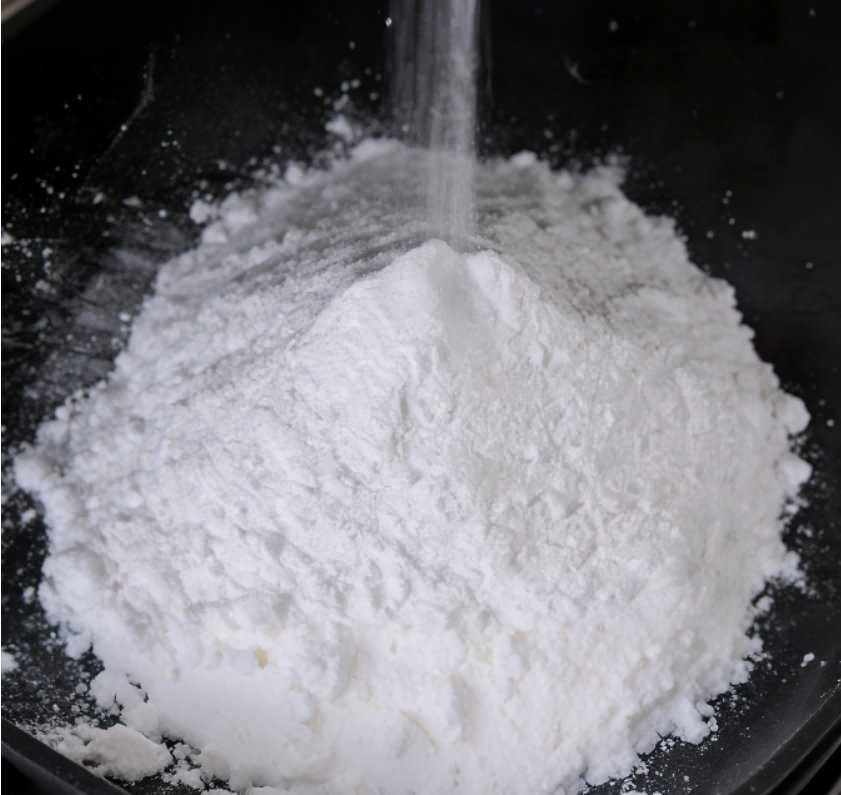
How Spray Equipment Meters, Heats, and Mixes
A production spray machine is not a paint sprayer with a bigger pump. It is a mobile proportioning and temperature-conditioning unit built around a core requirement: the A and B components must arrive at the mixing point within a narrow ratio and temperature window even as hose length, ambient temperature, and throughput change.
The work splits into four stages:
- Proportioning — A positive-displacement metering pump (gear pump, piston pump, or hydraulic drive) moves each component by volume at a set A:B ratio, typically 1:1 by volume for foam systems but often offset by mass for polyurea. Proportioning error shows up as incomplete reaction: excess polyol leaves sticky, soft foam; excess isocyanate leaves friable, overly hard foam.
- Heating — Both components must be heated to reduce viscosity and supply the energy needed for reaction. Typical spray processing temperatures run 40–60 °C depending on formulation. Undercooled material atomizes poorly and builds thickness unevenly; overheated material flashes through the gun before it can wet and bond to the surface.
- Hose transport — Heated, insulated hoses keep the components at temperature from the machine to the gun. Cold hose walls strip heat unevenly; the outer stream in a long hose cools faster than the core, producing intermittent viscosity swings at the gun.
- Impingement mixing — Inside a purge-style spray gun, the two pressurized streams collide in a small mixing chamber and atomize outward. Cleaning is done by solvent or hydraulic purge after every stop; a dirty mix chamber is the fastest route to streaking and soft material.
The metering pump and mixing head decisions govern far more of the final quality than the nominal flow rating does. A machine that holds ±0.3% dosing accuracy across a wide flow range matters most for repeated field work where an operator’s attention is split across substrate temperature, wind, and crew pace.
Three Main Application Categories
Polyurethane spray application splits into three separate practice areas, each with its own substrate, mix system, and acceptance criteria.
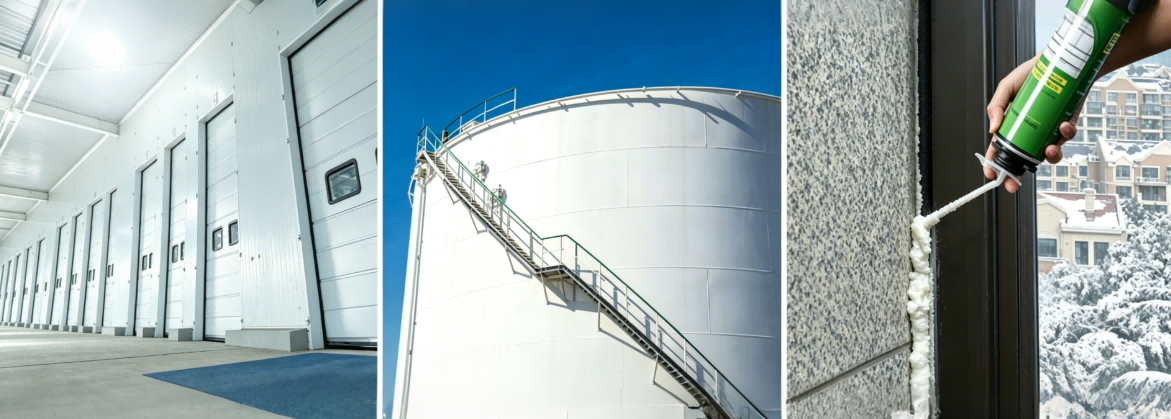
Insulation foam. Spray-applied closed-cell polyurethane foam is the fastest-installed continuous insulation layer available for cold storage, roofing, pipe insulation, and wall assemblies. It arrives as a liquid and expands to fill seams and irregular cavities in one pass, which avoids the thermal bridging of board-stock seams. Closed-cell content above 90% and low K-value (thermal conductivity) are the primary quality levers. Surface preparation matters even here: a dusty concrete wall or a wet steel deck reduces bond strength before any foam is sprayed [1][2].
Anti-corrosion coatings. Polyurea and hybrid polyurethane coatings applied by plural-component spray machines protect chemical storage tanks, pipelines, steel structures, sewage treatment equipment, and industrial floors. These systems cure in seconds to minutes and build a dense, well-adhered layer without solvents. Adhesion is the whole game on steel: the substrate must be dry and abrasive-blasted to a defined cleanliness such as NACE No. 2/SSPC-SP 10 for immersion or severe service, then coated before flash rust forms [3]. Pull-off adhesion testing per ASTM D4541 is the common acceptance method, with minimum bond values set by the spec rather than by the coating vendor [2].
Waterproofing membranes. Spray-applied PU membranes cover building roofs, basements, kitchens and bathrooms, swimming pools, and exterior walls with a joint-free, self-terminating layer. Unlike sheet membranes, the spray layer has no laps for water to track through. Thickness control is the recurring problem: a hand operator moving too fast at the edge of a roof drain gets 40% of the target build and never sees it because the membrane looks finished.

Each category uses the same machine class — a two-component, heated, plural-component proportioner — but the gun tips, hose layouts, pressures, and operator pace differ sharply. Buying a machine rated for insulation foam does not automatically prepare a crew for 240 bar anti-corrosion work; the pump drive, heater capacity, and hose insulation are sized for the coating type.
Process Parameters That Control Spray Quality
Spray quality is less a matter of the brand on the trailer than of six process parameters that change from job to job:
- Component temperature — uniform, stable heat on both sides holds viscosity and reaction rate inside the formulation’s working window.
- Spray pressure — high-pressure impingement (often 100–200 bar at the gun) is what produces the fine atomization and mix efficiency that hand mixing cannot match. Low pressure leaves coarse mix that underperforms.
- Ratio accuracy — a sustained drift of one to two percentage points can shift density, hardness, and cure extent enough to fail a physical property test without any visual warning.
- Substrate temperature and dew point — a steel or concrete surface within 3 °C of dew point invites condensation that gasifies under the reacting foam, causing pinholing and poor bond. Cold substrate below the system’s minimum temperature will not supply the energy the fast reaction needs.
- Gun-to-surface distance and pass speed — thermal spray is line-of-sight; distance changes the pattern width and build rate per pass. A skilled operator holds a steady standoff and overlaps each pass by roughly 30–50%.
- Purge discipline — every pause longer than the gel window requires a complete chamber purge. Skipped purges create soft, sticky patches that look like cured material but have never finished reacting.
Spray-applied foam adds another layer of process control: the product expands after leaving the gun, so operators must account for both the dispensed volume and the chemical rise that follows. <The Role Of Rise Time In Polyurethane Foaming> covers how rise time and gel time interact to set the practical pass window and re-coat interval for spray crews working against fast-curing systems.
If you are buying a machine for a specific coating, work backward from the worst day on the job — the longest hose run, the coolest ambient condition, the most viscous B-side — and size heaters and pumps for that condition, not for the brochure’s best-case flow rate [4].
Hydraulic vs. Pneumatic Spray Machines
Field spray equipment splits between hydraulic-drive and pneumatic-drive machines, and the right choice depends less on brand than on job size and available site services.
Hydraulic-drive machines deliver the highest sustained flow and pressure stability. A hydraulic system maintains steady output during continuous multi-hour spraying because the pump does not rely on shop air that fluctuates when compressors cycle. Large insulation jobs and continuous anti-corrosion work — cold storage walls, tank farms, long pipe runs — are the natural fit. Higher heater power (6–12 kW class) and longer heated hose runs (often 60–90 m) keep temperature stable when the machine sits far from the spray point. One hydraulic machine in the field commonly holds 10–15 kg/min at 110–160 bar.
Pneumatic-drive machines trade some output for portability and standard single-phase or low-amp supply compatibility. They run well on 230 V civil power and fit narrow access roofs, basements, and small construction sites. Flow ratings are typically under 5 kg/min, which is enough for residential waterproofing, small cold rooms, and remedial work but too slow for industrial-scale foam or heavy anti-corrosion coating.
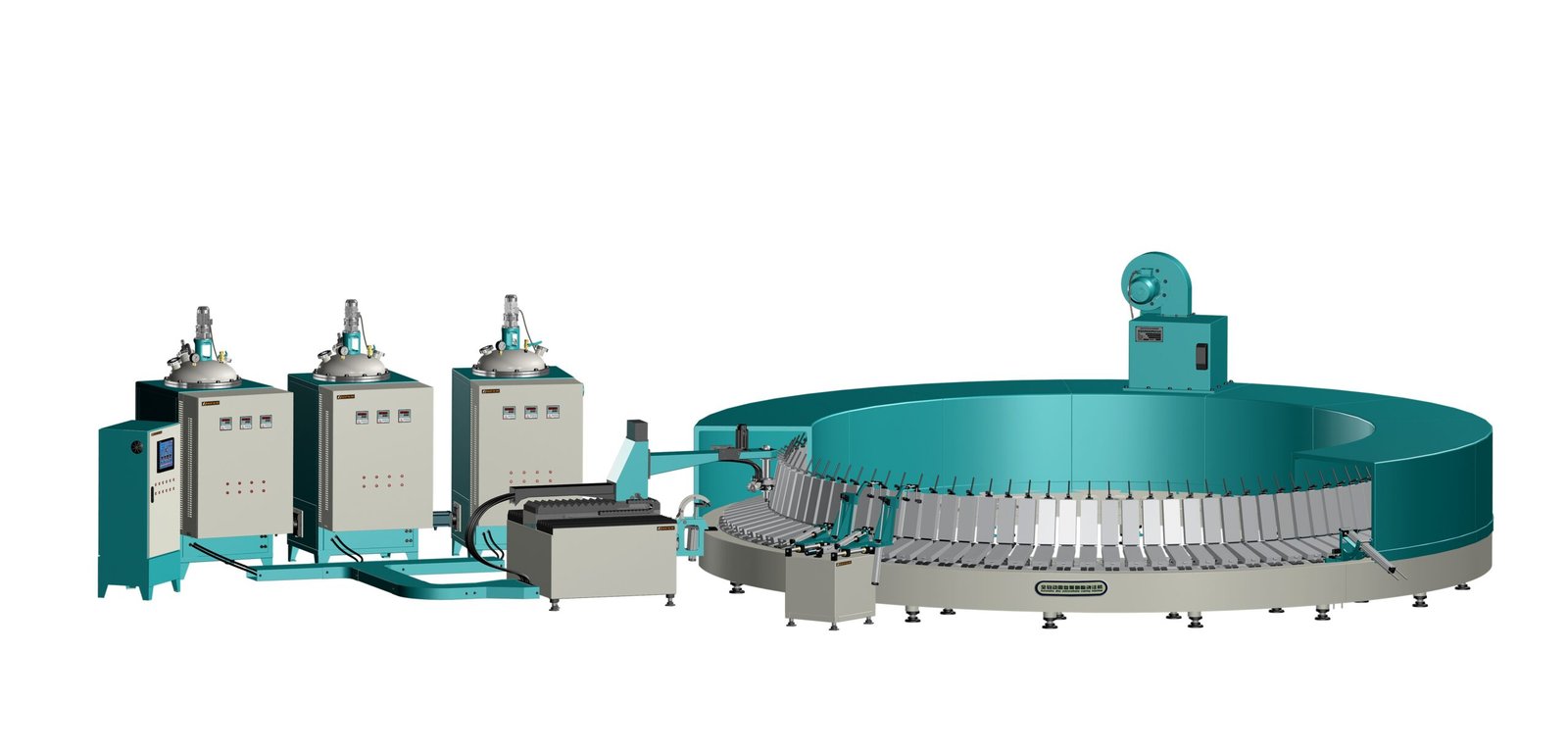
From the author’s perspective, the equipment decision that actually predicts job success is heater recovery time on a cold morning and the operator’s ability to hold ratio at the extreme ends of the flow range. A machine rated at 15 kg/min that only meters accurately at 12–15 kg/min is less useful than a smaller machine that stays accurate from 2 kg/min upward.
One educational example from our shop makes the point: the cold-storage insulation machine model HF-SP-03 was built around the requirement that a crew would work at low ambient temperature across long vertical drops. Its 6 kW heater and 93 m insulated hose were selected because temperature-control heating was more important than the maximum flow number. The line holds foam density within the spec window where an underheated alternative would produce a thick flash skin and weak interior cells. If you are on a similar cold-ambient job, list the worst-case hose length and ambient temperature on the inquiry sheet and ask the supplier to show the heater’s recovery data at that condition rather than the nominal wattage.
If you are specifying or sourcing a plural-component spray machine now, send the application details — substrate type, expected daily area, ambient range, and coating thickness — to Info@chinahaifeng.com or WhatsApp 86 13566296633. The selection process comes down to matching heater capacity, metering tolerance, and hose length to a real job, not to a maximum flow figure on a data sheet.
Common Field Defects and Their Root Causes
Most spray application failures trace back to one of four mechanisms, and nearly all are process-induced rather than material-induced:
Pinholing and blistering. When a coating is sprayed over a damp or below-dew-point surface, moisture at the interface flash-vaporizes as the exothermic reaction hits, leaving pinholes or full blisters. The fix is thermal control, not more pressure: verify substrate temperature and dew point with a surface thermometer and psychrometer before spraying; the dew-point margin should generally be at least 3 °C.
Delamination. A dense, hard polyurea layer can look perfect while sitting unbonded on an under-cleaned substrate. On steel, this is nearly always a surface preparation failure — insufficient profile, chlorides or oil left on the steel, or too long between blasting and coating. Pull-off testing per ASTM D4541 catches it, but only if the spec requires testing [2][3].
Soft or tacky streak lines. Intermittent ratio loss or a partially clogged mixing side leaves reactive material that never completes cure. The streak often follows one pass line. The root cause is usually a worn pump seal, a blocked filter on one side, or a gun chamber that was not purged at the end of the previous stop.
Shrinkage cracks in rigid foam. Closed-cell spray foam can shrink when the foam cools too quickly, when the B-side and A-side are out of ratio, or when the foam is sprayed at an excessive pass thickness that traps heat and then collapses internally. Shrinkage pulls the foam away from the substrate and opens through-cracks that defeat the thermal barrier and the air barrier in one move.
Shrinkage is one of the more costly field failures in spray-applied rigid foam because it appears days after the crew has moved on, usually in the form of substrate separation or visible through-cracks at the deepest passes. <Causes Of Shrinkage In Polyurethane Foam How To Control It> shows how pass thickness, component ratio, and cooling rate combine to produce those late-appearing failures, and which spray-side controls reduce the risk before the foam leaves the gun.
A useful discipline is to spray a small test coupon at the beginning of each work session, cut it after cure, and check density, cell uniformity, or adhesion before committing the first production pass. The coupon costs about ten minutes; a delaminated tank roof costs days.
Get the Application Spec Right Before the Machine Decision
The spray machine is only as good as the specification it is measured against. Write down the thickness per coat, the required adhesion or compressive strength, the surface preparation standard, the lowest expected substrate temperature, and the longest hose run. Then use those numbers to rule machines in or out. Flow rating alone is the least useful spec on the sheet when the real question is whether the heater can keep both components inside the working window for a full hopper of material on the coldest morning of the year.
For field verification, inspect a machine’s metering tolerance at the low end of the flow range and its heater recovery under your worst ambient condition, not under a test-stand ideal. A crew spraying pipe insulation inside a warm shop has different risks from a crew spraying a roof membrane in the open air, and the same model of machine may not serve both.
If you are at the specification stage, reach the engineering team at Info@chinahaifeng.com or WhatsApp 86 13566296633 with the substrate type, thickness, and job conditions — the equipment recommendation should follow from those numbers, not the reverse.
FAQ
What is the difference between polyurethane spray foam and polyurea spray coatings?
Polyurethane spray foam is a fast-reacting, blowing-agent-expanded insulation system used for thermal barriers and void filling. Polyurea spray coatings are dense, non-foamed elastomers used for waterproofing and anti-corrosion, with typically higher tensile strength and faster set time. The two are sprayed by the same class of plural-component machine but use different formulations, guns, tips, and substrate preparation standards.
How thick should spray polyurethane insulation be applied?
Closed-cell spray polyurethane foam is applied in passes typically 12–25 mm thick per pass for most field formulations, with total thickness set by the thermal design or code requirement. Spraying beyond the manufacturer’s maximum pass thickness risks trapped heat, shrinkage, and poor internal cell structure even when the total thickness looks correct.
How many components does a PU spray machine need?
A working polyurethane spray application rig needs two metered components — isocyanate (A-side) and polyol or amine resin (B-side) — plus heated hoses, a purge-capable spray gun, and adequate heater power. Additive or color channels are common on more complex coatings, but two-component proportioning is the core requirement.
What substrate preparation is needed before spraying polyurethane?
This depends on the substrate. Steel anti-corrosion work requires dry abrasive blasting to the spec cleanliness, usually NACE No. 2/SSPC-SP 10 for severe service, followed by coating before flash rust develops. Concrete insulation and waterproofing work needs a clean, sound, dry surface with an acceptable moisture level. Wood and rigid board substrates for insulation require a dry, dust-free base. Skipping preparation is the most common cause of apparent “material failure.”
Can a single spray machine handle both foam and polyurea?
Many plural-component machines can spray both foam and polyurea if the heater capacity, hose insulation, pressure capability, and gun tip are sized for the more demanding side — usually polyurea at higher pressure and faster set time. But a machine set up narrowly for low-flow waterproofing will not switch to industrial anti-corrosion polyurea without changes in heaters, hoses, and mixing elements. The specification must be defined before assuming one machine covers all coatings.
References
[1] ASTM C1029-23, “Standard Specification for Spray-Applied Rigid Cellular Polyurethane Thermal Insulation,” ASTM International, West Conshohocken, PA, 2023.
[2] ASTM D4541-22, “Standard Test Method for Pull-Off Strength of Coatings Using Portable Adhesion Testers,” ASTM International, West Conshohocken, PA, 2022.
[3] NACE No. 2/SSPC-SP 10, “Near-White Metal Blast Cleaning,” NACE International and SSPC: The Society for Protective Coatings, Houston, TX, and Pittsburgh, PA, 2015.
[4] Spray Polyurethane Foam Alliance, “Technical Guidance Document: Spray Polyurethane Foam — Equipment, Application, and Safety Practices,” SPFA, Fairfax, VA, 2021. Accessed via spfa.org.
If you’re interested, check out these related articles:
SRIM Explained Structural Reaction Injection Molding Basics
What Is Semi Rigid Polyurethane Foam
Shore A Vs Shore D Hardness In Polyurethane
How Polyurethane Rollers Are Made From Casting To Cure





