
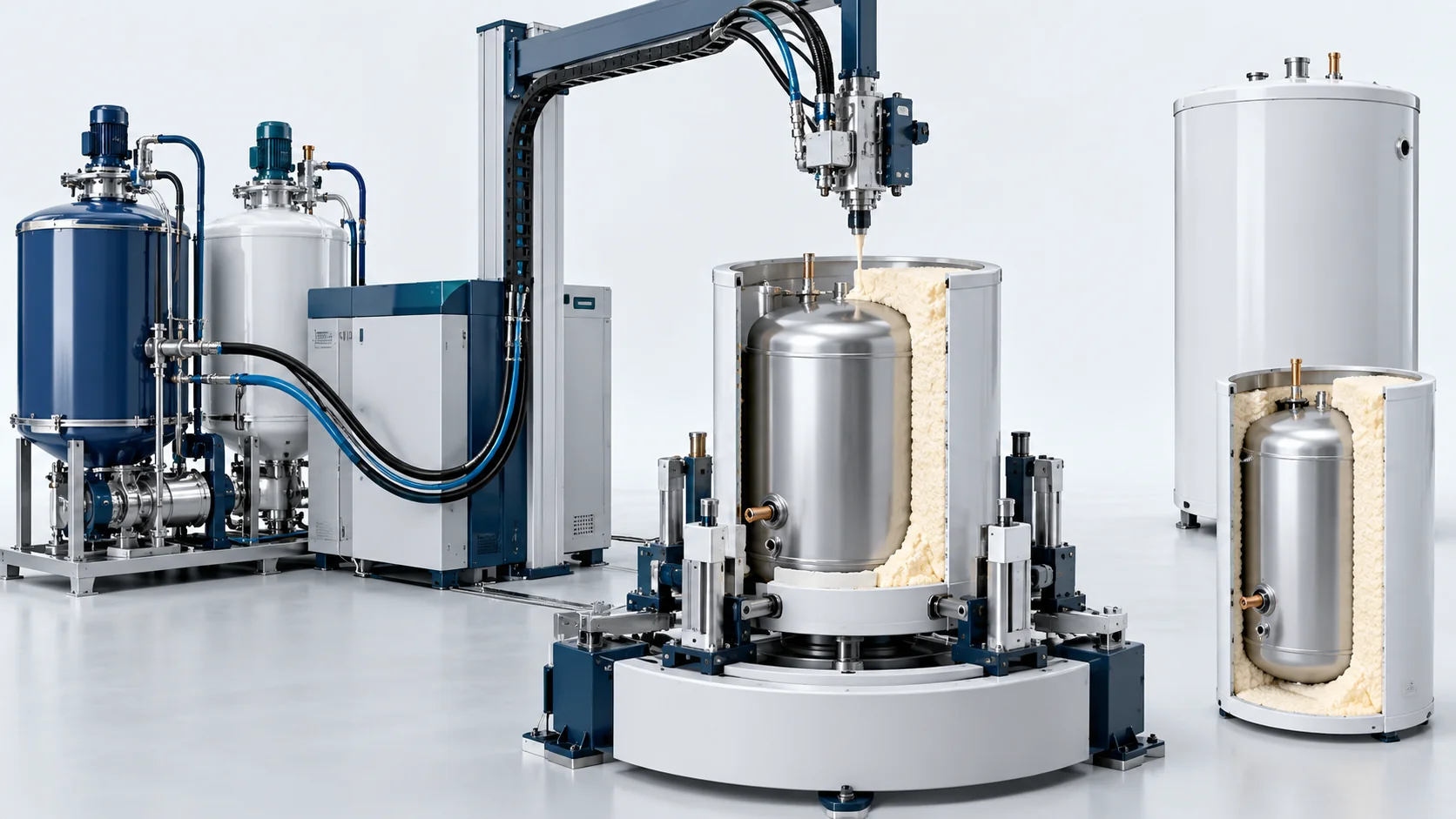
Water Tank Insulation Foaming Solution
Configure small-shot polyurethane insulation around appliance water tanks with indexed tooling, controlled dispensing and project-specific enclosure safety.
Plug-and-Play Precision Insulation for Compact Water Heating Boilers
Configure small-shot polyurethane insulation around appliance water tanks with indexed tooling, controlled dispensing and project-specific enclosure safety. Core interfaces cover micro-shot metering and mixing, rotary tooling, temperature controls and takeoff handling. Hydrocarbon ventilation, detection, interlocks, discharge routing and hazardous-area classification remain site-specific design requirements, including equipment outside the enclosure.
Product, material and tooling
Core interfaces cover micro-shot metering and mixing, rotary tooling, temperature controls and takeoff handling. Hydrocarbon ventilation, detection, interlocks, discharge routing and hazardous-area classification remain site-specific design requirements, including equipment outside the enclosure.
Capacity and acceptance
Review all preparation, dispensing, curing, handling and inspection stages. Material and component results require separate original test records.
Configuration references are reviewed for the selected material, product geometry and acceptance conditions. Two curing positions at a 30-second index provide 60 seconds, not 90 seconds. Four total positions may provide at most 90 seconds between injection and removal only if the actual sequence supports it; verify station timing. A rated enclosure does not eliminate site safety engineering or prove ATEX compliance.
Turnkey Compact Tank Foaming Workflow
The supplied process sequence is a configuration reference. Temperature, pressure, output and cure settings are confirmed for the selected material and tooling. Two curing positions at a 30-second index provide 60 seconds, not 90 seconds. Four total positions may provide at most 90 seconds between injection and removal only if the actual sequence supports it; verify station timing. A rated enclosure does not eliminate site safety engineering or prove ATEX compliance.
Boiler Loading & Pneumatic Mold Clamping
Configured reference: The operator loads the stainless vessel into Station 1 of the rotary indexer, where pneumatic clamps seal aluminum tooling shells around the tank.
Micro-Flow High-Pressure Impingement Shot
Configured reference: The miniature mixing head docks at Station 2, injecting 115 g of cyclopentane-polyurethane at 16.0 MPa in 1.1 seconds with ±0.2 g accuracy.
Enclosed Forced-Draft Hydrocarbon Ventilation
Engineer ventilation, detection thresholds, interlocks and exhaust routing for the installed hydrocarbon process. A self-contained booth does not establish certification or eliminate the site hazard assessment.
Reference Solution Engineering Envelope
Values transcribed from the supplied configuration brief. Material properties and finished-product benchmarks are separate validation targets, not general equipment guarantees.
| Parameter | Value / Unit | Applicable Configuration / Conditions |
|---|---|---|
| Workstation External Dimensions | 2,200 mm x 2,100 mm x 2,350 mm | Self-contained enclosure fitting standard lean cell; supplied reference requiring configuration or test verification |
| Continuous Hourly Output | 100 to 120 finished vessels/hour | 4-station automated rotary indexing on 30s tact; supplied reference requiring configuration or test verification |
| Chemical Injection Output | 50.0 to 200.0 g/s | Miniature servo axial piston high-pressure skid; supplied reference requiring configuration or test verification |
| Single Shot Weight Accuracy | Within ±0.2 grams | High-precision micro-metering at 120 g shot; supplied reference requiring configuration or test verification |
| Standby Electric Loss Cut | 18% thermal loss reduction | Seamless polyurethane wrap vs preformed clamshells; supplied reference requiring configuration or test verification |
| ATEX Explosion-Proof Compliance | Project-specific assessment and documented scope | Hazardous-area classification, components, detection, ventilation and installed interfaces require engineering and original certification records |
Core Equipment for This Solution
The linked pages describe shared preparation or feed-system families, not proof of delivery of the dedicated models listed in the case. Core interfaces cover micro-shot metering and mixing, rotary tooling, temperature controls and takeoff handling. Hydrocarbon ventilation, detection, interlocks, discharge routing and hazardous-area classification remain site-specific design requirements, including equipment outside the enclosure.
Cyclopentane PU Foaming Machine | Refrigerators and Freezers
The HF-CP200-HP is an explosion-proof high-pressure polyurethane foaming machine engineered for precision cyclopentane premixing and uniform insulation filling in domestic and commercial refrigeration lines.
Cyclopentane Safety and Premixing System | PU Foaming
Cyclopentane storage/feed, premixing or inline blending and monitoring interfaces configured for a PU/PIR panel line. The project schedule defines supply boundaries and equipment documentation.
Core Advantages of Haifeng Compact Tank Systems
Engineering functions and interfaces developed for the specified product and material system.
Small-Shot Metering
Configure and validate small-shot metering for the selected product, formulation, tooling and production conditions.
Indexed Tank Tooling
Configure and validate indexed tank tooling for the selected product, formulation, tooling and production conditions.
Enclosure Safety Interfaces
Configure and validate enclosure safety interfaces for the selected product, formulation, tooling and production conditions.
Cure Residence Planning
Configure and validate cure residence planning for the selected product, formulation, tooling and production conditions.
Related Project Draft
Review the project configuration described in the supplied brief. Project records and reported results require verification before public use.
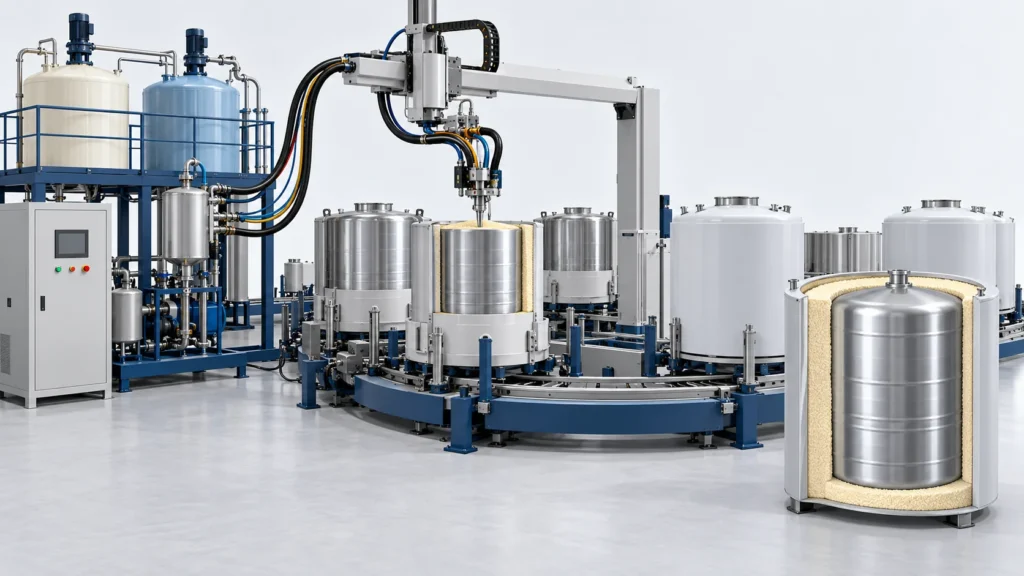
Frequently Asked Questions
Technical questions to establish the equipment scope, material window and validation plan.
What safety assessment is required for the installed enclosure?
Can different vessel sizes share the workstation?
How is nozzle cutoff quality verified?
Can different blowing-agent systems be considered?
Request a Compact Tank Insulation Proposal
Share your finished product or drawing, material system, target capacity, automation requirements and factory conditions to discuss the line configuration.


