
Cyclopentane PU Foaming Machine | Refrigerators and Freezers
Cyclopentane high-pressure metering and mixing with online premixing, fixture vacuum-assist interfaces and project-specific safety engineering.
Precision Hydrocarbon High-Pressure Foaming for Refrigeration
Cyclopentane high-pressure metering and mixing with online premixing, fixture vacuum-assist interfaces and project-specific safety engineering.
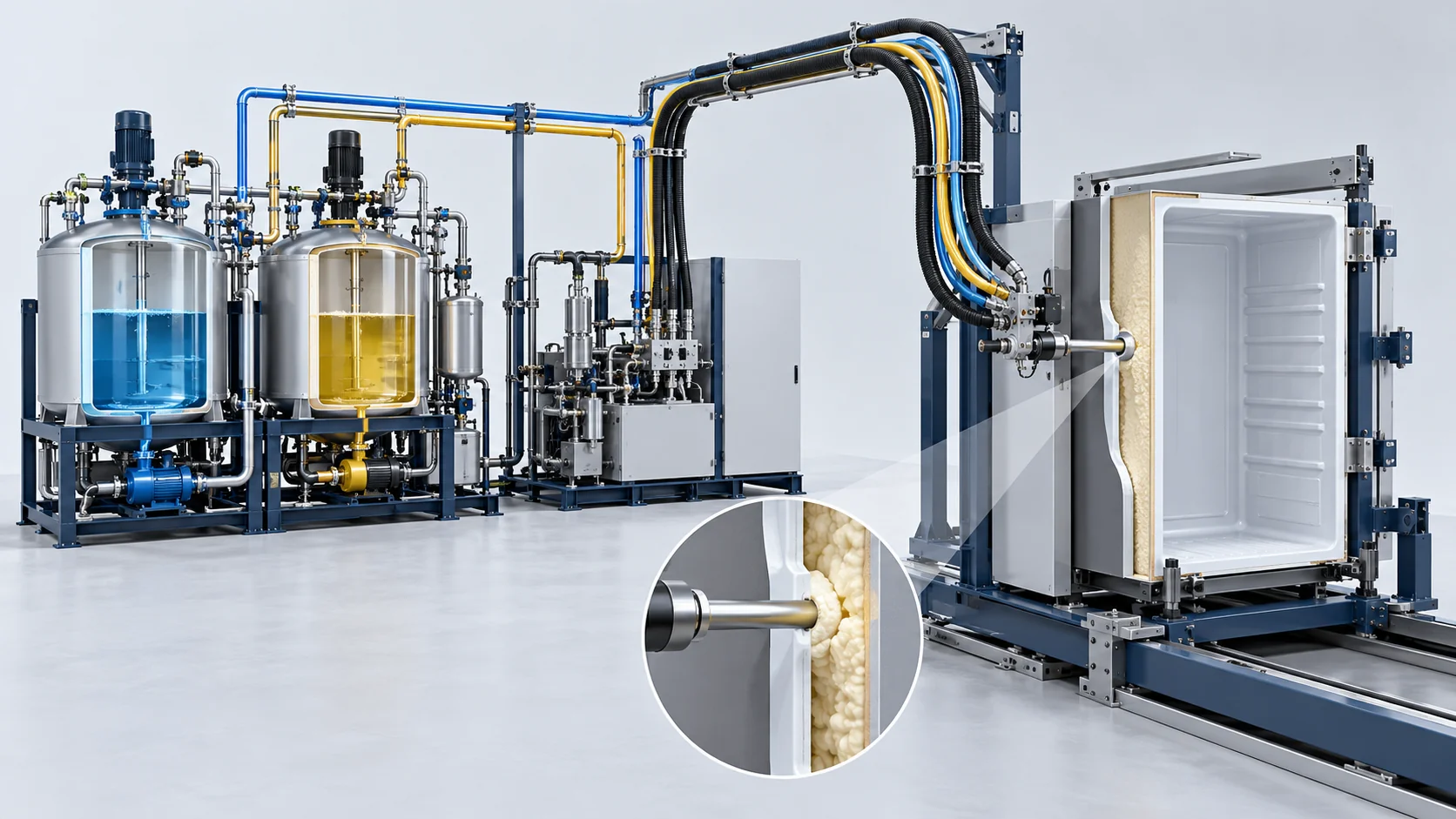
The HF-CP200-HP is an industrial high-pressure polyurethane foaming machine purpose-built for energy-efficient refrigerator and commercial freezer production utilizing cyclopentane (C-pentane) as a zero-ODP, low-GWP blowing agent. The equipment combines gas-safe explosion-proof hardware, real-time chemical conditioning, and dynamic high-pressure impingement mixing to produce rigid polyurethane foam with fine cell structures and thermal conductivities down to 18.2 mW/(m·K).
Featuring a closed-loop online premixing module, the HF-CP200-HP blends pure polyol with liquid cyclopentane directly in the pressurized feed stream, preventing phase separation and eliminating off-site blending costs. The system interfaces directly with multi-station rotary carousels and stationary hydraulic foaming fixtures, utilizing vacuum-assisted injection (VA) to ensure complete filling across ultra-thin cabinet walls without skin voids or density variations.
Material Flow and Working Principle
Pressurized Supply & Inline Gas Monitoring
Polyol and isocyanate are drawn from day tanks under nitrogen blankets while cyclopentane is metered from an explosion-proof storage area into an inline high-shear static-dynamic blender under continuous LEL combustible gas monitoring.
High-Pressure Servo Metering & Recirculation
Axial multi-piston metering pumps driven by explosion-proof servo motors raise fluid pressures to 15–20 MPa, continuously recirculating chemicals through temperature-regulated circuits to match viscosities.
High-Pressure Impingement Injection
Component streams collide inside a ceramic-lined impingement chamber at velocities exceeding 120 m/s, instantly achieving molecular-level homogenization before discharging via a laminar pour nozzle.
Vacuum-Assisted Cavity Filling & Auto-Purge
The mix is injected through an automated cabinet port into a pre-evacuated mold cavity (80 kPa vacuum); upon shot completion, an internal hydraulic clean-out piston mechanically seals the head without solvent waste.
Model and Technical Parameters
Configuration values from the supplied equipment brief. Final settings and capability are confirmed for the selected material and project conditions.
| Technical Parameter | HF-CP200-HP |
|---|---|
| Components | 2 Components + 1 Blowing Agent (Polyol + Isocyanate + C-pentane) |
| Output Range (g/s) | 60.0 to 240.0 kg/min (Continuous adjustable) |
| Mixing Ratio Range | 100:100 to 100:160 (Polyol to Iso, by weight) |
| Ratio Accuracy | ±0.3% (Measured with steady impingement pressure) |
| Power Supply | 380V, 3-Phase, 50Hz (Custom 440V/480V 60Hz available) |
| Working Pressure | 15.0 to 20.0 MPa (High-pressure metering and impingement) |
| Tank Capacity (L) | Tank A: 250 L, Tank B: 250 L (Stainless steel with N2 blanket) |
| Weight | 3,200 kg (Empty configuration including premix unit) |
| Dimensions (L×W×H) | 3600 mm x 2200 mm x 2400 mm |
| Cyclopentane Blending Ratio | 5% to 15% (By weight in polyol stream); Online Premixing Module |
| Premixing Dosing Accuracy | ±0.1% (Mass flow closed-loop control); Coriolis mass flow meters |
| Combustible Gas Detection | Project-specific detection, alarm and interlock configuration; validation and documentation required |
| Total Installed Power | 45 kW (Excluding hydraulic mold fixtures); Maximum operational load |
Key Equipment Features
The package covers cyclopentane premixing, high-pressure metering and mixing, mold vacuum-assist interfaces and project-specific safety controls. Carousels and robot handling are optional. Chemistry, ventilation and site power are agreed external interfaces. Hazardous-area suitability, detection and interlocks require project-specific engineering and documentation.
Project-Specific Safety Interfaces
Hazardous-area components, gas detection, ventilation and interlocks require coordinated engineering and supporting documentation.
Online Cyclopentane Premixing
The specified premix unit controls blowing-agent dosing before the main metering and mixing stage.
Mold Vacuum-Assist Interface
Vacuum assistance is configured with the cabinet fixture to support filling; it is distinct from vacuum-insulated panels.
Mechanical Head Cleanout
A cleanout piston is specified for the mixing chamber; maintenance and chemical handling follow the validated project procedures.


