
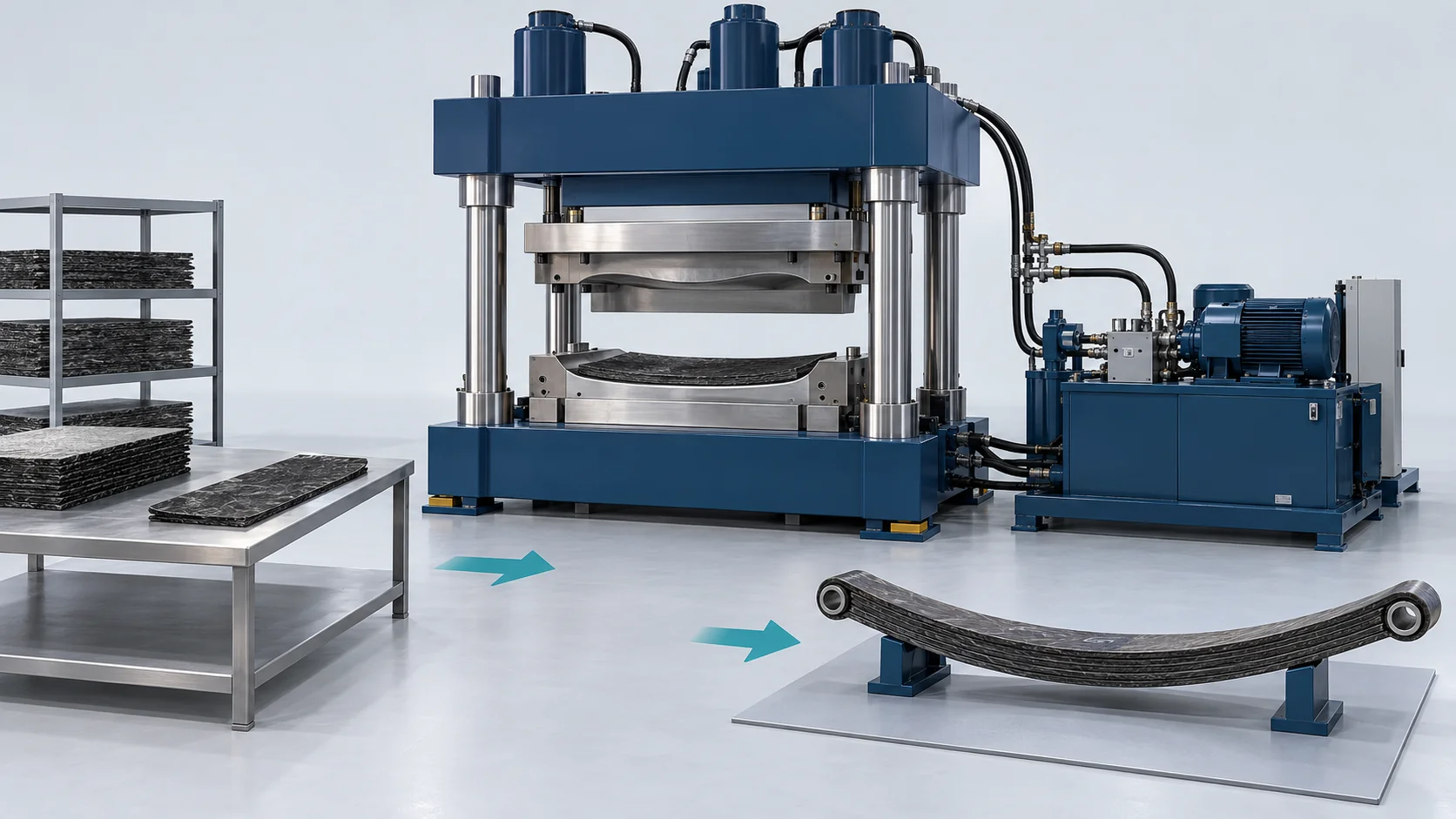
Composite Leaf Spring Compression Solution
A multi-cylinder hydraulic compression press with active platen leveling for specified composite tooling and solid preforms.
Extreme Mechanical Fatigue Resistance for Lightweight Chassis Suspensions
A multi-cylinder hydraulic compression press with active platen leveling for specified composite tooling and solid preforms.
Equipment and process scope
Press frame, hydraulic power/accumulator, platen-leveling feedback, heating and controls. Prepreg/SMC charge, molds, handling and part qualification are separately agreed.
Validation and production planning
Nominal pressing force is 30,000 kN, approximately 3,059 metric tonnes-force. Hydraulic pressure differs from tool cavity pressure. Platen leveling is an equipment quantity; spring weight, fatigue and fuel-consumption figures describe part or vehicle comparisons under their own conditions.
Nominal pressing force is 30,000 kN, approximately 3,059 metric tonnes-force. Hydraulic pressure differs from tool cavity pressure. Platen leveling is an equipment quantity; spring weight, fatigue and fuel-consumption figures describe part or vehicle comparisons under their own conditions.
Turnkey Composite Leaf Spring Compression Workflow
The sequence describes the supplied configuration. Final settings, cycle boundaries and acceptance are defined for the selected material and tooling. Nominal pressing force is 30,000 kN, approximately 3,059 metric tonnes-force. Hydraulic pressure differs from tool cavity pressure. Platen leveling is an equipment quantity; spring weight, fatigue and fuel-consumption figures describe part or vehicle comparisons under their own conditions.
Ultrasonic Prepreg Cutting & Robot Layup
Supplied process reference: Continuous unidirectional glass/epoxy prepregs are cut by ultrasonic knives and robotically stacked into a parabolic charge pack.
Robotic Infeed & Mold Positioning
Supplied process reference: A heavy-payload robot transfers the 18 kg charge pack into the chrome-plated steel tool heated to 150°C ± 1°C within the press bed.
400 mm/s Fast Descent & 1.8s Pressurization
Supplied process reference: The 3,000-ton press closes at 400 mm/s; accumulators ramp to 30,000 kN in 1.8s while 4-corner servo cylinders maintain ±0.02 mm parallelism.
Reference Solution Engineering Envelope
Supplied configuration and validation references; material/component results are separate from equipment ratings.
| Parameter | Value / Unit | Applicable Configuration / Conditions |
|---|---|---|
| Nominal Press Clamping Capacity | 30,000 kN (approximately 3,059 metric tonnes-force) | Heavy multi-cylinder structural frame with servo drives; configuration-specific reference or part acceptance target |
| Active 4-Corner Leveling Tolerance | Less than or equal to 0.02 mm | Closed-loop optical linear scale feedback under full load; configuration-specific reference or part acceptance target |
| High-Speed Pressure Ramp Time | Less than or equal to 1.8 seconds | High-capacity hydraulic accumulator assistance; configuration-specific reference or part acceptance target |
| Platen Working Surface Bed | 3,500 mm length x 2,000 mm width | Accommodates single or dual-cavity heavy leaf spring tools; configuration-specific reference or part acceptance target |
| Finished Spring Weight Reduction | Up to 120 kg per truck front axle | Replaces 138 kg steel spring pack with 18 kg composite spring; configuration-specific reference or part acceptance target |
| Cyclic Fatigue Endurance Limit | Greater than 1,000,000 Cycles | Full-load vertical oscillation test under QC/T 29035; configuration-specific reference or part acceptance target |
Core Equipment for This Solution
Press frame, hydraulic power/accumulator, platen-leveling feedback, heating and controls. Prepreg/SMC charge, molds, handling and part qualification are separately agreed.
Core Advantages of Haifeng Composite Press Systems
Configured equipment functions and interfaces for the selected material and tooling.
±0.02 mm Active Dynamic Leveling
Supplied configuration function: Digital servo cylinders neutralize asymmetrical platen tipping, locking leaf spring thickness profiles within ±0.02 mm. Project-dependent performance requires validation.
1.8s Fast Pressure Ramping
The supplied 1.8-second pressure ramp supports the selected consolidation sequence before gelation; it does not guarantee absence of voids.
120 kg Weight Reduction
The supplied spring comparison reduces the front-axle assembly from 138 kg to 18 kg (120 kg). Whole-vehicle fuel and wear effects depend on vehicle load and duty cycle.
1,000,000 Cycle Fatigue Integrity
The supplied 1,000,000-cycle reference concerns the specified finished spring and fatigue-test conditions; platen parallelism alone does not guarantee fatigue life.
Related Project Draft
The related leaf-spring brief reports its own assembly-weight baseline, finished-part fatigue test and loaded platen-leveling conditions.
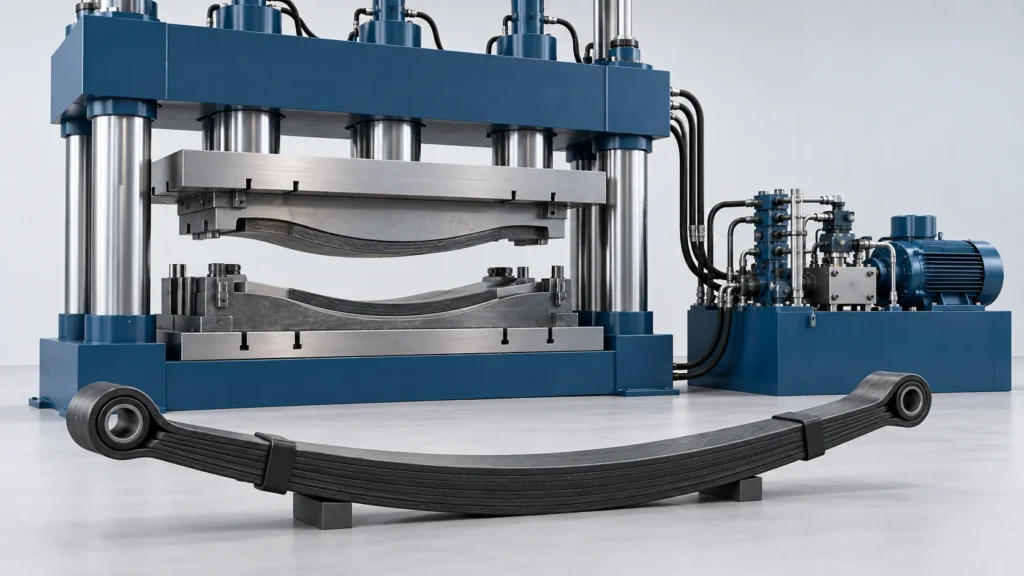
Frequently Asked Questions
Why is active dynamic leveling required specifically for parabolic leaf springs?
How does the 1.8-second pressure ramp prevent defect formation in PCM?
What maintains interlaminar shear strength in 65 mm thick spring centers?
Can this 3,000-ton press also run structural SMC sheet molding compound?
Discuss Your Production Goals
Share your product or drawing, material system, target output, automation needs and factory utilities so the equipment and interfaces can be configured.


