
Heavy Machinery Nylon Guide Plate Line Project in China
Review draft: Heavy Machinery Nylon Guide Plate Line. Configuration and reported outcomes require original project records.
Project Overview
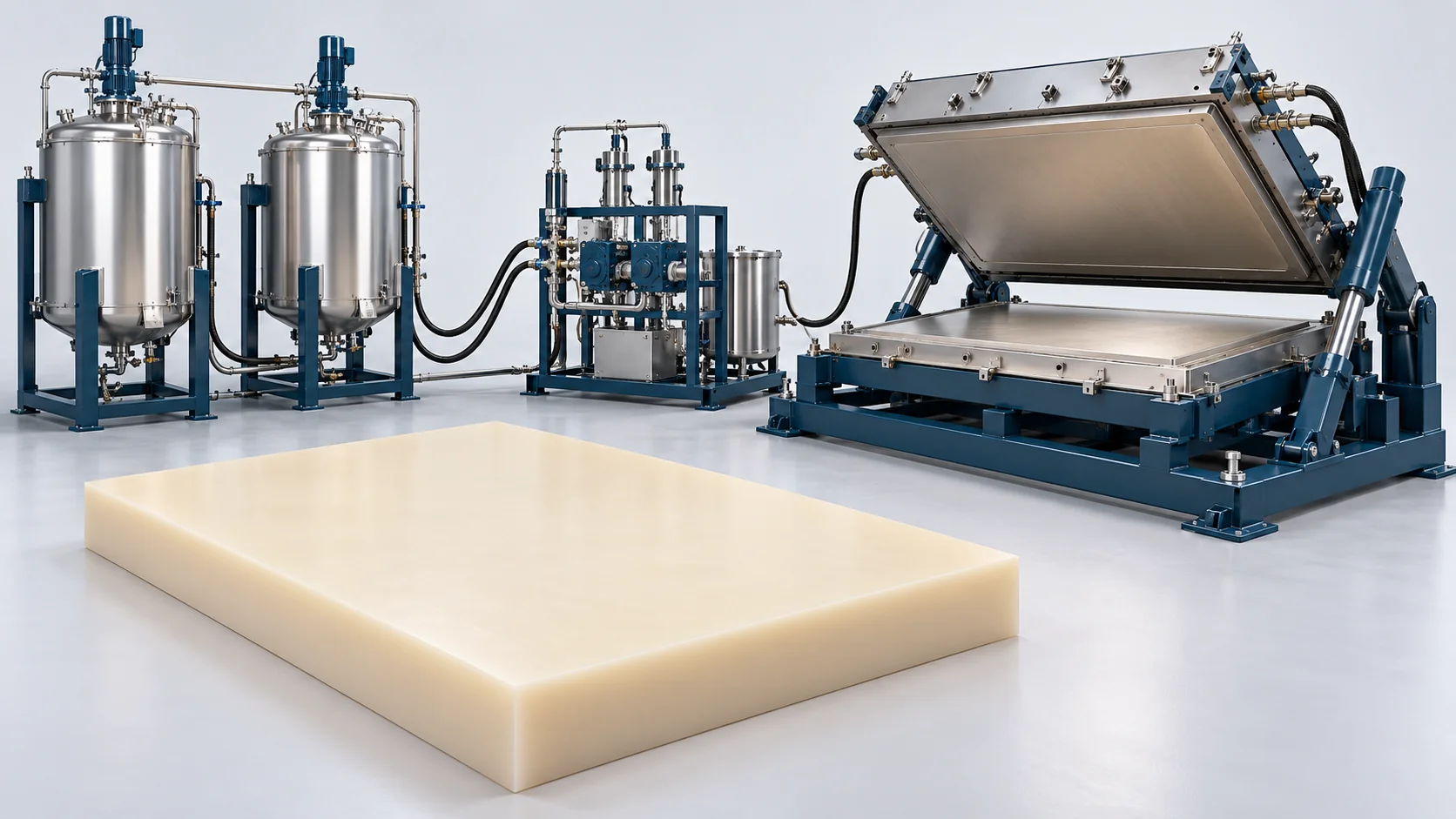
Illustration notice. Process illustrations are not verified photographs of this installation.
Project reference basis. Figures and configuration details are reported in the supplied project brief. They are reference values for the stated application, rather than verified acceptance results or a guarantee for another installation. Confirm the source records, material, tooling, operating schedule and test method when assessing a comparable project.
A leading national heavy machinery and port equipment manufacturer in Shanxi deployed Haifeng’s horizontal large-format MC nylon plate casting line. The facility was established to manufacture extra-thick (2,000× 1,000× 150 mm, single-part weight 350 kg) low-friction wear plates used on heavy container quayside gantry crane runways and mining shovel slew rings.
Prior to this installation, outsourced thick plates produced via vertical casting boxes suffered from severe centerline shrinkage cavitation and micro-porosity. High residual thermal stresses caused plates to bow by up to 12 mm during surface planing on CNC portal milling machines, resulting in a 22% machining scrap rate and delaying critical port crane delivery schedules.
Haifeng engineered a complete horizontal tilt-assisted plate casting cell centered on the HF-MCP200-PL platform. By integrating 8° hydraulic bed tilting with directional thermal oil crystallization and post-cure hot oil stress annealing, the line completely eliminated internal voiding, holding cross-sheet thickness variance under ±0.25 mm and delivering Rockwell hardness of R118 with zero machining warpage.
Review point: MC Nylon uses caprolactam anionic polymerization, not PU curing. Mass and volumetric 1:1 ratios require density/temperature reconciliation. Finished hardness and flatness depend on annealing and machining; the cited ±0.22 mm result is after face milling and is not as-cast accuracy.
Concept illustration: Generated concept illustration for process discussion; not a photograph of the specified machine, a customer facility or a delivered project.
Solutions Delivery
Configuration reported in the supplied brief.
Haifeng engineered an automated horizontal plate casting plant tailored for extra-heavy engineering plastics. Solid caprolactam monomer is dehydrated at 135°C in twin 250 L stainless vessels under continuous 0.01 kPa vacuum, stripping moisture below 18 ppm.
The 2,000× 1,000 mm heavy mold platen is preheated to 150°C and tilted to an 8° incline by hydraulic cylinders. Monomer streams A and B are metered at 26 kg/min through a low-shear dynamic mixing head, discharging into a submerged horn-gate runner at the lower edge. The liquid monomer advances upward smoothly across the 150 mm cavity thickness without turbulence or splashing.
A multi-zone thermal oil circulating system holds the lower platen at 165°C and the upper cover at 155°C, propagating crystal growth from bottom to top to push all micro-shrinkage voids into the sacrificial top riser. After 25 minutes of in-mold polymerization, the upper platen unclamps, and the 350 kg slab is transferred into an insulated 150°C oil bath annealing tank for 8 hours of progressive stress relief, aims to reduce distortion during subsequent milling.
MC Nylon uses caprolactam anionic polymerization, not PU curing. Mass and volumetric 1:1 ratios require density/temperature reconciliation. Finished hardness and flatness depend on annealing and machining; the cited ±0.22 mm result is after face milling and is not as-cast accuracy.
| Equipment | Model | Qty | Function |
|---|---|---|---|
| Horizontal MC Nylon Plate Casting Skid | HF-MCP200-PL | 1 set | Core 0.01 kPa monomer degassing, servo metering, and dynamic mixing. |
| 2,000 x 1,000 mm Tilting Mold Bed | HF-TMB-2010 | 1 unit | Hydraulic platen tilting (3°–15°) with precision 150 mm cavity frames. |
| Dual-Zone Thermal Oil Platen Skid | HF-TOS-02 | 1 set | Circulates 165°C / 155°C thermal oil across platens for directional crystallization. |
| Deep Stress-Relieving Annealing Tank | HF-SAT-350 | 1 unit | 150°C thermal oil immersion tank relieving internal crystalline stresses. |
Reported Results — Original Records Required
Manufacture Extra-Thick MC Nylon Plates Without Shrinkage
Connect with Haifeng engineering plastics specialists to deploy horizontal tilt-assisted plate casting lines engineered for heavy-section nylon slabs.


