
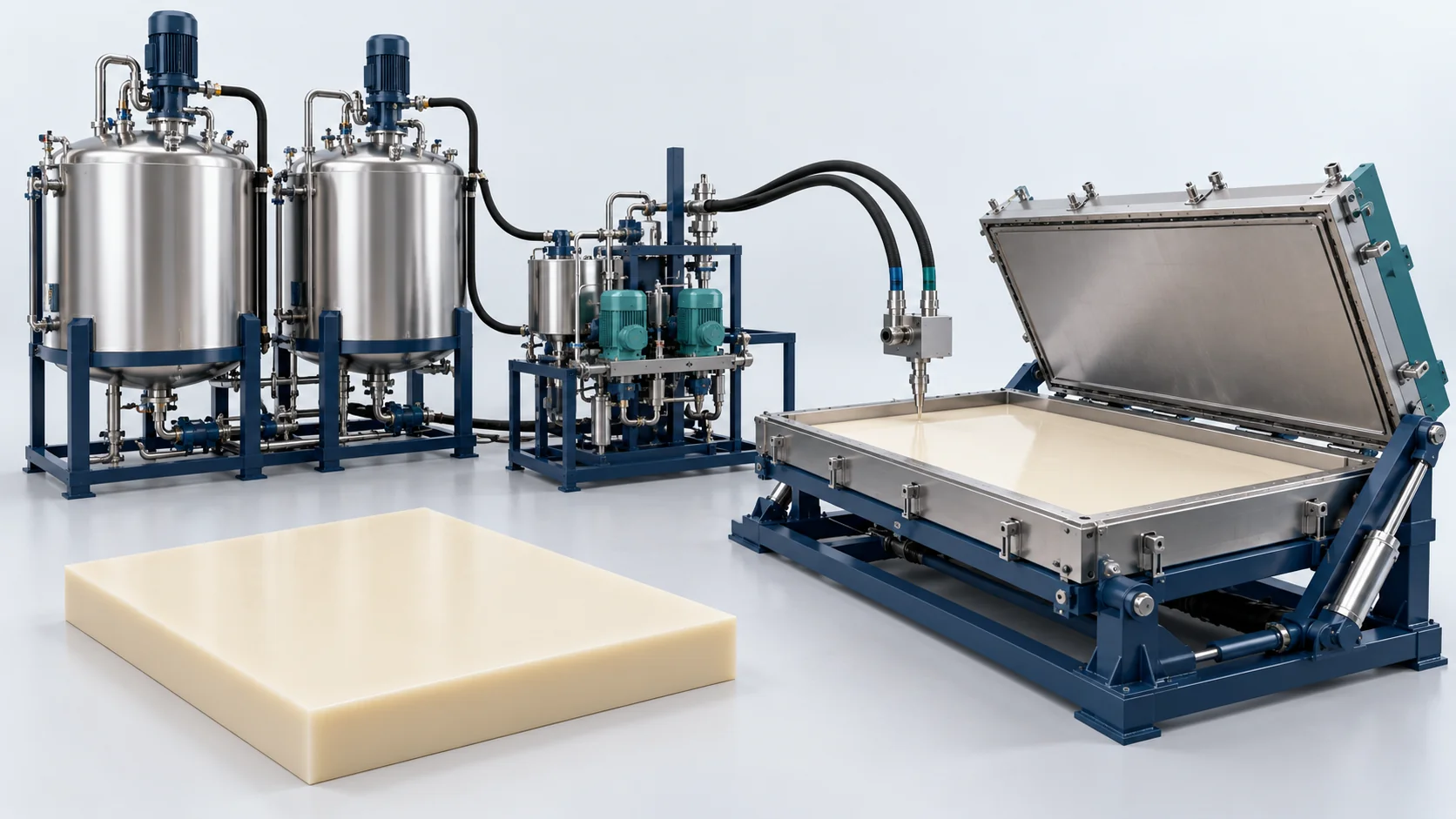
MC Nylon Casting Line | Thick Plates
Conditioned monomer feed, tilt-assisted filling and zoned thermal tooling for thick cast-nylon engineering plates.
Directional Crystallization Casting for Extra-Thick MC Nylon Plates
Conditioned monomer feed, tilt-assisted filling and zoned thermal tooling for thick cast-nylon engineering plates.
Conditioned monomer feed, tilt-assisted filling and zoned thermal tooling for thick cast-nylon engineering plates.
Monomer conditioning, catalyst/activator feeds, metering/mixing, tilt bed and thermal-control interfaces. Molds, formulation, annealing and finish machining are separately defined.
MC Nylon uses caprolactam anionic polymerization, not PU curing. Mass and volumetric 1:1 ratios require density/temperature reconciliation. Finished hardness and flatness depend on annealing and machining; the cited ±0.22 mm result is after face milling and is not as-cast accuracy.
Concept illustration: Generated concept illustration for process discussion; not a photograph of the specified machine, a customer facility or a delivered project.
Material Flow and Working Principle
Thin-Film Vacuum Dehydration & Premixing
Solid caprolactam flakes are melted at 135°C in twin 250 L stainless vessels under 0.01 kPa vacuum, stripping moisture below 20 ppm before adding catalyst (Stream A) and activator (Stream B).
Tilt-Angle Mold Alignment & Vacuum Purge
The 2,000× 1,000 mm heavy mold platen is preheated to 150°C and tilted by hydraulic cylinders to an 8° incline; dry nitrogen flushes the cavity to eliminate oxygen inhibition.
Laminar Stepped Injection via Submerged Runner
Synchronized high-temperature gear pumps meter Streams A and B (1:1 ratio) through a dynamic low-shear mixing head into a submerged bottom runner, advancing at 25 kg/min without splashing.
Directional Gradient Crystallization
Lower platens maintain 165°C while upper covers stay at 155°C, driving crystal front propagation from the bottom upwards to push shrinkage voids into the top riser.
Hydraulic Platen Opening & In-Situ Stress Annealing
After 25 minutes of in-mold polymerization, hydraulic clamps release the upper platen; the slab is transferred to an insulated thermal oil annealing chamber for stress relief.
Model and Technical Parameters
Supplied HF-MCP200-PL configuration references, pending original calibration and acceptance documents. Material, finished-part and project outcomes are separate from equipment ratings. MC Nylon uses caprolactam anionic polymerization, not PU curing. Mass and volumetric 1:1 ratios require density/temperature reconciliation. Finished hardness and flatness depend on annealing and machining; the cited ±0.22 mm result is after face milling and is not as-cast accuracy.
| Technical Parameter | HF-MCP200-PL |
|---|---|
| Components | 2 Primary Streams (Tank A: Monomer + Catalyst, Tank B: Monomer + Activator) |
| Output Range (g/s) | 5.0 to 35.0 kg/min (Continuous adjustable) |
| Mixing Ratio Range | 1:1 Fixed (Volumetric/weight balanced) |
| Ratio Accuracy | ±0.3% (Measured with steady thermal oil circulation) |
| Power Supply | 380V, 3-Phase, 50Hz (Custom 440V/480V 60Hz optional) |
| Working Pressure | 0.3 to 0.5 MPa (Metering lines and dynamic head) |
| Tank Capacity (L) | Day tanks: 2 x 250 L (Stainless steel with vacuum/oil jacket) |
| Weight | 12,800 kg (Combined casting unit and horizontal tilt mold bed) |
| Dimensions (L×W×H) | 6800 mm x 2800 mm x 2400 mm |
| Maximum Sheet Thickness | Up to 200 mm (Adjustable cavity frame); Finished MC nylon engineering plate; supplied reference pending original configuration or test records |
| Plate Surface Rockwell Hardness | R116 to R120 (Target R118); ASTM D785 test on cured plate; supplied reference pending original configuration or test records |
| Horizontal Bed Tilting Angle | 3° to 15° (Hydraulic stepless tilt); Incline laminar filling mode; supplied reference pending original configuration or test records |
| Cured Thickness Profile Variance | Within ±0.3 mm (Across 2,000 x 1,000 mm); Non-contact laser thickness scanner; supplied reference pending original configuration or test records |
Key Equipment Features
Monomer conditioning, catalyst/activator feeds, metering/mixing, tilt bed and thermal-control interfaces. Molds, formulation, annealing and finish machining are separately defined.
200 mm Extra-Thick Capability
Supplied configuration reference: Directional thermal gradient crystallization eliminates shrinkage cavities in massive 200 mm slabs. Actual capability requires material and tooling validation.
±0.3 mm Plate Flatness
Supplied configuration reference: Precision ground horizontal platens with multi-point hydraulic locking prevent post-mold warpage. Actual capability requires material and tooling validation.
3°–15° Tilt Laminar Filling
Supplied configuration reference: Submerged bottom runners paired with hydraulic bed tilting eliminate resin splashing and air bubbles. Actual capability requires material and tooling validation.
R118 Uniform Hardness
Supplied configuration reference: Anionic polymerization in nitrogen yields high molecular weight with uniform Rockwell R118 surface hardness. Actual capability requires material and tooling validation.


