
Thick MC Nylon Sheet Casting Solution
Conditioned monomer feed, tilt-assisted filling and zoned thermal tooling for thick cast-nylon engineering plates.
low-void Directional Crystallization for Heavy-Section Plastic Slabs
Conditioned monomer feed, tilt-assisted filling and zoned thermal tooling for thick cast-nylon engineering plates.
Equipment and process scope
Monomer conditioning, catalyst/activator feeds, metering/mixing, tilt bed and thermal-control interfaces. Molds, formulation, annealing and finish machining are separately defined.
Validation and production planning
MC Nylon uses caprolactam anionic polymerization, not PU curing. Mass and volumetric 1:1 ratios require density/temperature reconciliation. Finished hardness and flatness depend on annealing and machining; the cited ±0.22 mm result is after face milling and is not as-cast accuracy.
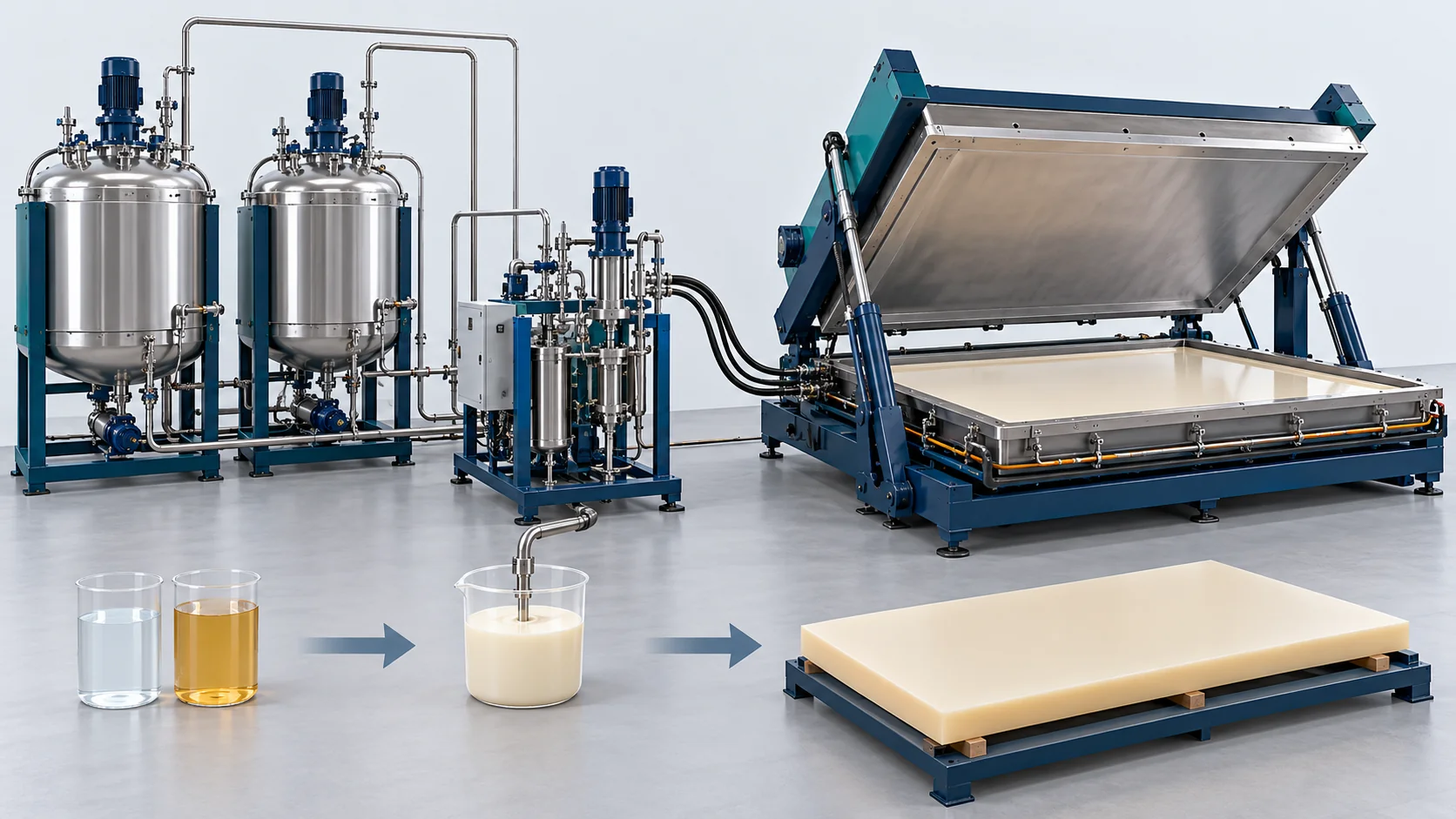
Monomer conditioning, catalyst/activator feeds, metering/mixing, tilt bed and thermal-control interfaces. Molds, formulation, annealing and finish machining are separately defined. MC Nylon uses caprolactam anionic polymerization, not PU curing. Mass and volumetric 1:1 ratios require density/temperature reconciliation. Finished hardness and flatness depend on annealing and machining; the cited ±0.22 mm result is after face milling and is not as-cast accuracy.Generated concept illustration for process discussion; not a photograph of the specified machine, a customer facility or a delivered project.
Turnkey Horizontal MC Nylon Sheet Casting Process
Configuration sequence from the supplied brief. Material, tool, pressure/temperature basis and complete line balance require verification. MC Nylon uses caprolactam anionic polymerization, not PU curing. Mass and volumetric 1:1 ratios require density/temperature reconciliation. Finished hardness and flatness depend on annealing and machining; the cited ±0.22 mm result is after face milling and is not as-cast accuracy.
Monomer Melting & Deep Vacuum Dehydration
Supplied process reference: Caprolactam is melted at 135°C in twin 250 L tanks under 0.01 kPa vacuum, stripping moisture below 20 ppm before adding catalyst and activator.
Bed Tilting & Dry Nitrogen Mold Purging
Supplied process reference: The preheated tool (150°C) tilts to an 8° incline; dry nitrogen flushes the cavity to remove oxygen that inhibits anionic polymer growth.
Submerged Laminar Stepped Injection
Supplied process reference: Servo-driven gear pumps meter Streams A and B (1:1 ratio) at 25 kg/min through submerged runners, filling the 200 mm cavity smoothly.
Reference Solution Engineering Envelope
Supplied configuration and validation references; material/component results are separate from equipment ratings.
| Parameter | Value / Unit | Applicable Configuration / Conditions |
|---|---|---|
| Maximum Sheet Dimensions | 2,000 mm length x 1,000 mm width | Large-format horizontal plate casting bed; supplied configuration or material target, pending the applicable original records |
| Plate Thickness Envelope | 20 to 200 mm (Stepped frame adjustment) | Heavy welded steel mold frames with hydraulic clamping; supplied configuration or material target, pending the applicable original records |
| Continuous Monomer Pour Output | 5.0 to 35.0 kg/min | Continuous variable servo-driven high-temperature pump skid; supplied configuration or material target, pending the applicable original records |
| Cured Rockwell Hardness Profile | R116 to R120 (Target R118) | ASTM D785 testing on fully crystallized PA6 matrix; supplied configuration or material target, pending the applicable original records |
| Horizontal Table Tilting Angle | 3.0° to 15.0° (Hydraulic stepless tilt) | Motorized tilt mechanism with angle encoder; supplied configuration or material target, pending the applicable original records |
| Plate Thickness Uniformity | Within ±0.3 mm across entire slab | Precision ground heated platens with multi-point locking; supplied configuration or material target, pending the applicable original records |
Core Equipment for This Solution
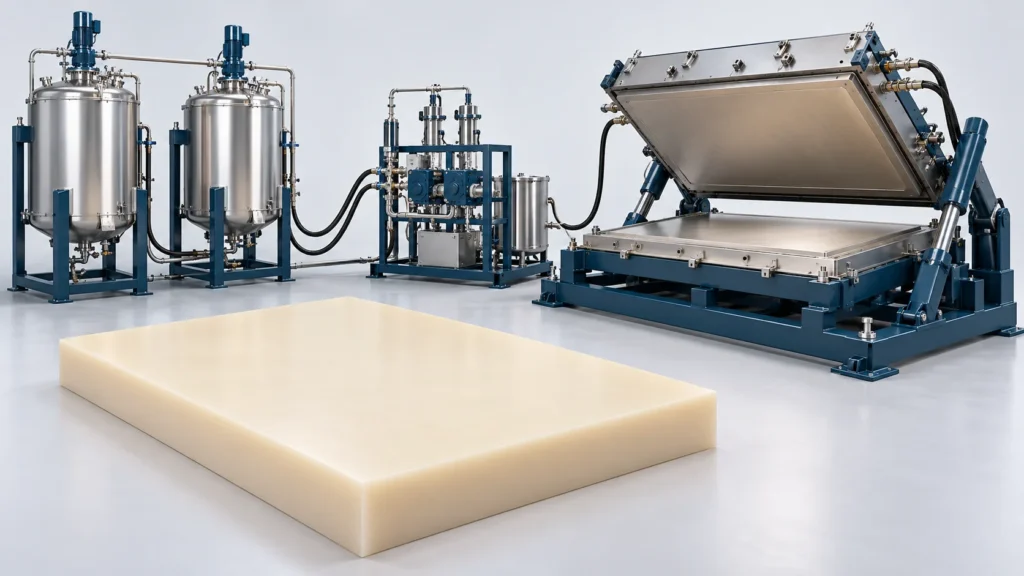
Monomer conditioning, catalyst/activator feeds, metering/mixing, tilt bed and thermal-control interfaces. Molds, formulation, annealing and finish machining are separately defined.
Core Advantages of Haifeng Sheet Casting Systems
Configured equipment functions and interfaces for the selected material and tooling.
low-void 200 mm Core Integrity
Supplied configuration function: Directional thermal gradient crystallization pushes shrinkage voids upward into risers, ensuring 100% solid cores. Project-dependent performance requires validation.
±0.3 mm Thickness Precision
Supplied configuration function: Precision ground horizontal platens prevent thickness variation, drastically lowering CNC face milling waste. Project-dependent performance requires validation.
Zero Turbulence Tilting Inflow
Supplied configuration function: Submerged horn-gate runners combined with 8° bed tilting eliminate air entrapment and surface ripples. Project-dependent performance requires validation.
Warpage-Free Machinability
Supplied configuration function: Controlled 150°C hot oil annealing relieves frozen crystalline stresses, ensuring plates remain flat after heavy machining. Project-dependent performance requires validation.
Related Project Draft
An anonymous project brief from the supplied document. Original attribution, dates, acceptance and outcome records require verification before public use.
Frequently Asked Questions
How does directional crystallization eliminate center shrinkage in 200 mm plates?
Why is 3°–15° bed tilting used during liquid monomer filling?
What ensures uniform Rockwell R118 hardness across the entire 2m span?
How does post-cure annealing prevent plate warpage during customer machining?
Discuss Your Production Goals
Share your product or drawing, material system, target output, automation needs and factory utilities so the equipment and interfaces can be configured.


