
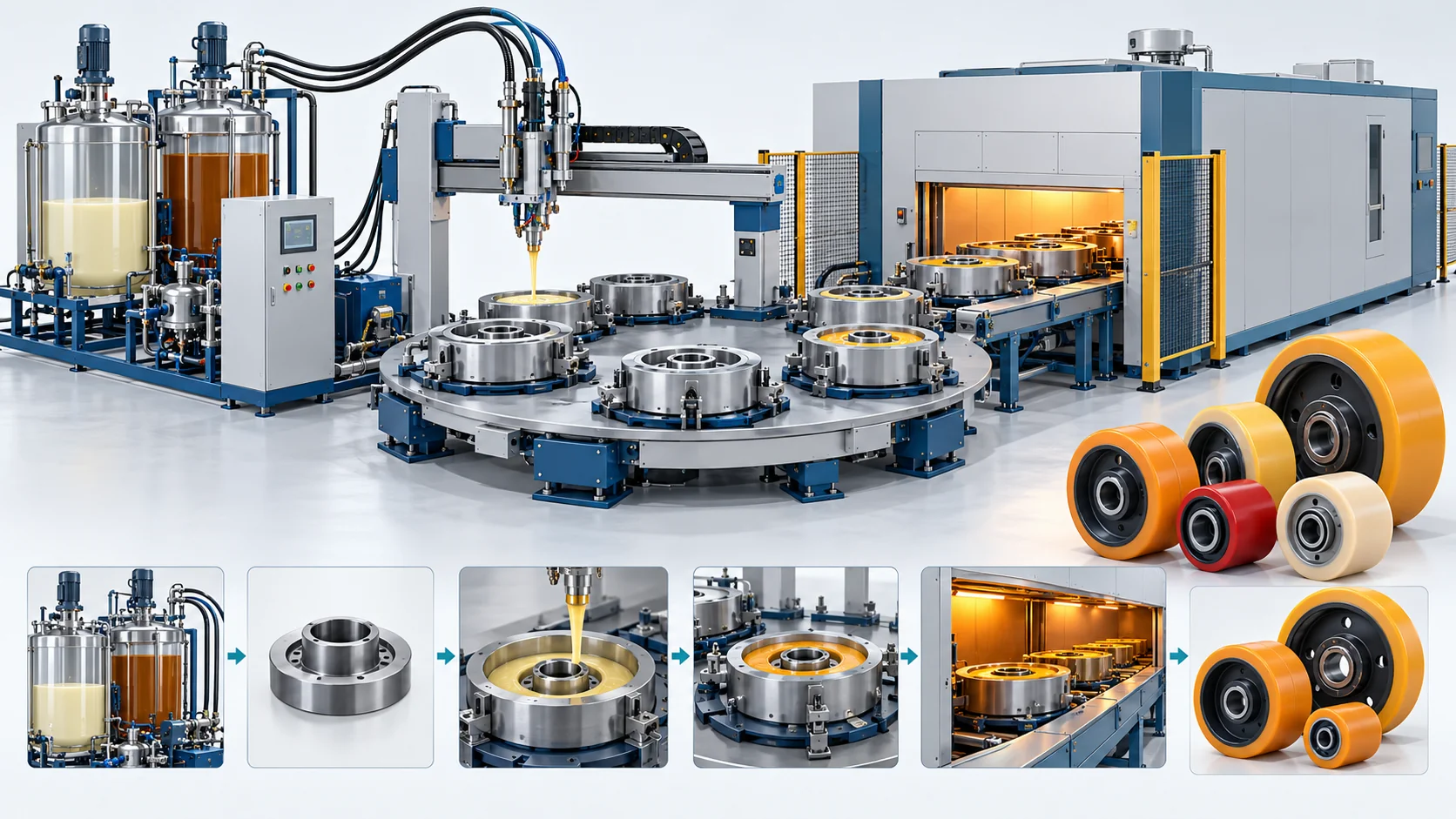
Automatic PU Wheel Casting Line | AGV and Forklift Wheels
Configured polyurethane solid-wheel production with core preparation interfaces, induction preheating, dual-flow dispensing and indexed mold curing.
High-Bonding Automated Polyurethane Solid Wheel Casting
Configured polyurethane solid-wheel production with core preparation interfaces, induction preheating, dual-flow dispensing and indexed mold curing.
Configured polyurethane solid-wheel production with core preparation interfaces, induction preheating, dual-flow dispensing and indexed mold curing.
The package covers material preparation, dual-flow dynamic mixing, induction hub preheating, the specified heated mold line and controls. Automatic blasting/cleaning and hydraulic demolding are optional. Prepolymer and bonding agents are supplied separately; site power and compressed air are customer interfaces. Capacity depends on parallel mold positions, cycle stages and product size.
Material Flow and Working Principle
Core Surface Abrasive Blasting & Bonding Adhesive Application
Forged steel or ductile iron wheel cores are automatically grit-blasted to Sa 2.5 cleanliness and spray-coated with Chemlok bonding primer before entering a drying tunnel.
Medium-Frequency Induction Core Preheating
Primed wheel cores pass through a medium-frequency induction heating coil, bringing metal core temperatures rapidly to 90°C ± 2°C in 45 seconds to activate the bonding adhesive.
High-Accuracy Servo Polyurethane Metering
High-precision servo-driven gear pumps measure MDI prepolymer and 1,4-BDO chain extender under continuous Coriolis mass flow control, maintaining mix ratios within ±0.2%.
Dual-Flow Matrix Dynamic Dispensing
Material enters the dual-flow mixing head; a low-flow nozzle injects 3 kg/min into the narrow hub clearance to displace air, before the main nozzle floods the tire tread cavity at 15 kg/min.
In-Mold Pressurized Curing & Conveyance
Filled wheel molds travel along a heated 100°C closed-loop indexing conveyor, achieving demold green strength in 15 minutes before automated hydraulic extraction and post-curing.
Model and Technical Parameters
Configuration values from the supplied HF-CPU180-WL brief. Final performance is confirmed for the chemical formulation, tool, operating conditions and original calibration records. Casting-circuit pressure is distinct from finished-component service or qualification pressure.
| Technical Parameter | HF-CPU180-WL |
|---|---|
| Components | 2 Primary Streams (A: Prepolymer, B: Curative) + 1 Color/Additive |
| Output Range (g/s) | 2.0 to 18.0 kg/min (Dual-flow matrix switching) |
| Mixing Ratio Range | 100:8 to 100:25 (By weight) |
| Ratio Accuracy | ±0.2% (Continuous closed-loop Coriolis feedback) |
| Power Supply | 380V, 3-Phase, 50Hz (Custom 440V/480V 60Hz optional) |
| Working Pressure | 0.3 to 0.7 MPa (Metering lines and dynamic head) |
| Tank Capacity (L) | Tank A: 200 L (Oil-jacketed), Tank B: 80 L (Stainless steel) |
| Weight | 4,200 kg (Main casting unit and induction heater) |
| Dimensions (L×W×H) | 3200 mm x 2100 mm x 2400 mm |
| Induction Preheating Cycle | 45 seconds (To reach 90°C ± 2°C); Medium-frequency induction coil |
| Single-Wheel Molding Tact Time | ≤ 90 seconds (For Ø 300 mm solid wheel); Dual-flow matrix injection |
| Interfacial Peel Adhesion | > 30 kN/m (Polyurethane to metal core); ASTM D429 Method B 90° peel |
| Dynamic Rolling Temperature | ≤ 45°C (Continuous 25 km/h at 3-ton load); Drum endurance test bed |
Key Equipment Features
The package covers material preparation, dual-flow dynamic mixing, induction hub preheating, the specified heated mold line and controls. Automatic blasting/cleaning and hydraulic demolding are optional. Prepolymer and bonding agents are supplied separately; site power and compressed air are customer interfaces. Capacity depends on parallel mold positions, cycle stages and product size.
Hub Induction Preheating
The specified induction stage conditions the metal hub; adhesive selection and actual bonding performance require validation.
Dual-Flow Dispensing
Programmed leading and main-fill rates are selected for hub clearance and tread cavity geometry.
Material and Endurance Testing
Rolling heat and bond durability are verified for wheel size, compound, load and speed rather than inferred from the dispenser.
Indexed Production Interfaces
Mold indexing and curing can operate in parallel. Total output requires a complete line balance and operating record.


